
For years, Artificial Intelligence was discussed largely in terms of potential. Today, the conversation is increasingly about business impact.
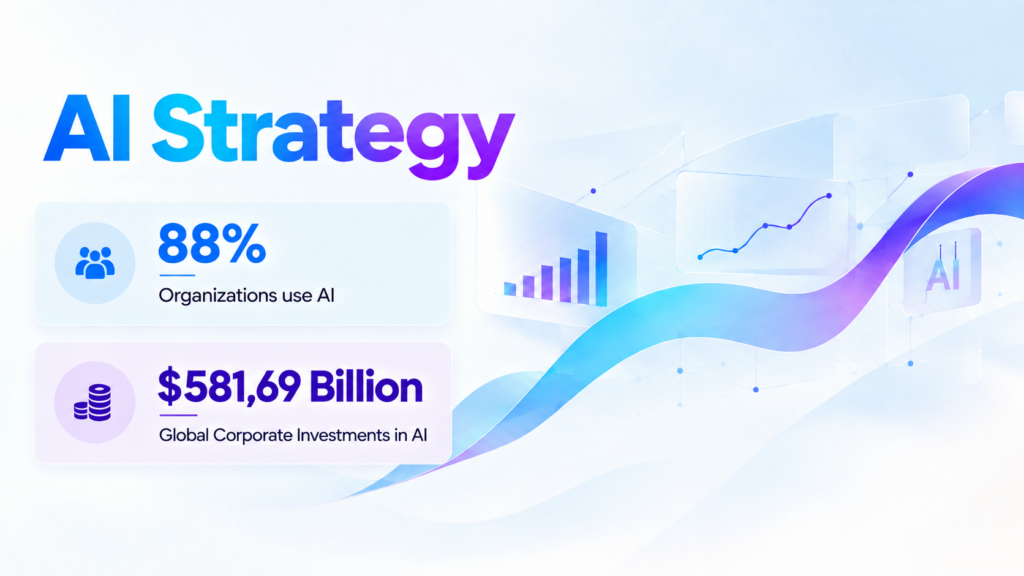
The latest Stanford AI Index Report shows just how far the market has moved: 88% of surveyed organizations now use AI in at least one business function. At the same time, global corporate investment in AI has reached $581.69 billion, increasing by 129.9% year over year. Private investment in Generative AI alone reached approximately $170.9 billion, growing by more than 200%.
These are remarkable numbers. But for a CEO, CMO or CRO, the most important question is no longer: “How fast is AI growing?”
It is: “Where is AI already creating measurable business value?”
AI ROI: Moving Beyond Productivity to Revenue Growth
One of the most compelling answers comes from Marketing and Sales.
Among organizations using analytical AI, 67% of respondents report revenue gains in Marketing and Sales, the highest percentage across the business functions analyzed by Stanford.
More specifically, 43% report revenue increases of up to 5%, 14% report increases between 6% and 10%, and 10% report gains above 10%. At the same time, 49% report cost reductions.
This matters because it changes the conversation around AI ROI.
The value of Artificial Intelligence should no longer be measured only in hours saved or tasks automated. It should also be measured through revenue growth, customer value, conversion, retention, efficiency and better decision-making.
And this is where the distinction between Generative AI and Predictive AI becomes strategically important.
Generative AI and Predictive AI Solve Different Business Problems
Generative AI has transformed how organizations create, summarize and interact with information. It can generate content, analyze documents, automate interactions, synthesize knowledge and enable entirely new customer experiences.
Predictive AI addresses a different question.
Generative AI asks: “What can I create?”
Predictive AI asks: “What is most likely to happen, and what should I do next?”
Which customers are most likely to buy? Which are at risk of churning? Which product should be recommended to each customer? Where should sales teams focus their efforts? How is demand likely to evolve? Which customers are likely to generate the highest lifetime value?
This is the difference between using AI to generate information and using AI to systematically improve business decisions.
A mature AI Strategy will increasingly need both.
AI, Customer Experience and Competitive Advantage
The Stanford AI Index also suggests that the value of AI extends well beyond productivity and direct financial outcomes.
Among organizations regularly using AI in at least one business function, 64% report improved innovation, 45% report improved customer satisfaction, and 45% report improved competitive differentiation.
For C-Level executives, that last point deserves particular attention.
As access to Artificial Intelligence becomes widespread, access to AI alone becomes less of a competitive advantage. Foundation models and Generative AI capabilities are becoming broadly available across industries.
The real differentiation is shifting elsewhere: to the quality of proprietary data, the ability to integrate AI into business processes, the speed at which insight becomes action, and, most importantly, the ability to connect AI-driven decisions to measurable business outcomes.
$581 Billion and the New Meaning of AI Strategy
When global corporate AI investment reaches $581.69 billion and grows by nearly 130% year over year, AI is no longer simply an emerging technology category.
It is becoming part of the competitive infrastructure of modern business.
That does not mean every AI initiative will generate ROI. Stanford itself notes that many of the business outcomes included in its analysis are self-reported and should be treated as directional rather than as universal evidence of causation.
But the management conversation is clearly evolving.
The first phase was: “Should we experiment with AI?”
Then came: “Where can we use AI?”
The more important question now is: “Where can AI move a KPI?”
That is the point at which AI Strategy and business strategy begin to converge.
Predictive AI and Decision Intelligence: The Next Competitive Frontier
This is why Predictive AI deserves far more attention in the executive conversation.
Generative AI has made powerful AI capabilities accessible to millions of people and organizations. Predictive AI extends that transformation from content and interaction into decision intelligence.
Marketing, Sales, CRM, customer engagement, retention, forecasting and demand planning all depend on decisions made repeatedly and at scale: which customer to contact, when to contact them, which offer to make, which opportunity to prioritize, which customer to protect from churn and where to allocate budget and resources.
The more these decisions become data-driven, predictive and scalable, the more AI moves from being a tool used by the organization to becoming part of its operating model.
This is why the next meaningful distinction may no longer be between companies that “use AI” and companies that do not. With adoption already at 88%, that distinction is rapidly becoming less relevant.
The more important distinction will be between organizations that use AI primarily to do existing work faster and those that use it to make better decisions, drive growth and build measurable competitive advantage.
That is where the combination of Generative AI, Predictive AI and a clear AI Strategy becomes far more valuable than any individual technology in isolation.
Source: Stanford University, AI Index Report.