
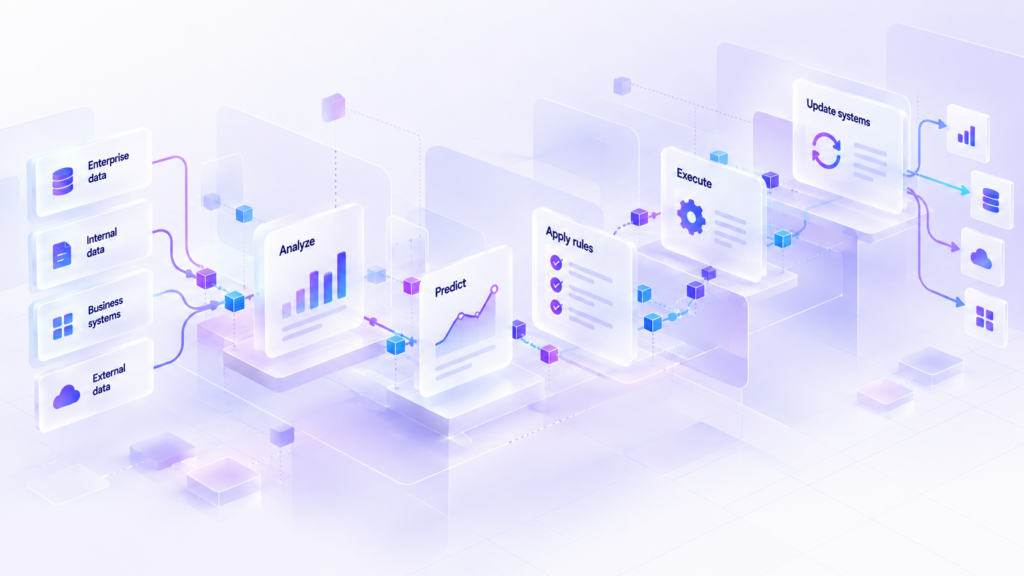
As AI becomes more deeply embedded in enterprise operations, the AI Agent vs AI Assistant distinction is starting to matter for reasons that go well beyond the interface. The real difference is not simply how sophisticated the answer is, but how far the system can move through a business process once that answer has been produced.
An AI Assistant typically helps a person work with information by retrieving data, interpreting results, generating content or explaining an analytical output, while responsibility for the next step remains with the user. An AI Agent can play a broader role by interacting with systems, using available tools and pursuing a defined objective within the boundaries set by the organization.
This shift is becoming increasingly relevant as companies move from individual AI use cases toward workflows designed around greater autonomy. In its June 2026 research, AI-First Enterprise Operations: Reinventing the Operating System of Work, BCG argues that many organizations have already introduced copilots, bots and automation without fundamentally changing how work is structured, while the larger opportunity emerges when end-to-end processes are redesigned around agentic execution, orchestration and governance.
For predictive AI, the issue becomes even more concrete because generating a forecast is only one part of the process. What ultimately matters is how that prediction reaches a decision, what happens next and who remains accountable for the outcome.
AI Agent vs AI Assistant Is a Workflow Question
It is tempting to frame the difference between assistants and agents as a question of technical sophistication, but that comparison misses much of what matters to a business.
An assistant usually operates inside a process that is still designed around people. It can speed up analysis, help an employee interpret a result or suggest a possible response, but the structure of the workflow remains largely intact because a person still connects one step to the next.
This model can create meaningful productivity gains without necessarily changing how the organization operates. BCG makes a similar point in its research on agentic enterprise operations, arguing that adding AI to existing tasks tends to improve individual efficiency, while larger gains depend on redesigning processes from end to end around outcomes, orchestration and governance.
An AI Agent changes the role of the technology because it can participate more directly in what follows the initial output, potentially using data and connected systems to continue the process rather than waiting for a person to restart it manually.
For business leaders, this is a more useful way to think about AI workflow automation. The relevant question is not whether the system can hold a better conversation, but whether it remains an advisory layer or becomes part of how work is actually executed.
From Prediction to Action in a Predictive AI Workflow
Predictive models estimate what is likely to happen, but a probability, score or forecast has limited business value if the organization cannot translate that information into a timely response.
Consider a predictive AI workflow that identifies a customer with an elevated probability of churn, anticipates a change in demand or signals that another relevant event is becoming more likely. An assistant can help a user understand the prediction, highlight the factors associated with it and provide context for the decision, while a person still determines what should happen next.
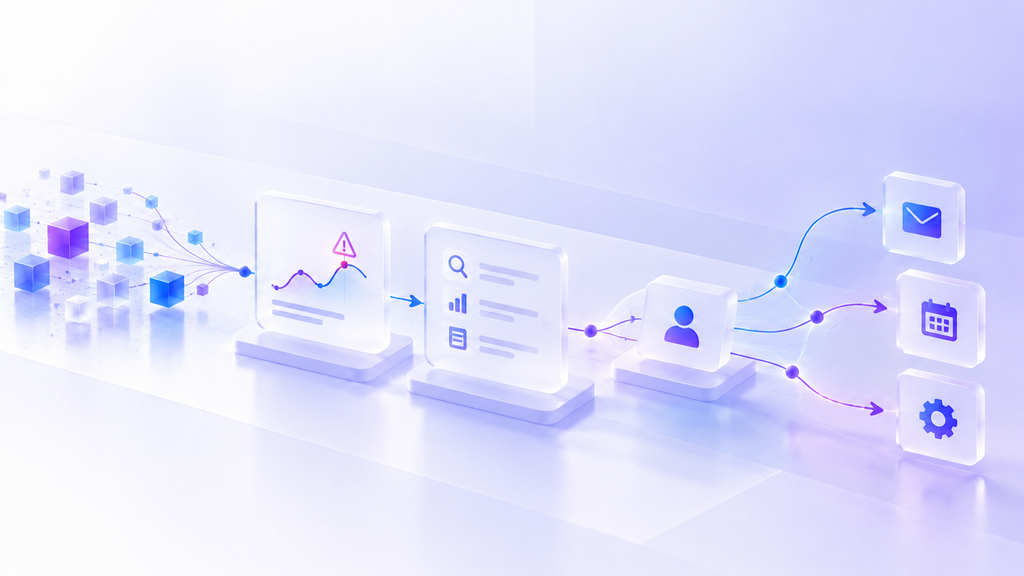
An agentic system can potentially continue further through the process by evaluating predefined conditions, interacting with connected applications and initiating actions that fall within its permitted scope.
The difference is subtle but important. The role of AI moves from helping someone understand a prediction toward helping the organization respond to it.
Recent OECD research highlights the growing relevance of this question. Its September 2026 working paper, Agentic AI in organisations: Early insights from practitioner interviews, examines how agentic AI is being deployed and governed across organizations, with particular attention to emerging applications, practical challenges and governance approaches. The evidence is still early, which makes the report especially useful as a reminder that enterprise adoption is evolving alongside questions about how these systems should operate in practice.
For predictive AI, this places more attention on everything surrounding the model. An accurate prediction is useful, but the business outcome also depends on whether there is a reliable process for deciding what that prediction should trigger.
Autonomy Changes Execution, Not Accountability
As AI Agents take on a greater share of execution within the workflow, a more important question emerges: who ultimately owns the predictive process and remains accountable for its outcomes? More autonomous execution does not mean that accountability can simply be transferred to the system.
BCG describes a move toward an agentic process owner who remains accountable for outcomes even as coordination, control and parts of execution become increasingly embedded in agentic processes. Its framework also emphasizes governance, risk thresholds, monitoring and decision rights as part of the operating model rather than as safeguards added only after deployment.
That matters because not every prediction should lead to the same degree of automation. A routine operational adjustment with limited downside may allow an agent to act with relatively little intervention, while a decision involving financial exposure, customer treatment or significant commercial consequences may still require explicit human review.
The objective is therefore not to maximize autonomy for its own sake. Organizations need to decide where autonomous execution creates value, where approval remains necessary and how exceptions should be handled when the system encounters conditions outside its expected range.
Human oversight in this context is not evidence of an incomplete agentic model. It is part of the design that allows autonomous execution to operate within acceptable business boundaries.
The Operating Model Determines Whether AI Agents Create Value
Moving from an AI Assistant to an AI Agent requires more than replacing one interface with another because an agent needs an environment in which it can operate reliably.
BCG identifies trusted data access, integration with core systems, testing, monitoring, permissions and auditability among the foundations required to scale agentic processes. The report also warns against layering AI onto unstable or fragmented operations, arguing instead for redesign that starts with the desired outcome and works backwards toward the process required to achieve it.
This is particularly relevant to predictive AI because a model can produce a useful forecast even when the surrounding organization is poorly equipped to act on it.
A functioning predictive workflow therefore depends on more than predictive performance. The business also needs reliable data, explicit decision logic, access to the systems where actions occur and clear rules governing what AI is allowed to do once a prediction reaches the workflow.
Seen from this perspective, the move from assistant to agent is less a feature upgrade than an operating model change. Assistants improve how people interact with information, while agents have the potential to change how that information travels through a process and how subsequent actions are carried out.
That potential only becomes useful when the workflow itself has been designed for it.
The Future of Predictive Workflows Is About Orchestration
As enterprise workflows evolve, the distinction between AI Assistant and AI Agent is likely to become less clear, with predictive models, generative capabilities, human expertise and different degrees of autonomous execution increasingly working together.
The challenge for business leaders is deciding how those elements should work together.
Some processes will continue to benefit from an assistant because judgment, context or direct human responsibility is central to the outcome. Other workflows may allow an agent to interpret a predictive signal, apply established decision logic and interact with operational systems before involving a person only when a specific condition requires escalation.
This changes the strategic question from which AI product an organization should deploy to which parts of the workflow AI should inform, which it should execute and where human ownership must remain explicit.
That is also why the future of predictive AI is about more than producing increasingly accurate forecasts. The larger opportunity lies in creating a reliable connection between prediction, decision and action, while making sure the organization still understands who is responsible for the process and the outcome.
An AI Assistant can help someone understand what is likely to happen next, while an AI Agent can increasingly help the organization respond to that prediction within a governed process. Execution may become more autonomous, but ownership remains an organizational decision shaped by objectives, controls, decision rights and accountability.