
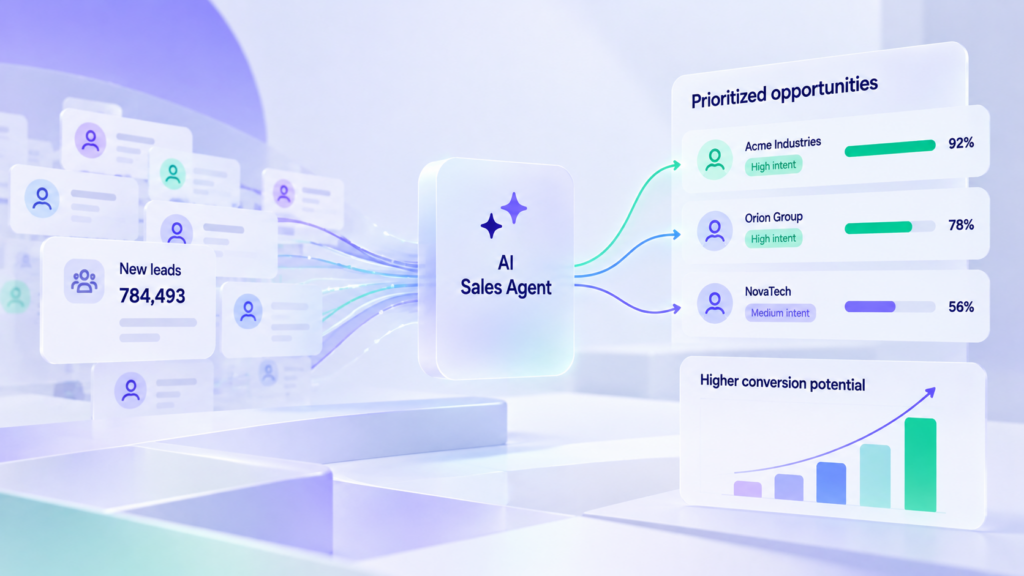
A larger prospect list does not automatically create a stronger sales pipeline. What matters is knowing which opportunities are most likely to convert and which deserve attention first, especially when signals of purchase propensity are spread across customer, company and interaction data.
This is where purchase propensity becomes useful in practical terms. Predictive models can help sales teams move beyond treating every lead in the same way by estimating conversion likelihood and highlighting the opportunities with stronger potential.
With ELAI, that prediction can become more than a score. The AI Sales Agent can help surface the opportunities that deserve attention first, bring forward the relevant context and support the next permitted action within the sales workflow.
A 2026 study by Migao Wu, Pavel Andreev and Morad Benyoucef, published in the Journal of Personal Selling & Sales Management, explored exactly this problem through PRISM, a predictive model that groups B2B leads with similar characteristics and then ranks them according to their likelihood of conversion. The approach was tested across three B2B service industries.
Deloitte Digital approaches the same issue from another angle. In its 2026 research on Agentic AI in sales, it describes an operating model in which customer intelligence, AI and commercial workflows are more closely connected, so that data can support decisions throughout the revenue pipeline rather than remain confined to individual tools.
Taken together, the two sources point in the same direction: predictive intelligence becomes more valuable when it helps sales teams decide what deserves attention next.
Purchase Propensity Changes the First Sales Decision
Lead prioritization has often relied on predefined rules, salesperson experience and behavioral information that only becomes available after the relationship with a prospect has already started.
PRISM takes a different route. It first groups leads according to observable customer and company characteristics, then estimates conversion probabilities within those groups and produces prioritized lists for sales teams.
The scale of the research is worth noting. The final dataset included 784,493 leads and more than 3.4 million call interactions from 40 companies across three B2B service industries.
That makes the underlying business question very concrete. Before deciding how to approach a prospect, sales teams first need to understand which prospects are worth prioritizing. When large numbers of opportunities are being managed at the same time, predictive models can add another layer of evidence to that decision.
Better Lead Priorities Can Start Before Sales History Exists
One of the most interesting findings in the study is that useful signals do not necessarily appear only after repeated contact with a lead.
Many scoring systems become more informative as behavioral data accumulates, for example through calls, engagement and other interactions. Wu, Andreev and Benyoucef wanted to understand what could be predicted before that history existed.
They therefore repeated the analysis using only customer and company characteristics available when the lead entered the system or around the first contact attempt.
The result remained meaningful. Average conversion rates moved from 6.2% with the traditional approach to 8.9% with the predictive model, a 43.5% relative uplift, even without the behavioral variables. According to the researchers, the initial profiling already contained a forward looking signal about purchase intent.
Later interactions still matter and can improve the prediction as more information becomes available. What changes is the starting point: sales teams do not necessarily have to wait for a long interaction history before beginning to distinguish between higher and lower priority opportunities.
A Predictive Score Should Change What Happens Next
A conversion probability has limited commercial value if it simply appears as another number in a system.
The PRISM researchers frame their model as a practical way to generate ranked lead lists so that sales teams can concentrate first on higher potential opportunities, while other leads can follow different engagement or nurturing paths.
They also suggest that this type of predictive model could be integrated into commercial lead management systems, with scores and lead characteristics updated as new information becomes available.
That is the point where predictive lead scoring starts to meet the role of an AI Sales Agent.
The predictive model can estimate where the stronger opportunities are. The agentic layer can then help bring that information into the workflow, surface the relevant context for the seller and support the next permitted action.
The difference may sound small, but it changes the role of the prediction. Instead of being something a salesperson has to find and interpret separately, it becomes part of how opportunities are organized and acted upon.
The AI Sales Agent Brings Prioritization Into the Workflow
Deloitte Digital describes an AI powered sales model built around a similar principle: use customer intelligence to improve decisions, then connect those decisions with the processes where sales work actually happens. Its framework combines customer intelligence, commercial workflows and agentic capabilities rather than treating AI as a collection of isolated productivity tools.
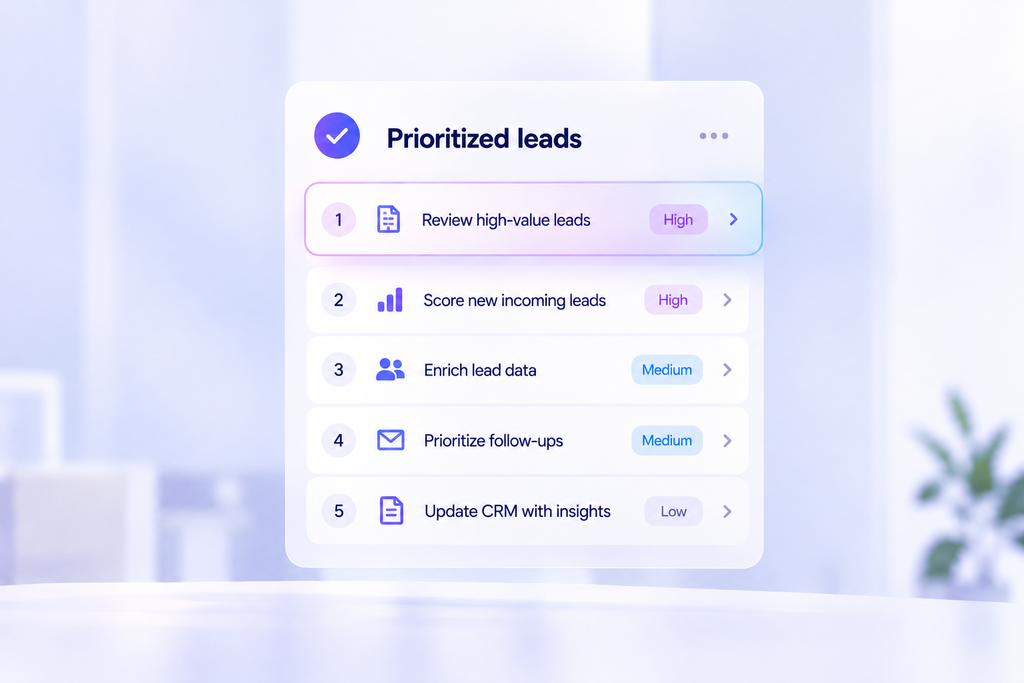
In practice, Elai can help sales teams:
- Identify purchase propensity from available customer and company signals
- Rank opportunities according to their predicted commercial potential
- Bring priority leads into the sales workflow together with the context needed for the next decision or action
One of Deloitte’s cases makes the prioritization logic particularly clear. A leading retail brand used look alike models based on existing high value customers to identify new B2B prospects and enrich those records with additional first party and third party data. The company expanded its prospect universe by 10 times and was then able to prioritize prospects with the highest predicted value.
The larger prospect pool is only part of the value. The more important question is whether the organization can identify which opportunities inside that pool deserve attention first.
A second Deloitte case shows what happens further along the workflow. An AI sales agent supported more than 1,500 sales representatives through a shared workspace that provided context aware insights, templates and embedded support. Deloitte reports more than 25,000 tasks completed and over 20,000 hours of seller time reclaimed within nine months.
Here again, the point is not to remove the salesperson from the process. It is to give the seller better information at the moment it is needed and reduce the work required to move from insight to action.
Better Sales Priorities Matter More Than More Leads
The next step for AI in sales is not simply to generate larger prospect databases or automate a growing number of individual tasks.
More value can come from improving the way organizations identify potential demand, estimate conversion likelihood, prioritize opportunities and decide where sales attention should go.
The 2026 PRISM study shows that meaningful differences between leads can be identified early, including before a substantial behavioral history exists. Deloitte shows how AI and agentic workflows can then bring that intelligence closer to everyday sales execution.
For business leaders, this points to a broader shift: purchase propensity becomes more useful when it influences which opportunities rise to the top, while an AI Sales Agent can help carry that intelligence into the workflow where those priorities become decisions and actions.
The objective is not to pursue every lead faster. It is to create a sales process that becomes better at recognizing where commercial potential is strongest and where human attention can make the greatest difference.
Ready to turn predictive intelligence into better sales priorities? Book a demo and see how Elai can help bring purchase propensity, lead prioritization and next actions into one sales workflow.