

For C level leaders exploring agentic commerce, product visibility is becoming more complex than simply appearing in a set of results, because a product can be available to an AI agent without being examined in detail, inspected without remaining a serious candidate, or considered without ultimately becoming the selected option.
This suggests a broader way to think about visibility across presence, inspection, consideration and choice, four stages that describe increasingly meaningful levels of attention. Understanding the difference between them can help companies reassess how they manage catalog information, product attributes and ranking systems, while also reconsidering whether traditional visibility metrics capture what actually happens when an AI agent participates in product discovery.
Recent research from McGill University provides an interesting perspective on this shift by examining whether ranking effects commonly observed in human search continue when consumers delegate shopping decisions to AI agents.
The main experiment involved 7,000 sessions across five proprietary large language models, tested at different levels of reasoning effort. During each session, an agent received a randomized list of 100 hotel options and could inspect individual alternatives before submitting a final choice, allowing the researchers to observe not only what was ultimately selected but also which options received additional attention along the way.
At their default reasoning levels, the AI agents inspected between 1.63 and 5.83 listings per session, compared with a human benchmark of 1.12 inspections used in the study. The agents therefore explored more alternatives than the human comparison group, although they still examined only a small proportion of all available products, which makes the distinction between being included in a result set and actually receiving attention particularly important.
Presence Makes a Product Available to the Agent
The first stage is presence, meaning that a product is available somewhere within the catalog, results set or information environment the agent can access and use when evaluating possible alternatives.
At this level, visibility is primarily about eligibility for further evaluation. Product information needs to be accessible, sufficiently complete and connected to the customer request in a way that allows the agent to retrieve or encounter the offer during its search process.
Incomplete attributes, inaccessible information or weak alignment with the request may prevent an offer from entering that environment effectively, while successful presence simply establishes the possibility of further consideration. It does not tell the company whether the agent has actually examined the product or whether the offer has played any meaningful role in the decision.
For companies measuring agentic commerce, this distinction makes inclusion in a feed or result set only the starting point of visibility rather than evidence of meaningful attention.
Inspection Shows Where the Agent Directs Attention
The next stage begins when the agent goes beyond basic availability and actively retrieves or evaluates additional information about an option.
In the McGill experiment, agents initially had access to selected hotel attributes and could then use a tool comparable to a human click to inspect additional details, including amenities, location, ratings and availability. This made it possible to distinguish between products that were merely present in the initial environment and products that the agent considered interesting enough to investigate further.
The agents did not inspect all 100 alternatives, and their attention remained selective even though they explored more options than the human benchmark. Position also influenced this behavior, although the pattern did not consistently resemble the familiar decline in attention associated with traditional human search.
Among the tested AI agents, inspection probability could fall in the middle of the available context before increasing again toward the end, with the lowest probabilities appearing between positions 62 and 81 in the experiment. The magnitude and shape of this pattern varied across models and configurations, which is important because it means that the effect should not be treated as a universal rule for every AI shopping system.
The researchers connect this behavior with the “lost in the middle” effect, which has been observed when language models retrieve information from longer contexts and can give different levels of attention to information depending on where it appears.
For commercial teams, the implication is that numerical ranking position may no longer provide a complete representation of visibility. A more useful measurement framework would distinguish between products that were available to the agent and those whose detailed information was actually retrieved for closer evaluation.
Consideration Is Harder to Observe
Inspection still does not tell a business whether its product remained a serious candidate after the agent had evaluated additional information.
An AI agent can retrieve the details of several alternatives, compare their attributes against the customer’s requirements and eliminate some of them without exposing every intermediate step of that evaluation. Companies may therefore be able to observe that an offer was accessed while remaining uncertain about whether it continued to belong to the effective consideration set.
This is one of the reasons why inspection and final choice should be treated as separate stages. When an agent reviews several products before reaching a recommendation, receiving attention becomes a necessary but insufficient condition for selection, while ranking position may influence which products enter deeper evaluation without determining which one ultimately survives it.
For commercial teams, the more interesting question therefore becomes which combinations of product information, customer requirements and contextual signals allow an inspected product to remain relevant as the agent continues comparing alternatives. Answering that question requires understanding what differentiates an offer once the agent has started evaluating fit.
Choice Reflects the Final Evaluation
The final stage is choice, meaning the product that the agent ultimately recommends, books or selects after evaluating the available alternatives.
At this point, the McGill findings became less consistent across the models tested, particularly when reasoning effort changed. Position effects on final choice appeared mainly at lower reasoning levels, while increasing reasoning effort reduced the middle position disadvantage in cases where that pattern had previously emerged, although the behavior did not become identical across every model and configuration.
This variation matters because it makes AI agent behavior difficult to reduce to one stable pattern. Final outcomes can depend on the model being used, the way the agent is configured, the information available to it, the order in which that information appears and the amount of reasoning applied before the recommendation is produced.
A company testing only one model, one prompt or one configuration may therefore be observing a relatively narrow version of how its products could be evaluated across a broader agentic commerce environment.
Traditional Visibility Metrics May Capture Only Part of the Journey
Digital performance has traditionally linked visibility with measures such as ranking position, impressions, clicks and conversion, all of which remain useful but may describe only part of what happens when an AI agent participates in discovery and evaluation.

A product near the top of a result set may benefit from greater initial exposure, while the attributes displayed at that stage influence whether the agent considers further inspection worthwhile. Another product positioned elsewhere may still receive meaningful attention if the model retrieves information effectively from that part of the context, and once several alternatives have been inspected, their relevance to the customer’s requirements may become more influential than their original position.
Companies evaluating agentic commerce may therefore need to monitor several related dimensions, including product availability to the agent, frequency of detailed retrieval, inclusion in recommendations or observable shortlists, final selection and sensitivity to changes in position, attributes, customer context or model configuration.
These dimensions should not yet be treated as a standardized industry measurement system. They are better understood as a management framework that companies can adapt according to the platforms they use, the signals they are able to observe and the role AI agents actually play in their commercial environment.
Product Information Becomes Part of the Competitive Interface
Product visibility has traditionally been interpreted through signals such as ranking position, impressions, clicks and conversion. Agentic commerce complicates that picture because an AI shopping agent can encounter a product, decide whether it deserves further inspection, compare it with alternatives and eventually recommend something else, all before the customer directly engages with the offer.
This introduces a more layered way of thinking about visibility. A product can be available to an agent without receiving meaningful attention, inspected without remaining a serious candidate, or considered without becoming the final choice.
This suggests four distinct stages that businesses may increasingly need to understand: presence, inspection, consideration and choice.
The distinction matters because each stage reveals a different point at which a product can gain or lose relevance. It also changes how companies should think about catalog quality, product attributes, ranking experiments and the metrics used to evaluate performance in environments where AI participates directly in product discovery.
The research from McGill University provides useful evidence for this shift. In an experiment involving 7,000 shopping sessions across five proprietary large language models, AI agents received randomized lists of 100 hotel options and could inspect individual listings before selecting one. At their default reasoning levels, the agents inspected between 1.63 and 5.83 listings per session, compared with a human benchmark of 1.12 inspections used by the researchers.
The agents therefore explored more alternatives than the human comparison group, but still examined only a limited share of what was available. That gap between availability and attention is where the visibility question begins to change.
Presence Is the First Level of Product Visibility
A product first needs to be available within the information environment the agent can access.
That may sound obvious, but presence increasingly depends on more than being listed somewhere in a catalog. Product information needs to be accessible, sufficiently complete and expressed in a way that allows the agent to connect the offer with the customer’s request, preferences and constraints.
If relevant information is missing, inconsistent or inaccessible, the product may have little opportunity to progress further even when it technically exists within the broader commercial ecosystem.
Presence should therefore be interpreted as eligibility for evaluation, rather than proof that meaningful evaluation has already occurred.
This distinction is important because traditional metrics can make availability look more valuable than it really is. A product may appear in a result set or feed without the agent ever retrieving enough information to seriously assess it.
For companies entering agentic commerce, the first question is therefore broader than whether a product appears. It is whether the agent has sufficient access to the information required to recognize that product as potentially relevant.
Inspection Reveals Where the Agent Actually Directs Attention
The next level begins when the agent chooses to retrieve or evaluate additional product information.
In the McGill experiment, the initial results contained selected hotel attributes, while agents could inspect further details such as amenities, ratings, location and availability. This made it possible to observe which options progressed from basic presence to deeper evaluation. That progression was highly selective.
The agents did not systematically inspect all 100 alternatives, and product position influenced which listings received additional attention. However, the pattern did not consistently resemble the familiar behavior of human search, where attention typically decreases as an item moves further down a ranked list.
Some of the tested agents showed lower inspection probability in the middle of the available context, followed by an increase toward the end. In the experiment, the weakest inspection levels appeared between positions 62 and 81, although the effect varied across models and configurations.
This behavior is consistent with what is commonly described as the lost in the middle effect, in which language models can retrieve information unevenly depending on where it appears within a long context.
The commercial implication is significant because ranking position alone may no longer provide a complete representation of visibility.
A product can be present and technically accessible while receiving little or no deeper evaluation. Businesses may therefore need to distinguish between being returned to the agent and being actively inspected by the agent.
Those are two different forms of visibility.
Consideration Depends on What the Agent Learns After Inspection
An agent can retrieve detailed information about several alternatives, compare their attributes and eliminate some of them without exposing every intermediate judgment behind that decision. A business may know that its product was inspected while still having limited visibility into whether the offer remained relevant as the comparison progressed.
This is where product information becomes particularly important.
Once the agent has decided to examine an offer more closely, generic presence matters less than whether the available attributes provide convincing evidence of fit. Price, availability, service characteristics, product specifications, ratings or other relevant variables can all become part of the comparison, depending on the category and the customer’s requirements.
Consideration therefore introduces a more demanding question: Which information helps an inspected product remain relevant when the agent begins comparing alternatives?
That question is different from asking what helped the product appear in the first place. A company may perform well at the presence stage but lose relevance during evaluation because its product attributes are incomplete, poorly structured or insufficiently differentiated. Another product may attract frequent inspection but fail to remain competitive once the agent evaluates it against more specific customer requirements.
Treating these stages separately makes the problem easier to diagnose.
Choice Is Influenced by More Than Initial Position
The final stage is the recommendation, booking or transaction eventually proposed by the agent.
By this point, the relationship between initial position and outcome becomes more complex. The research found that position effects on final choice were less consistent across the tested models and were particularly sensitive to reasoning effort.
Where a middle position disadvantage appeared, increasing reasoning effort could reduce the effect, although behavior did not become uniform across all models or configurations. For companies, this is a useful warning against treating AI shopping behavior as one fixed pattern.
The same catalog can potentially be evaluated differently depending on the underlying model, the prompt, the reasoning configuration, the information available and the order in which products appear. A result observed with one agent therefore may not hold when another system evaluates the same alternatives.
This makes final choice a more complex measure than conversion alone suggests. What matters is not only whether the product won, but also how consistently it remains competitive across different evaluation environments.
Traditional Visibility Metrics May Need Another Layer
Ranking position, impressions, clicks and conversion will remain useful because they still describe important parts of the customer journey. Agentic commerce, however, creates intermediate decisions that those measures may not capture directly.
A product can appear frequently but receive little inspection. Another can attract substantial inspection while rarely remaining in the final consideration set. A third may survive comparison consistently but lose at the final selection stage because another offer better matches the customer’s requirements.
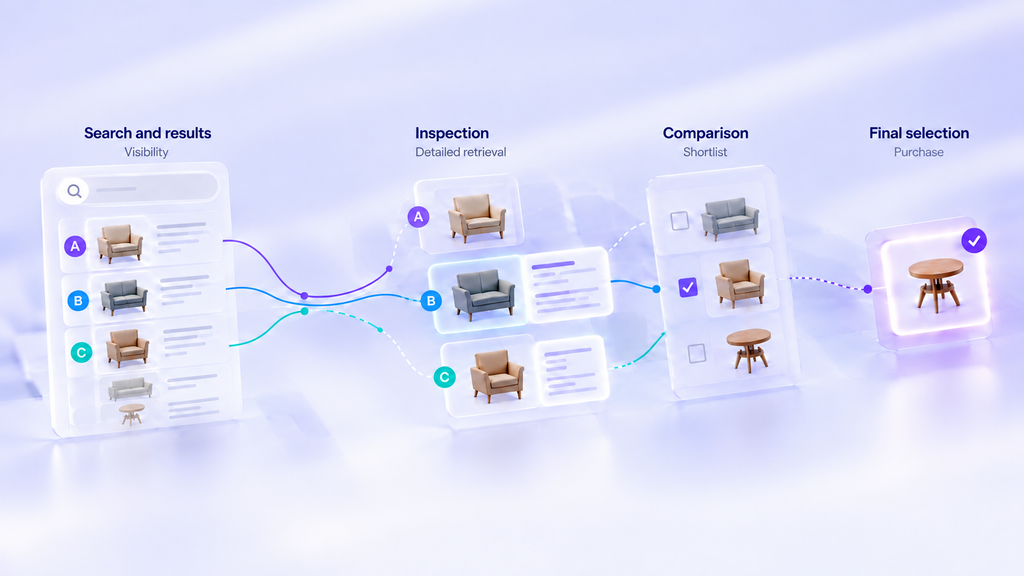
Those situations require different responses.
Companies may therefore benefit from monitoring several related dimensions, including:
- product availability to the agent;
- frequency of detailed retrieval or inspection;
- observable inclusion in recommendations or shortlists;
- final selection frequency;
- consistency across models and agent configurations;
- sensitivity to changes in product position, attributes and customer context.
These should not be treated as established industry KPIs. They are better understood as a management framework for investigating where product visibility is gained or lost.
Product Information Becomes Part of the Competitive Interface
As AI agents take a larger role in comparison, product information becomes part of the interface through which competition occurs.
Attributes can no longer be viewed only as descriptive catalog fields. They provide the evidence an agent can use to distinguish alternatives and determine how well each one fits the customer’s stated requirements.
This places greater importance on completeness, consistency and clarity.
A product with strong underlying value may still be difficult to evaluate if the information required to differentiate it is missing or ambiguous. Conversely, well structured attributes can make it easier for an agent to identify why one offer fits a particular need better than another.
Companies therefore need to understand which product characteristics actually matter during evaluation and whether those characteristics are represented consistently across catalogs, feeds and other environments that AI systems may access.
This also changes the interpretation of ranking tests.
If a new ranking improves impressions but inspection remains unchanged, the problem may lie in the information shown at first exposure. If inspection increases without any improvement in final choice, the issue may instead sit deeper in product fit or differentiation.
The visibility funnel becomes useful precisely because it helps isolate where attention is being lost.
Agent Testing Should Reflect More Than One Technical Setup
Another challenge is that product visibility can change when the technical environment changes. A single test using one model, one prompt and one reasoning configuration provides evidence about that setup, but it may not describe how another agent will behave with the same products.
Organizations experimenting with agentic commerce should therefore evaluate whether important results remain stable across different models, reasoning settings, prompts and information orders. The goal is not to discover one universal behavior for AI agents. A more useful objective is to understand how robust product relevance remains when the system evaluating the product changes.
This matters because customers are unlikely to interact with a single standardized AI shopping environment. Different agents may retrieve, compare and prioritize information differently, creating new variability in how products are discovered and assessed.
Predictive Signals Can Strengthen the Customer Context
Agentic commerce also makes customer context more important because even well structured product information only becomes useful when it can be evaluated against a sufficiently clear understanding of the buyer’s needs. Preferences, constraints, previous behavior and purchase context can all affect which attributes matter most in a given situation.
Predictive intelligence can add another layer to this decision environment. Signals related to customer needs, propensity to buy or offer relevance can help organizations assess which products may deserve stronger consideration for a specific customer or commercial context.
For Elai this creates a natural connection between predictive intelligence and commercial decision making. Customer signals can enrich the context used to evaluate potential offers and bring that information into the operational workflows where recommendations and commercial decisions are made.
The predictive layer complements rather than replaces product information. Reliable attributes remain necessary, while customer signals can help determine which parts of that information are most relevant for the situation being evaluated.
A Broader Definition of Product Visibility
The research behind this discussion comes from a simulated hotel search environment in which AI agents evaluated randomized lists of 100 alternatives. Those findings describe the behavior observed under those experimental conditions and should not be assumed to apply identically across retail, financial services, travel or every other form of agentic commerce.
The broader implication is nevertheless important because presence, inspection, consideration and choice represent different levels of product visibility, each revealing a different point at which relevance can be gained or lost.
As AI agents participate more actively in product discovery and comparison, companies will need to understand more than where a product ranks. They will also need to know whether the offer is accessible to the agent, whether it receives detailed attention, whether it remains credible as alternatives are compared and under which conditions it eventually becomes the selected option.
For C level leaders, this creates a more useful way to frame the visibility question. Product performance in agentic commerce will depend not only on appearing in the right place, but also on providing enough relevant information to progress through an evaluation process that companies may only partially observe.
That makes product visibility less about a single ranking position and more about how successfully an offer moves from availability to meaningful consideration and, eventually, choice.