
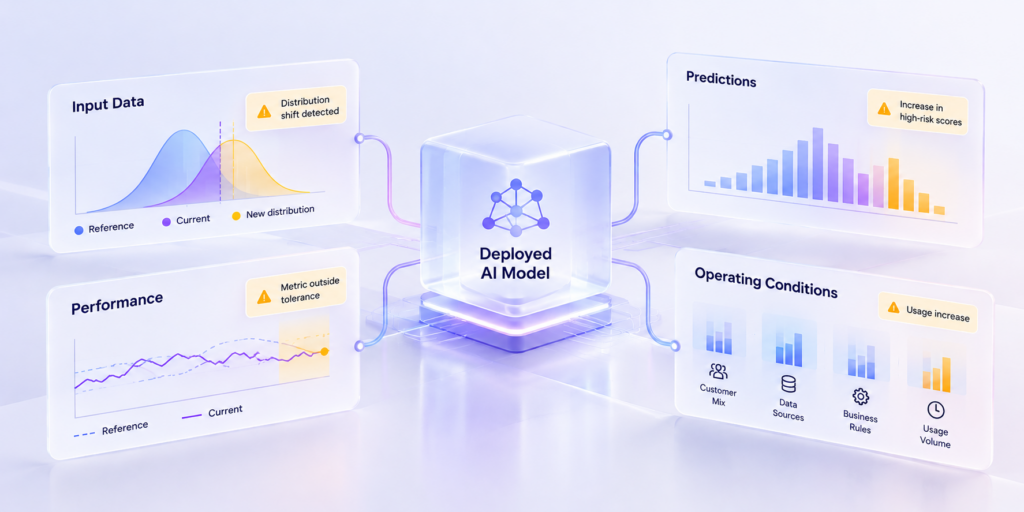
AI model monitoring is the ongoing assessment of a deployed model’s data, predictions, performance and operating conditions. It helps teams decide whether the model remains suitable for its intended use and when to investigate, adjust, retrain or suspend it.
Deployment marks the moment a model begins supporting real decisions. From that point, the environment around it continues to change: customer behavior shifts, data sources evolve and business priorities move.
A model can keep generating predictions while becoming less useful for the process it supports. Post-deployment monitoring provides the evidence needed to recognize that change and respond appropriately.
Consider a churn model that helps an account management team prioritize customer outreach. At launch, it identifies a manageable group of customers whose behavior suggests they may leave. Months later, the number of customers flagged as high risk increases. The system still runs correctly, but the team needs to understand what changed before deciding what to do next.
Why AI Models Need Monitoring After Deployment
Validation provides evidence about performance under the conditions represented in the evaluation data. It does not establish that those conditions will persist.
For the churn model, a rise in high-risk scores could have several explanations. The company may have acquired customers through a new channel, changed its prices or introduced a data processing error. Customers may also be responding differently to the same service experience.
Each explanation points to a different response. A data error needs repair. A changing customer population calls for further evaluation. A shift in the relationship between customer behavior and churn may justify reviewing the model itself.
Monitoring should connect an observed change to an informed decision. An alert identifies something worth examining; the investigation establishes its significance.
This lifecycle approach is reflected in the NIST AI Risk Management Framework, which addresses post-deployment monitoring plans, including user feedback, incident response, change management and decommissioning.
Data Drift vs. Concept Drift
Two important changes to watch after deployment are data drift and concept drift. They describe different problems and should be investigated accordingly.
Data drift: the incoming population changes
Data drift is a change in the distribution of model inputs relative to a reference dataset. That reference might be the training data, validation data or an approved production baseline.
Suppose the churn model begins assessing more customers acquired through a new sales channel. Their account sizes, usage patterns or contract terms may differ from those of the customers used to validate the model.
That difference deserves attention, but it does not automatically mean the predictions have become less accurate. Teams need to examine which variables changed, which customer groups are affected and whether performance remains acceptable as outcomes become available.
Concept drift: the relationship with the outcome changes
Concept drift occurs when the relationship between inputs and the outcome being predicted changes. A decline in product usage may once have been a strong indicator of churn. After a product redesign, customers might achieve the same result through fewer interactions. The behavior looks similar, but its relationship with churn has changed.
Input distributions can remain relatively stable while these relationships shift. Monitoring inputs alone therefore cannot establish whether a model continues to predict outcomes reliably.
Data quality failures need a separate diagnosis
A missing field, a changed unit of measurement or an incorrect transformation can also alter predictions. If an upstream update records unavailable usage data as zero, the churn model may interpret those records as a sudden drop in engagement. The resulting increase in risk scores would reflect a pipeline problem.
Identifying that cause matters: retraining on corrupted data could carry the problem into the next model version.
What Should You Monitor in Production?
A useful monitoring plan follows the path from incoming data to the decision made with a prediction.
Input quality and distribution
Check whether data arrives on time, follows the expected schema and contains usable values. Missing fields, unexpected categories, duplicate records and outdated information can all affect predictions.
Then examine whether important input distributions are changing relative to the chosen reference. Review relevant segments as well as the full population: a shift concentrated in one market or acquisition channel may be difficult to see in aggregate. For the churn model, these checks help distinguish a genuine change in customer activity from an issue in how that activity is collected or processed.
Predictions and model performance
Monitor the distribution of scores and the proportion of cases assigned to each decision category. A sudden increase in customers classified as high risk is useful evidence, even before confirmed churn outcomes are available.
When outcomes arrive, evaluate predictions using metrics appropriate to the decision. Precision and recall may be relevant for classification, mean absolute error for forecasting, and calibration when teams rely on predicted probabilities.
The operating context should guide the choice. If account managers can contact only a limited number of customers, precision among the highest-priority accounts may be particularly useful. Recall can reveal how many customers who eventually churned were identified.
Review performance across relevant customer groups, while considering sample sizes. A small segment may produce volatile results that require more evidence before drawing a conclusion.
Delivery and business use
Predictions also need to reach the right process reliably. Failed scoring jobs, delayed outputs or incomplete customer coverage can reduce the value of a model even when its predictive performance remains acceptable.
Monitor what happens after delivery. Are account managers receiving more alerts than they can review? Are they overriding recommendations? Have eligibility rules changed which customers can receive an intervention?
These signals reveal whether the workflow still fits the model’s outputs.
Business results require careful interpretation. Retention may change because of pricing, service quality or the effectiveness of outreach, as well as the quality of predictions. Monitoring should make those relationships visible without attributing every movement to the model.
How to Monitor When Outcomes Are Delayed
Confirmed outcomes, often called ground truth or labels, may arrive well after a prediction.
If the churn model estimates whether a customer will leave during the next quarter, its full predictive performance cannot be assessed immediately after scoring.
In the meantime, teams can review data quality, input drift, score distributions and operational failures. These provide early indications of change, but they do not establish whether predictions are correct.
Once outcomes become available, match them to the corresponding predictions, model version and evaluation period. Consistent outcome definitions and evaluation windows are essential for meaningful comparisons.
A monitoring plan should distinguish between evidence available immediately and evidence that requires time to mature.
Turn Monitoring Signals Into Decisions
A monitoring framework needs clear conditions for investigation and a defined response process.
For each important signal, establish a reference, a trigger, a review frequency and an owner. Set tolerances according to the consequences of an error, the variability of the signal and the time available to respond. There is no universal drift threshold or review schedule that works for every model.
Returning to the churn example, an increase in high-risk customers could lead to several decisions:
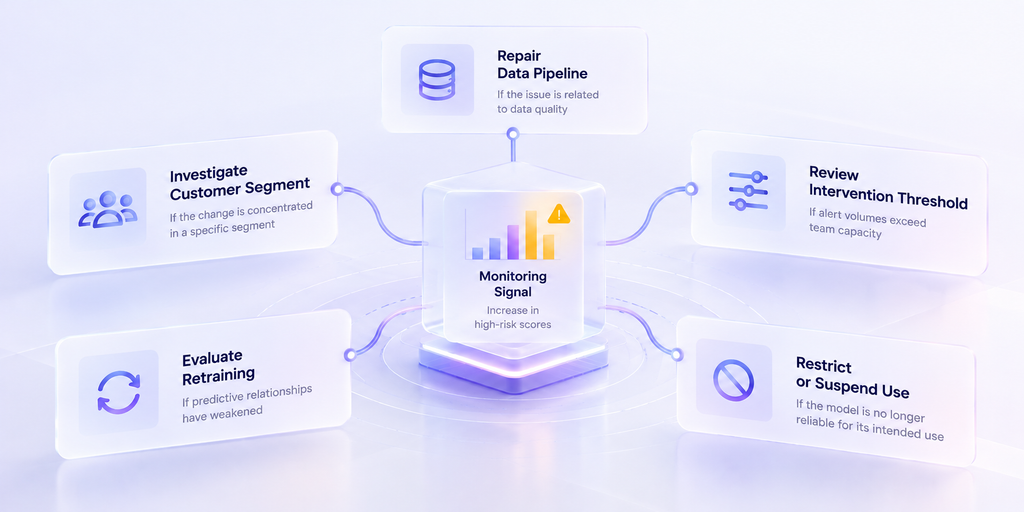
- Repair the data pipeline if missing usage records were incorrectly treated as zero.
- Investigate a customer segment if the change is concentrated in a new acquisition channel.
- Review the intervention threshold if alert volumes exceed team capacity, assessing the effect on missed cases as well as workload.
- Evaluate retraining if recent outcomes show that the model’s predictive relationships have weakened.
- Restrict or suspend use if the available evidence no longer supports relying on the scores.
Any updated model should be validated before release. Changes to thresholds or workflows should also be assessed against the decision they affect.
The objective is to choose a response that addresses the cause and remains proportionate to its consequences.
Match Monitoring Frequency to the Evidence
Data availability and scoring failures may require rapid detection. Predictive performance may need a longer window because outcomes arrive slowly or sufficient observations take time to accumulate. Business impact may follow another review schedule.
Routine checks should be complemented by reviews triggered by significant events. A pricing change, product redesign, data migration or expansion into a new market can justify an assessment even when existing indicators remain within their expected ranges.
For the churn model, reviewing the implications of a major pricing change can help teams identify assumptions that need closer observation before the next scheduled performance review.
Define Who Owns the Response
Technical teams can identify changes in data and predictive performance. Business owners help determine what those changes mean for the process the model supports.
A workable monitoring plan makes that responsibility explicit. Teams should know who reviews alerts, who investigates them and who can approve changes or suspend use. Record the relevant model version, evidence, decision and follow-up action. This gives later reviews a clear account of what happened and whether the response resolved the issue.
Ownership matters most when the signal crosses team boundaries. An increase in churn alerts may involve data engineering, data science and account management. Someone needs responsibility for bringing those perspectives together and closing the investigation.
A Practical Post-Deployment Monitoring Checklist
Before deployment, confirm that the monitoring plan answers these questions:
- Which decision does the model support, and what are its approved limits of use?
- Which data, prediction, performance and operational signals need review?
- Which reference datasets, model versions and evaluation windows will be used?
- When will confirmed outcomes become available?
- Which changes trigger investigation, and who owns the response?
- Who can approve adjustments, retraining, restrictions or suspension?
- What fallback process is available if predictions cannot be used?
- How will decisions be documented, and when will the monitoring plan be reassessed?
The plan should evolve as the model’s use, the available evidence and the business environment change.
Keep Predictive AI Useful Beyond Deployment
The value of a predictive model depends on how well it continues to support a real decision.
For the churn model, that means more than producing a risk score. The underlying data must remain usable, the predictions must remain informative and the account management process must be able to act on them.
Effective AI model monitoring brings those elements together. It gives technical and business teams a shared basis for deciding when to continue, investigate or change course.
If your organization is deploying predictive AI or reviewing models already in production, talk to ELAI about the decisions they need to support and how success should be assessed over time.