
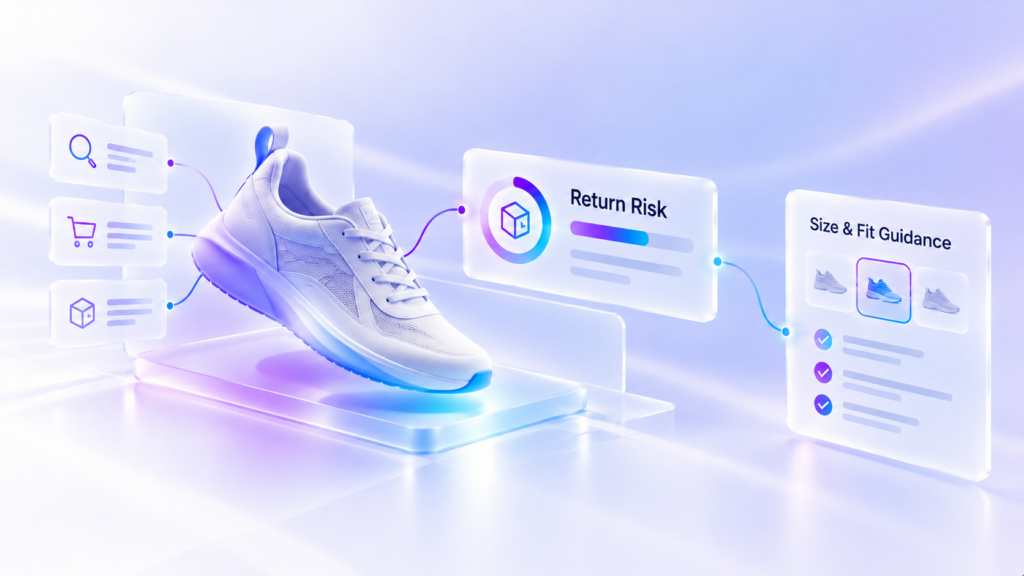
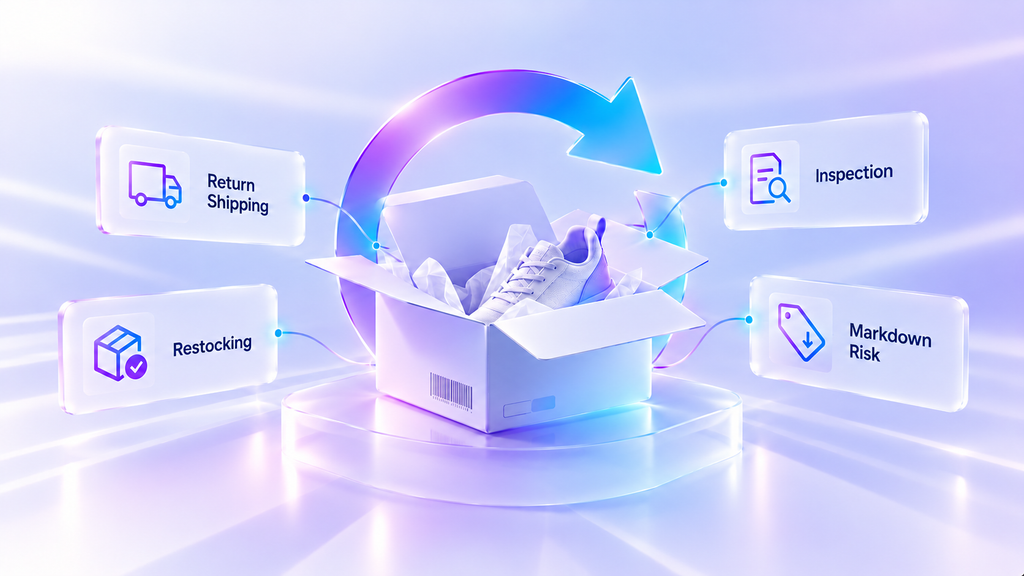
A completed sale does not always translate into a profitable transaction. When a product is returned, retailers may face additional shipping, inspection, handling and restocking costs. Depending on its condition and seasonality, the item may also need to be discounted before it can be sold again.
These expenses arise after purchase, but some signals associated with return risk can appear earlier in the customer journey. Repeated searches for product information, uncertainty about size or compatibility, and purchasing patterns across channels may offer useful context. None of these behaviors proves that a return will occur. Together with historical outcomes, however, they can help estimate which purchases are more likely to result in a return.
Product return prediction offers retailers an opportunity to identify potential risks before checkout and test whether timely assistance can reduce avoidable returns. The commercial objective is to protect profitability while helping customers make informed purchasing decisions, without introducing unnecessary friction or undermining conversion.
Why Product Returns Affect Retail Profitability
Returns can reduce the economic contribution of a sale in several ways. They may involve refunds, transportation, inspection and warehouse processing, as well as inventory that cannot be resold immediately. The financial impact depends on the product, its condition and the retailer’s fulfillment model. An unopened item returned to stock quickly has different economics from a seasonal product that requires repackaging and a markdown.
High sales volumes can therefore coexist with substantial return-related costs. For commercial teams, revenue and conversion rates provide only part of the picture. Return rates, reverse-logistics expenses and contribution margins help reveal how much economic value the business retains from completed transactions.
Tightening return policies may seem like an obvious response, but restrictions can discourage purchases or create friction for customers. A more targeted approach is to investigate whether some returns are associated with uncertainty that could be addressed before checkout.
This changes the operational question. Instead of focusing exclusively on processing returned products efficiently, retailers can also explore whether clearer product information or timely assistance might help customers choose the right item in the first place.
How AI Can Identify Return Risk Before Checkout
Predictive models can combine historical purchases with information available before checkout to estimate the likelihood of a future return. The relevant signals vary across retailers, product categories and purchasing contexts.
In fashion retail, purchasing several sizes of the same item or repeatedly consulting a sizing guide may reflect uncertainty about fit. Both behaviors can also represent reasonable shopping strategies, so they should not automatically be interpreted as negative signals. In other categories, repeated product comparisons or searches for compatibility information may provide more relevant indicators.
Product characteristics, historical return patterns and interactions across online and physical channels can offer additional context when the data are lawfully collected and appropriate for the intended purpose. Their predictive relevance must be established using the retailer’s own historical information rather than assumed in advance.
A useful modeling project begins by defining the outcome to be predicted. For example, a retailer might want to estimate whether an individual item will be returned within 30 days, or whether an order will contain at least one returned item. These targets are related but not interchangeable, since a single order may contain several products and only one may be returned.
Historical transaction records can then be connected to their observed outcomes. A classification model learns patterns associated with returned and retained purchases and produces a risk estimate for a new item or order.
The timing of the available information is essential. A prediction generated before checkout must rely on data that would genuinely have been available at that point. Complaints, delivery problems or other events occurring after a purchase can contribute to historical outcome analysis, but they cannot be used as inputs to predict that same purchase before checkout.
Model evaluation should consider both the ability to rank purchases by risk and, when numerical probabilities inform business decisions, the calibration of those probabilities. A model may correctly distinguish higher-risk purchases while systematically overstating their absolute likelihood of return. Testing performance on later transactions can also help determine whether the model remains reliable as customer behavior and product assortments change.
What a 2026 Retail Study Found
A June 2026 study by Xiao Chen, Muhammad Haron and Mammadova Simuzar Sultan, published in the Journal of Retailing and Consumer Services, examined how machine learning could predict and help reduce product returns in omnichannel apparel retail.
The researchers analyzed anonymized information from 58,412 shoppers, covering approximately 1.27 million purchases and 243,000 returns over twelve months. The dataset combined e-commerce browsing information, RFID fitting-room activity, mobile application signals and product characteristics.
A gradient-boosted model achieved an AUC-ROC of 0.879 on its holdout test, indicating strong ability to distinguish purchases that would later be returned from those retained in the studied setting.
The research also examined whether predictive information could support an intervention that changed customer outcomes.
In a six-week randomized field experiment involving 112,473 high-risk transactions, the retailer tested targeted size-and-fit assistance designed to help shoppers resolve uncertainty before completing their purchases. The experiment reported a 3.0 percentage-point reduction in return rates, corresponding to a 15.6% relative reduction, without deterioration in checkout conversion, average order value or customer satisfaction in the experimental setting.
These findings illustrate two separate capabilities. First, information available during the purchasing journey can help identify transactions associated with higher return risk. Second, in this specific environment, targeted assistance was effective in reducing returns.
The distinction matters because predictive accuracy alone does not demonstrate that an intervention will improve business performance. A model may identify customers who are likely to return a product without indicating whether additional guidance will change their behavior.
The reported results should not be interpreted as a universal benchmark. The effectiveness of an approach depends on the retailer’s product assortment, data infrastructure, customer behavior and intervention design. Other businesses would need to validate their own models and evaluate customer-facing actions within their specific commercial environment.
From Return Prediction to Commercial Action
A high return-risk score does not automatically identify the most appropriate action. A customer comparing several sizes might benefit from clearer product measurements, additional sizing information or optional assistance before checkout. Another shopper may already have enough information, making further prompts unnecessary or potentially disruptive.
Retailers therefore need to consider the customer’s likely information needs alongside the potential cost of a return, the resources required to provide assistance and the possibility of creating friction during the purchasing process.
One possible approach is to test additional guidance for transactions that exceed a validated risk threshold and show signs of unresolved uncertainty. Any intervention should help customers make informed decisions rather than discourage legitimate purchases or impose unnecessary restrictions.
Predicting which purchases may result in returns is different from identifying which customers will respond to a preventive action.
A customer with a high predicted likelihood of returning an item is not necessarily the customer whose behavior is most likely to change after receiving additional information. Understanding that difference requires experimental or causal evaluation rather than relying exclusively on predictive scores.
A controlled experiment can compare an intervention group with an appropriate comparison group, allowing sufficient time for returns to become observable.
Return rates should be evaluated alongside checkout conversion, average order value, customer complaints, the cost of providing assistance and contribution margin after return-related expenses.
This broader assessment is important because reducing returns does not automatically improve profitability. A retailer could lower return rates by discouraging purchases and still experience a negative commercial outcome. Conversely, assistance that reduces avoidable returns without weakening conversion may help protect the economic value of completed sales.
Results should also be monitored across product categories and over time. An intervention that works for fit-sensitive products may offer limited value in categories where returns arise from different causes. The goal is to identify actions that produce measurable improvements while preserving a positive purchasing experience.
Building an Effective Product Return Prediction Strategy
Implementing product return prediction requires more than selecting a machine learning algorithm. Retailers need reliable historical purchase and return records, a clearly defined prediction target and sufficient information available at the point where the model will be used.
Data preparation, feature engineering, model validation and integration with operational systems are essential components of the process. Predictive outputs must be accessible where teams can evaluate potential interventions, while model performance should be monitored as products, customer behavior and return patterns evolve.
Equally important is defining the commercial objective before deployment. A retailer seeking to reduce reverse-logistics costs may prioritize different decisions from one aiming to improve product information or reduce uncertainty about fit and compatibility.
These objectives influence which outcomes should be predicted, which interventions are appropriate and how success should be measured.
Product return prediction is therefore most useful when it connects reliable estimates with actions that can be tested against real commercial outcomes. For retail leaders, the opportunity extends beyond identifying higher-risk purchases: it involves understanding where timely assistance can reduce avoidable costs, support customers and protect the profitability of the sale.