
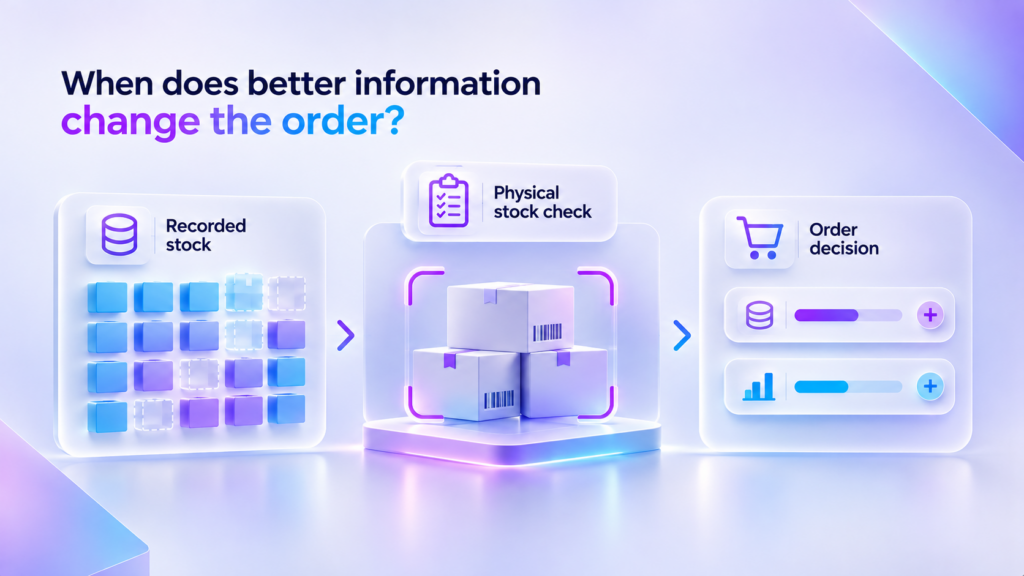
An inventory system may indicate that sufficient stock is available to meet demand, even when the quantity that can actually be sold has already fallen below what the records suggest. For retailers relying on these figures to plan replenishment, the difference can lead to delayed orders, unexpected shortages or decisions based on an increasingly inaccurate picture of the inventory available.
Physical stock checks can help resolve this uncertainty, although verifying inventory requires employee time and operational resources that cannot be devoted to every product continuously. Retailers must therefore consider not only how much inventory to order, but also whether obtaining more accurate information through an additional check would improve the decision enough to justify its cost.
Recent research into learning-based inventory management explores how these two decisions can be coordinated, offering an approach in which statistical learning supports replenishment and verification choices as new information becomes available.
When Recorded Inventory Differs From Available Stock
Inventory systems generally maintain stock records by accounting for deliveries, recorded sales and adjustments, allowing retailers to estimate how many units should remain available at any given time. However, spoilage, damage, misplacement and other unrecorded losses can gradually create differences between the quantities shown in the system and the products actually available for sale.
These discrepancies become particularly problematic when replenishment decisions rely on recorded inventory without accounting for the possibility that some stock has disappeared. A grocery retailer, for example, may postpone an order because its system indicates that sufficient quantities remain, even though a portion of those products has deteriorated or been discarded without the corresponding adjustment being recorded.
Automatically ordering additional units to compensate for possible losses is not necessarily an effective solution, since the retailer may accumulate excess inventory when its records are reasonably accurate. This is especially relevant for perishable products, where larger orders can increase waste and holding costs, while insufficient replenishment may result in lost sales and reduced availability.
The operational challenge is therefore to determine how replenishment decisions should account for uncertainty about the true stock position, rather than assuming that the quantity recorded in the system always reflects what is available.
The Economic Value of an Inventory Check
Physical inventory counts provide an opportunity to correct inaccurate records and improve the information available for subsequent replenishment decisions, but the value of that information depends on the circumstances in which it is obtained.
When inventory records are relatively reliable and the likelihood of a significant shortage is low, conducting another check may offer little benefit compared with its operational cost. In other situations, particularly when unrecorded losses could lead to substantial shortages or unnecessary orders, verification may help the retailer avoid a more expensive decision.
This relationship becomes important when businesses must balance several competing costs, including the labor required to count products, the consequences of stockouts and the expense of holding inventory that may not be sold before it deteriorates.
A retailer deciding whether to inspect a particular product should therefore consider how much an additional count is likely to change its replenishment decision and whether the potential improvement outweighs the cost of obtaining more accurate information.
Rather than treating inventory verification as an activity whose frequency is determined exclusively by fixed schedules, this perspective considers whether an audit is economically justified under the conditions facing the retailer at that moment.
What the 2026 Research Introduces
In an October 2026 study published as an SSRN working paper, Recep Yusuf Bekci and Mehmet Gumus investigate how retailers can coordinate inventory replenishment and physical audits when some stock losses are not directly observable.
Motivated by the operating conditions of a small online grocery retailer, the researchers develop KM-Audit, a learning-based inventory control method that uses statistical information accumulated during operations to inform decisions about stock levels and verification.
The approach is designed for situations in which the retailer does not know the distribution of unrecorded inventory losses in advance and must gradually learn about those losses from incomplete observations. Rather than treating replenishment and stock checking as independent activities, the method considers how new information obtained through verification can influence future ordering decisions.
This changes the role of an inventory audit within the decision process, because a physical count is no longer viewed solely as a way to correct an inaccurate record. It can also provide information that helps the retailer better understand unobserved losses and make subsequent decisions under less uncertainty.
The research therefore addresses a question that goes beyond identifying whether an inventory discrepancy is likely to exist: when is the information gained from checking inventory valuable enough to justify the resources required to obtain it?
Learning From Incomplete Inventory Information
One of the difficulties in managing unrecorded inventory losses is that retailers cannot always observe when products disappear or precisely how much stock has been lost between replenishment events.
Inventory records may continue to report available units even as the actual quantity declines, while sales, stockouts and occasional physical counts reveal only part of what has happened. These incomplete observations complicate the estimation of inventory losses, particularly when verification is infrequent or expensive.
KM-Audit addresses this challenge through a statistical learning approach based on the Kaplan-Meier estimator, which is commonly used to analyze data containing censored observations. Such observations provide partial information about an underlying quantity without revealing its exact value, allowing the learning process to incorporate available evidence rather than treating incomplete records as if they contained no useful information.
By incorporating new observations as they become available, the method can progressively refine its estimates of unrecorded losses and use them to inform both replenishment and audit decisions.
The significance of this approach lies in the relationship between learning and action. Information collected during operations contributes to future decisions, while those decisions influence which additional observations become available, creating a process in which inventory management can adapt as the retailer gains a better understanding of its operating conditions.
Why Replenishment and Auditing Should Be Considered Together
Replenishment and inventory verification are closely connected because the quality of the information available about current stock affects how much a retailer should order, while the expected consequences of an ordering decision influence the potential value of conducting a physical count.

When a retailer suspects that unrecorded losses may have reduced its available inventory, relying entirely on the recorded stock position could increase the risk of shortages. Consistently reducing its assumed inventory balance, however, may encourage unnecessary replenishment in periods when actual losses are limited.
Physical verification can reduce uncertainty about the current stock position, but the decision to conduct an audit must account for the costs of the check and the extent to which more accurate information could improve subsequent orders.
KM-Audit examines these choices within a common framework, allowing the replenishment policy and the use of physical checks to respond to information accumulated over time rather than operating according to unrelated rules.
The appropriate balance will depend on the retailer’s operating conditions, including the consequences of excess inventory, the cost of shortages and the resources required for verification. Products with short shelf lives, for example, may present a different balance of risks from goods that can be stored for longer periods without deterioration.
From this perspective, inventory accuracy is not an isolated objective to be pursued regardless of cost, but a source of information whose practical value depends on the decisions it enables.
What the Research Demonstrates
Bekci and Gumus examine KM-Audit through theoretical analysis and numerical experiments that consider how an adaptive inventory policy performs when the distribution of unrecorded stock losses must be learned over time.
Under the assumptions established in their mathematical model, the researchers demonstrate a sublinear cumulative cost gap relative to a benchmark policy that already knows the underlying loss distribution. This means that the average cost difference relative to that benchmark decreases toward zero as the learning horizon grows, providing a theoretical basis for the method’s ability to improve decisions as information accumulates.
The numerical analysis further explores how adaptive replenishment and audit decisions behave under different operating conditions, offering evidence about the potential benefits and trade-offs of learning-based inventory management.
These findings are methodologically relevant, but their interpretation requires an important distinction. The paper does not establish that KM-Audit has already produced a specific reduction in stockouts, product waste or operating expenditure through a documented commercial deployment, and the numerical results should not be presented as guaranteed business outcomes.
The research is also available as a working paper rather than a verified peer-reviewed journal publication, meaning its contribution is best understood as a recent mathematical and computational approach whose practical effectiveness would need to be assessed in individual operating environments.
Evaluating Learning-Based Inventory Decisions in Practice
For a retailer considering a learning-based approach, the starting point would be an assessment of how existing replenishment procedures respond to inventory discrepancies and how frequently physical counts reveal differences between recorded and actual stock.
Historical information about orders, sales, stock adjustments, product losses and completed audits could help establish whether there is sufficient evidence to estimate unrecorded losses and whether the current inventory policy is particularly sensitive to inaccurate records.
The next consideration would be economic, since the value of adapting replenishment and verification decisions depends on the relative costs of shortages, excess stock, waste and the labor required for physical checks. Without a reasonable understanding of these costs, an improvement in inventory estimates would not necessarily establish that the resulting decisions are more efficient.
A practical evaluation could compare current inventory procedures with a learning-based policy under suitably comparable conditions, measuring whether changes in replenishment quantities and audit frequency produce benefits that justify the additional analytical and operational requirements.
The assessment should extend beyond the accuracy of estimated losses to consider outcomes such as product availability, waste, stockholding costs and verification effort, since these measures help determine whether better information is translating into better decisions.
An approach that improves statistical estimates without materially changing ordering outcomes or reducing avoidable costs may be technically successful while providing limited economic benefit.
Making Inventory Decisions With Imperfect Information
Retailers cannot always know their exact inventory position without carrying out physical checks, particularly when stock losses are difficult to observe and verification requires scarce operational resources. The challenge is to make replenishment decisions despite that uncertainty while determining when obtaining additional information is likely to be worthwhile.
Learning-based inventory management provides a way to examine these decisions together, using available observations to improve estimates of unrecorded losses and adapt the balance between ordering stock and verifying what remains.
The contribution of the October 2026 research is to show how this relationship can be represented within an adaptive mathematical framework, offering a basis for further investigation rather than a commercially validated solution ready for universal application.
For retailers, the underlying question extends beyond how frequently inventory should be counted: it concerns when the information obtained through a stock check can improve a replenishment decision enough to justify the cost of obtaining it.