
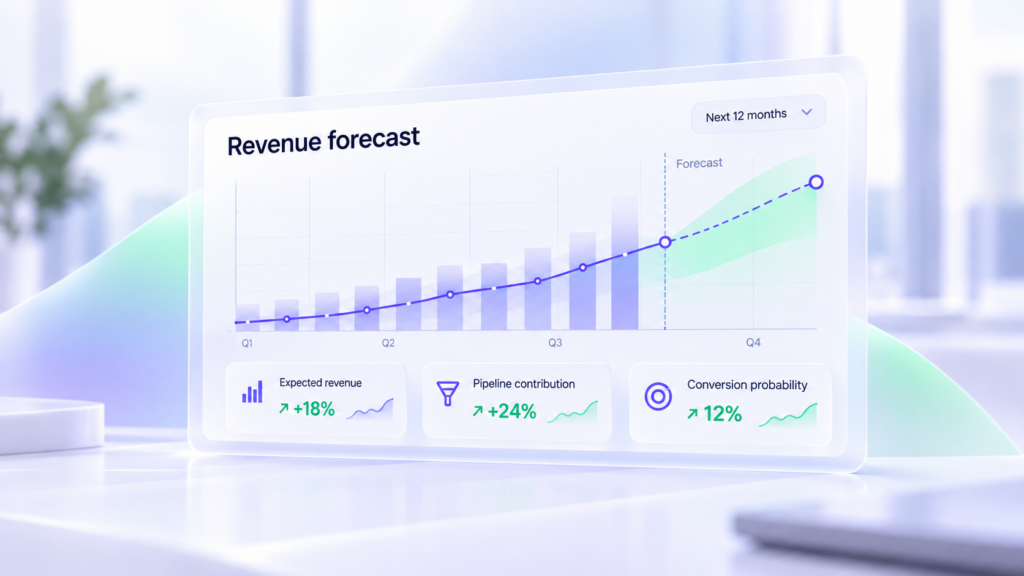
Revenue forecasting often begins too late in the information chain. By the time a change becomes visible in financial reporting, the commercial conditions behind it may have been developing for weeks. Customer interest may be shifting, opportunities may be progressing differently from expected and conversion probabilities may already be moving in a direction that has not yet reached the forecast.
Predictive AI can give finance an earlier view of these changes by identifying signals that indicate how future commercial performance may evolve.
This opportunity becomes particularly relevant when those signals are connected to an AI Agent for Finance. Rather than replacing the forecasting process, the agent can help identify meaningful changes in predictive sales data, connect them with existing assumptions and bring the relevant context to finance when it can still influence a decision.
Research published this year by ACCA and Chartered Accountants Australia and New Zealand, CA ANZ, based on a global survey of 1,600 finance professionals alongside interviews and roundtables, reflects this broader shift. Finance is moving beyond retrospective reporting and increasingly working with operational data, analytics and AI to generate enterprise insight.
The question is therefore becoming less about whether finance should use more data and more about which signals deserve to influence the view of future revenue.
Revenue Forecasting Is Often Too Far Downstream
Traditional financial information remains essential, but forecasting has a different purpose from reporting: it tries to understand what may happen before the outcome is known.
Many of the events that eventually affect revenue begin inside commercial processes much earlier. A weakening pipeline, changing customer demand or a decline in conversion probability can all become visible before their financial impact is recorded.
Predictive intelligence can help reduce this gap by making earlier commercial signals available to finance. The objective is to give forecasting a more current view of the business conditions developing behind them.
In this context, timing can be as important as accuracy. A signal that arrives early enough to challenge an assumption may be more useful than a precise explanation of an outcome that has already occurred.
Predictive Sales Signals Can Give Finance an Earlier View
Sales organizations already generate information about future commercial potential through pipeline activity, opportunity progression and customer behaviour. Predictive models can add another layer by estimating factors such as conversion probability, purchase propensity or changes in demand.
These predictions are probabilities, not future revenue. Their value for finance comes from a more practical question: Has the probability of a commercial outcome changed enough to reconsider an assumption already used in the revenue forecast?
This moves predictive intelligence beyond the idea of generating another score. The same signal that helps sales understand where attention should go can also give finance an earlier indication that expected revenue may be strengthening, weakening or shifting in timing.
The ACCA and CA ANZ research does not specifically test the impact of sales propensity signals on forecasting accuracy, but it does describe a finance function increasingly using operational information and AI across descriptive, diagnostic, predictive and prescriptive activities.
The connection with sales signals is therefore an important practical extension: predictive information becomes more valuable when it reaches the business decision it can actually improve.
An AI Agent for Finance Can Connect Signals With the Forecast
Relevant information often already exists, but remains distributed across different systems and business functions.
Sales teams work with CRM data, finance manages forecasting processes and predictive models may operate in separate analytical environments. The challenge is making sure an important signal reaches the right workflow with enough context to be evaluated.
An AI Agent for Finance can help reduce that distance.
If predictive sales data indicates a significant decline in conversion probability across a group of high value opportunities, for example, the agent could surface the change, connect it with the assumptions potentially affected and bring the relevant information forward for review.
Finance would still determine whether the forecast should change.
This creates a useful separation between prediction, orchestration and judgment. The model estimates what may happen, the agent helps relevant information move through the workflow and finance determines its financial significance.
Better Forecasting Depends on Better Data Foundations
Connecting additional signals to a forecast only creates value if the information can be trusted and interpreted correctly.
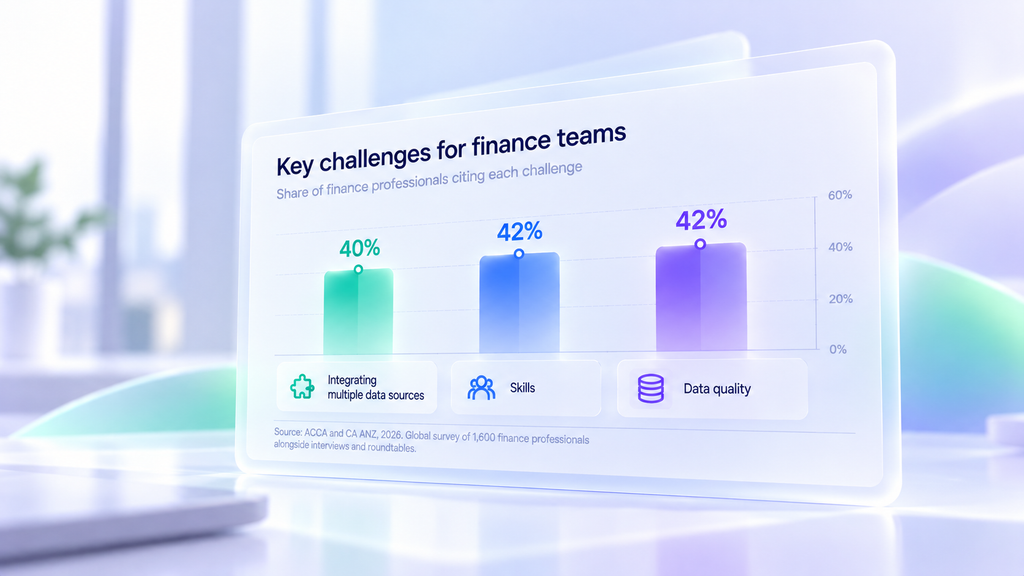
ACCA and CA ANZ identify a clear set of obstacles. Among surveyed finance professionals, 42% cite data quality as a challenge, 42% point to skills and 40% report difficulties integrating multiple data sources.
These issues become particularly relevant when finance begins using predictive information generated outside traditional financial systems.
A conversion probability is only meaningful if the organization understands what it represents and can connect it with the correct customer, opportunity and financial assumption. An AI Agent cannot compensate for unreliable data or unclear relationships between commercial and financial information.
The real challenge is therefore to determine which information is financially meaningful and when a change becomes significant enough to deserve attention.
Not Every Predictive Change Should Alter the Forecast
Making forecasting more responsive also creates a risk of overreaction.
Predictive outputs naturally change as new information becomes available. If every movement immediately affected the revenue forecast, the process could become more dynamic without becoming more reliable.
Context is what separates a new signal from a meaningful financial change.
A small shift in conversion probability across a low value opportunity may have little impact. The same movement across several strategically important deals could justify a closer review of the forecast.
An AI Agent for Finance should therefore do more than detect change. It should help surface the changes that matter to the financial decision, considering the available context around value, timing and existing assumptions.
This is also where human judgment remains essential. ACCA and CA ANZ highlight capabilities such as critical thinking, sceptical validation and contextual storytelling as finance becomes more AI enabled, reflecting the need to interpret AI generated insights rather than accept them automatically.
From Predictive Sales Signals to Better Revenue Decisions
The larger opportunity for AI in finance is giving finance earlier access to the operational signals shaping future performance, and predictive sales intelligence provides one way to create that connection.
When commercial probabilities change, finance does not necessarily need another dashboard. It needs to understand whether the change is significant, which assumptions it may affect and whether the forecast deserves another look.
An AI Agent for Finance can help bridge that gap by connecting predictive sales signals with revenue forecasting, surfacing financially relevant changes and providing the context needed to evaluate them.
The forecast remains a financial judgment rather than an automated prediction. What changes is the quality and timing of the information available when that judgment is made.
As finance works with increasingly dynamic operational and predictive data, one of the most valuable applications of Predictive AI may be precisely this: helping organizations recognize changes in future revenue potential early enough to make better decisions about what comes next.