
For business leaders, the next phase of AI strategy is becoming less about access to technology and more about turning it into measurable business value.
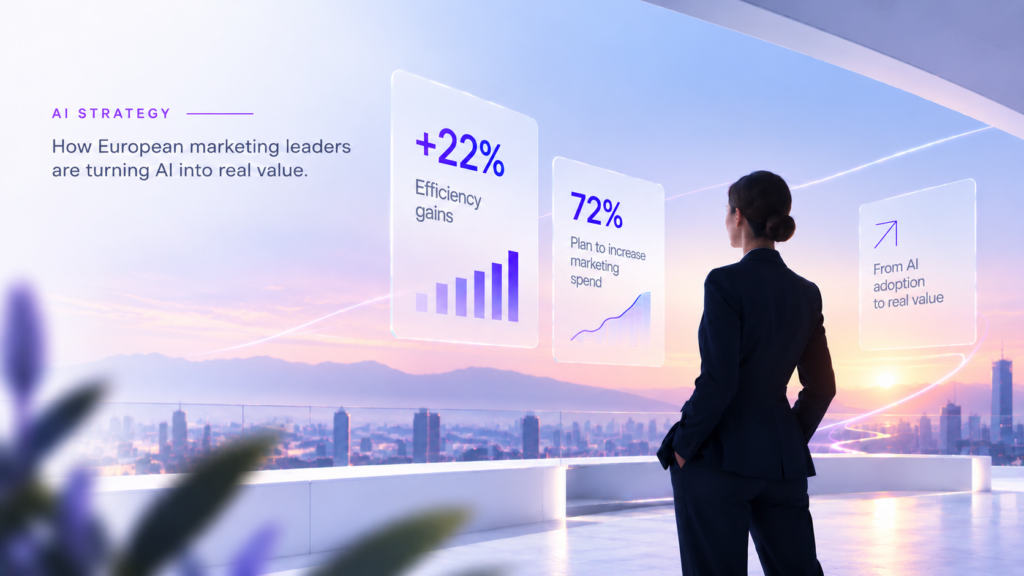
McKinsey & Company’s State of Marketing Europe 2026, based on a survey of 500 senior marketing leaders across five major European markets, reveals a striking maturity gap. Only 6% of surveyed marketing leaders qualify as high-maturity Generative AI users. Yet these leaders report average marketing efficiency gains of 22%, with projected gains rising to 28% over the next two years.
The implication for CEOs, CMOs and other senior executives is clear: the competitive question is shifting from whether organizations use AI to how effectively they integrate it into workflows, measurement and decision-making.
AI ROI: Moving From Experimentation to Measurable Value
Generative AI is often associated with faster content production. But McKinsey’s findings suggest that its business value becomes more significant when organizations move beyond isolated productivity use cases.
Among high-maturity Gen AI users, average marketing efficiency gains reached 22% over the previous two years, with 28% expected over the following two years. McKinsey defines these gains as reductions in expenses without loss of revenue. By contrast, 89% of Gen AI laggards reported efficiency gains of no more than 5%.
The BMG case shows what this can look like in practice. Its MAGE system uses Gen AI to create platform-optimized marketing assets at scale, generating efficiency gains of around 98% in asset creation. Controlled testing also found that AI-generated assets delivered higher click-through rates and engagement and lower advertising costs than human-made alternatives.
The strategic value, then, is not simply creating more content. It is the ability to create, test, learn and scale more efficiently.
AI Investment Is Raising the Bar for Measurement
European marketing leaders are not responding to uncertainty simply by cutting expenditure. In McKinsey’s survey, 72% expected marketing spending as a percentage of net sales to increase, while another 27% expected it to remain stable.
Gen AI-enabled marketing ranked first among the areas expected to receive the greatest increase in marketing-related spending, selected among the top three priorities by 50% of respondents. MROI measurement followed at 42% and consumer insights at 38%.
But investment alone does not guarantee accountability. More than 90% of respondents have some form of marketing ROI measurement, yet only 3% can explain more than half of their marketing spend through MROI measurement.
As privacy constraints and fragmented customer journeys make deterministic attribution more difficult, McKinsey points toward a more holistic measurement architecture combining Marketing Mix Modeling (MMM) with lift studies and other approaches.
For executives, this connects AI investment to a broader question: not simply where can AI reduce cost?, but where can AI improve effectiveness, and can the organization prove it?
From Generative AI to Predictive and Agentic AI
Greater AI maturity also requires precision about what different technologies actually do.
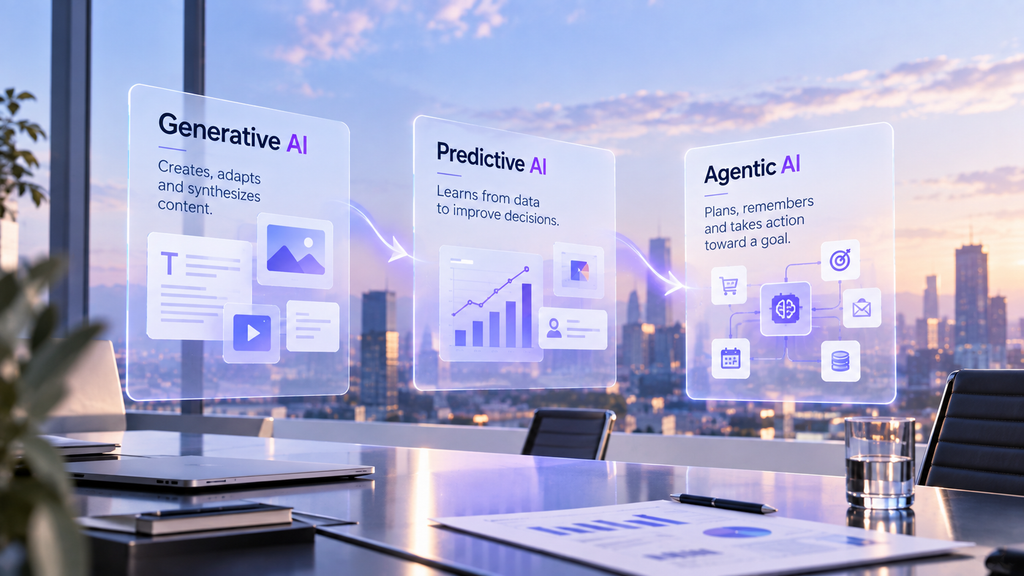
Generative AI creates, adapts and synthesizes information and content. In marketing, McKinsey identifies applications ranging from media optimization and customer insights to personalized content at scale.
The report offers a more specific example of Predictive AI through BMG. Professor Jochen Hartmann describes how experimental data can feed predictive systems such as MAGE’s personalization engine. The important progression is from generating content to learning from performance data and using those signals to improve subsequent decisions.
Agentic AI takes this further. Rather than simply producing an output, AI agents can plan, remember and take independent action toward a goal.
McKinsey highlights Coca-Cola’s use of autonomous agents to deliver personalized coupons to more than 800,000 consumers. The initiative generated nearly four times higher click-through rates while operating at a fraction of the cost of traditional manual campaigns.
For business leaders, the progression is not simply from “less AI” to “more AI.” It is toward systems that can create, learn and increasingly act across business workflows.
AI Strategy Is Becoming an Operating-Model Question
Technology alone does not explain the gap between AI leaders and laggards.
McKinsey evaluates Gen AI maturity across dimensions including strategy, data quality, technological infrastructure, production deployment, operating-model redesign, change management and training. Even among leaders, strategy and operating models remain challenges; laggards face more fundamental barriers around infrastructure, adoption and scaling.
That reframes AI strategy. Capturing value requires more than adding AI tools to existing processes. It requires organizations to rethink workflows, strengthen data foundations, build capabilities and integrate AI into everyday operations.
BMG again provides a useful example. Its MAGE initiative combines AI development with controlled experimentation, academic collaboration and integration into marketing workflows.
The distinction matters: AI adoption is about deploying technology, AI transformation is about redesigning how work gets done.
AI Is Also Changing How Customers Discover Brands
The impact of AI is no longer confined to internal operations.
McKinsey reports that more than 50% of AI search users now rely on these tools to guide discovery and purchase decisions. As large language models become part of the customer journey, traditional SEO is evolving to include Generative Engine Optimization (GEO), focused on brand visibility within AI-generated summaries and recommendations.
For executives, this expands the scope of AI strategy once again. AI is becoming both an infrastructure companies use to operate and an interface customers increasingly use to discover and evaluate them.
From AI Adoption to AI Business Value
The most important signal in McKinsey’s findings is not that every organization should pursue every emerging AI capability. It is that the gap between experimentation and business value is becoming measurable.
High-maturity Gen AI users are already reporting significant efficiency gains. Investment is moving toward AI-enabled marketing and stronger measurement. More advanced applications are connecting experimentation with predictive systems and autonomous agents. At the same time, organizations struggling to capture value continue to face gaps in infrastructure, strategy and operating models.
For the C-suite, the mandate is therefore changing.
The next phase of AI strategy will not be defined by how many AI tools an organization deploys, but by whether it can connect them to measurable outcomes, integrate them into workflows and scale what works.
Competitive advantage is moving from access to AI toward the ability to operationalize it.