
Introduction
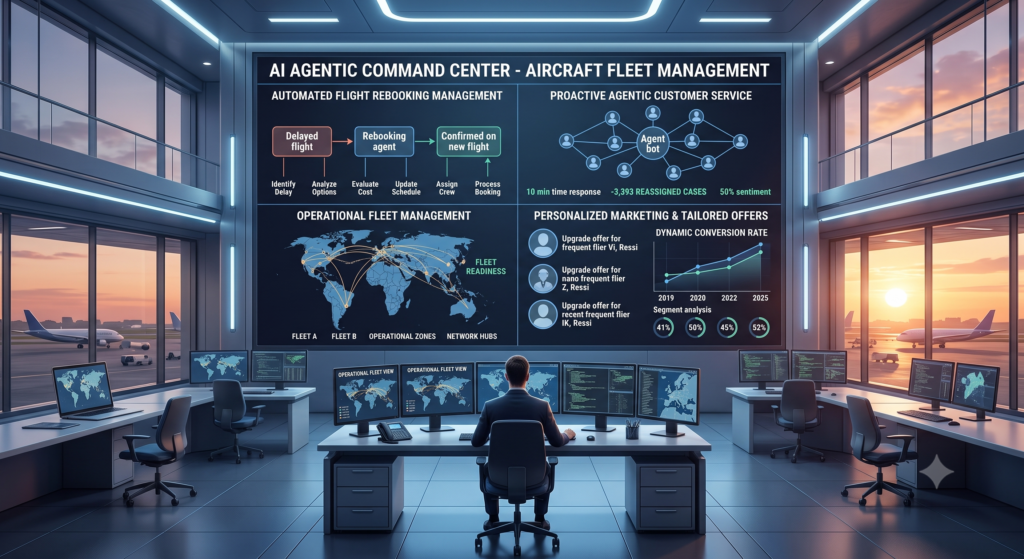
Agentic AI marks a significant breakthrough in the aviation sector, with the potential to transform many key aspects of the travel experience. This technology goes beyond traditional artificial intelligence by operating semi-autonomously under human supervision and integrating deeply with airline systems. In aviation, agentic AI proves especially effective in managing automatic flight rebooking, customer support, operational management, and personalized marketing.
Why is automatic rebooking so important?
Flight changes, delays, or cancellations are common events that negatively affect the passenger experience. Automatic rebooking powered by AI eliminates long phone waits and complicated procedures, providing a fast and seamless solution for changing itineraries or travel dates. An AI voice agent guides customers naturally, offering alternative options and even handling fare difference payments without interruption.
The impact of agentic AI on air transport
- Customer Support: Fast and personalized interactions with instant responses to complex inquiries.
- Operational Management: Automation of strategic processes such as passenger reallocation and crowd forecasting.
- Marketing: Tailored offers and proactive communications based on each traveler’s individual preferences.
How does automatic rebooking with AI work?
The AI agent acts as an intelligent virtual assistant that:
- Automatically detects necessary changes to flights.
- Suggests alternative solutions in real time.
- Makes the booking change after passenger confirmation.
- Handles payment of any fare differences securely and quickly.
Benefits for airlines and travelers
- For airlines: Reduced operational costs, improved reputation thanks to more efficient service, increased customer loyalty.
- For travelers: Shorter wait times, a smoother and more personalized experience, support available 24/7.
It is clear that Agentic AI has the potential to revolutionize the aviation sector, not only by enabling automatic flight rebooking but also by transforming customer service management, digital marketing, and airport operational optimization. To successfully implement this technology, high-quality data, strict governance, and concrete use cases that deliver real value for airlines and travelers are essential.
What is Agentic AI and Why Is It Revolutionary for Aviation?
Agentic AI marks a significant leap forward compared to traditional artificial intelligence. While conventional AI is often limited to performing specific tasks based on predefined rules or predictive models, Agentic AI introduces a new level of intelligent automation. This allows digital agents to act semi-autonomously, making contextual decisions and dynamically adapting to changing situations.
Differences Between Traditional AI and Agentic AI
- Traditional AI: Performs operations restricted to single tasks, such as voice recognition or data analysis, without autonomous decision-making capabilities.
- Agentic AI: Integrates reasoning abilities, continuous learning, and proactive interaction with its environment, simulating more complex human-like behaviors.
This distinction is crucial in the aviation sector, where the complexity of operations demands flexible and responsive solutions.
Semi-autonomous operation with human supervision
Agentic AI does not completely replace human operators. Instead, it works within a hybrid model:
- The AI agent takes automatic initiatives, handling repetitive or urgent tasks such as rebooking flights.
- Human operators step in to oversee complex or exceptional decisions that require critical judgment.
- This collaboration increases response speed without compromising service quality.
Human supervision also ensures compliance with company policies and ethical standards during interactions with passengers.
Collaborative ecosystem between AI and human operators in airlines
The effectiveness of agentic AI depends on an integrated ecosystem where:
- AI systems communicate with each other and with airport and flight infrastructures.
- The information collected is continuously updated, enabling accurate forecasts and timely responses.
- Human operators collaborate with artificial intelligence to manage unforeseen scenarios or exceptions.
This synergistic approach is transforming the way airlines handle operational management, enhancing both efficiency and customer satisfaction. Autonomous artificial intelligence thus becomes a valuable tool for both passengers and staff, enabling smoother and more personalized processes.
Automatic Rebooking: How Agentic AI Manages Flight Changes
Automatic rebooking through an AI voice agent marks a significant step forward in improving the management of flight changes and passenger assistance. This system relies on AI-powered voice support for flight rebooking, intervening quickly and efficiently whenever a change is required.
The Automatic Rebooking Process with an AI Voice Agent
- The passenger is contacted or can independently activate the AI voice agent via phone or app.
- The AI agent recognizes the customer and accesses the original booking data in real time.
- A natural conversation begins, where the system asks what changes the customer would like to make: change of date, itinerary, or other travel options.
- The AI automatically suggests the best available alternatives, balancing customer preferences with operational availability.
Smooth and Natural Customer Interaction
The voice interface is designed to replicate a human conversation, avoiding rigid or pre-set responses. The language used is simple and direct, allowing for:
- Spontaneous customer requests without having to follow a strict script.
- Contextual understanding of travel needs and dynamic adaptation of suggestions.
- The ability to ask additional questions or request clarifications naturally.
A practical example: if a traveler says “I’d like to move my flight to the next day,” the voice agent not only offers available options but also highlights fare differences and deadlines for confirming the change.
Automated Payment of Fare Differences
One of the main challenges with traditional rebooking processes involves long waiting times and complicated procedures for paying any fare differences. AI-powered agents address this by offering:
- Instant calculation of the difference between the original fare and the updated one.
- Automatic submission of payment authorization requests using saved customer profile methods (credit card, digital wallet).
- Immediate confirmation of successful payment, allowing the new booking to be finalized right away.
This automation eliminates phone queues, lengthy waits, and manual steps by human operators. For more complex or exceptional cases, the system can seamlessly transfer the call to a human agent while retaining all previously gathered information, reducing both time and frustration.
The integration of AI voice assistance for flight rebooking is redefining what customer support means in airline management. The AI agent’s ability to act quickly, understand real needs, and handle payments smoothly greatly enhances the traveler’s experience, lowers operational costs for airlines, and ensures greater flexibility in managing unexpected situations.
Personalized travel experiences and proactive support powered by artificial intelligence
AI-powered personalized itineraries are among the most significant innovations for enhancing the travel experience. Artificial intelligence deeply analyzes each traveler’s individual preferences—such as favorite destinations, desired activities, budget, and travel habits. This enables the creation of tailor-made proposals that go far beyond standard package offers.
How personalized itineraries are created
Here’s how the process of building a customized itinerary works:
- Information gathering: The AI agent collects detailed information directly from the traveler or from previously saved data.
- Optimal combinations: It processes the best combinations of flights, hotels, activities, and transfers based on specific preferences and time constraints.
- Experience suggestions: It recommends unique experiences—such as cultural or sports excursions—that match personal tastes and family profiles.
Automating seat selection and check-in
A key aspect of personalization is the automated management of practical tasks through the AI agent:
- You can entrust the agent to select your seat based on your saved preferences (e.g., window, aisle, or quiet zone).
- Check-in is performed automatically according to your preset parameters, eliminating stress and waiting times.
- The AI ensures every operational detail is handled without your direct involvement, enhancing your comfort and peace of mind before the flight.
Proactive support throughout your journey
The AI digital concierge is constantly active to provide immediate assistance and anticipate your needs:
- Real-time notifications keep you updated on schedule changes, cancellations, or delays.
- Personalized recommendations are sent directly to your device, suggesting alternatives or additional services when needed.
- If unexpected issues arise—such as disruptions or last-minute changes—the agent steps in immediately to offer quick solutions without you having to seek help manually.
The introduction of Agentic AI is radically transforming the airline industry—not only in customer service or automatic rebooking but also in personalized marketing, efficient operational management, and tailor-made offers.
An effective approach, however, requires certified high-quality data, strict governance that sets ethical and operational boundaries, and concrete use cases capable of generating tangible value for both airlines and travelers.
The ability of agentic AI to integrate these elements into a single collaborative system opens up a new frontier in travel personalization. Technology thus becomes an indispensable ally for those who want to enjoy unique experiences without bureaucratic or operational hassles.
Airport Operational Optimization through Predictive Operations and AI Automation
AI-powered predictive airport operations rely on analyzing large volumes of aggregated data from various sources: passenger flows, weather conditions, local traffic, flight performance, and even external events such as demonstrations or strikes. This data makes it possible to anticipate crowding and critical issues, enabling more agile and efficient operational management.
Resource Forecasting and Management
- Real-time analysis of passenger movement patterns to identify peak times.
- Dynamic staff planning at check-in counters, security checks, and boarding gates.
- Optimal allocation of self-service facilities based on forecasts, reducing queues and improving flow.
Smart Automation of Bag Drop
Artificial intelligence automatically activates self-service bag drop units when forecasts predict an increase in passenger volume. This system:
- Reduces waiting times by ensuring stations are available exactly when needed.
- Minimizes human intervention in repetitive tasks.
- Enhances traveler satisfaction by providing a smoother and faster experience.
The Importance of Data Quality
Successfully implementing predictive airport operations requires accurate, up-to-date, and well-integrated data. High-quality information powers agent-based algorithms, enabling precise and timely decisions. Without this solid foundation, automation risks inefficiencies or errors that could negatively impact the overall experience.
Airlines and airport operators are increasingly investing in intelligent systems that combine machine learning with advanced analytics to turn data into concrete actions. This synergy not only optimizes resources but also enables personalized services, allowing for rapid adaptation to operational changes and the specific needs of passengers.
Intelligent Management of Emergencies and Disruptions with Agent-Based AI
AI-powered flight disruption management marks a significant leap forward in assisting passengers during unexpected events such as delays, cancellations, or lost luggage. The AI agent plays a key role by promptly communicating relevant information, enabling a swift and coordinated response.
Instant and Personalized Communication
- The AI agent automatically sends notifications to passengers as soon as an operational issue is detected.
- Clear and detailed messages explain the nature of the disruption, possible consequences, and recommended actions.
- Communication is delivered via app, SMS, or email, according to the traveler’s saved preferences.
- If luggage is lost, the AI guides the customer through reporting the issue and collects information to initiate tracking and recovery.
“Your flight has been delayed by 45 minutes. You can choose from several rebooking options directly in the app.”
Balanced Automation with Human Support
The AI autonomously handles most common requests, reducing wait times and stress for passengers. However, not every situation can be resolved without human intervention:
- For complex changes or specific complaints, the AI agent transfers the request to a human operator.
- The system ensures that the level of automation does not compromise service quality or customer satisfaction.
- Operators can access information gathered by the AI before the call, optimizing their intervention.
Benefits for Airlines and Travelers
The integration of AI agents in emergency management enables:
- Reduced response times and increased operational efficiency.
- Improved transparency for customers through constant updates.
- Greater ability to handle spikes in requests during critical situations without overloading human staff.
- Increased passenger loyalty thanks to proactive and timely assistance.
A hybrid system that combines intelligent automation with human oversight ensures that even during crises, travel continues with minimal disruption.
Key Requirements for Effective Adoption of AI Agents in Airlines
The introduction of agentic AI in the aviation sector is not merely a matter of advanced technology. To fully harness its potential in customer service, automatic rebooking, marketing, operational management, and personalized offers, airlines must meet essential requirements.
High-quality data to power agentic algorithms
The accuracy and effectiveness of AI agents are closely tied to the quality of the data they rely on. This data must be:
- Accurate: Up-to-date and error-free information ensures correct and timely responses.
- Comprehensive: Data should cover all relevant variables related to travel and passenger preferences.
- Real-time: Fast processing of operational changes or customer requests requires continuous, instantly updated data streams.
Only under these conditions can algorithms analyze complex scenarios, make semi-autonomous decisions, and offer effective solutions without constant human intervention.
Governance: ethical boundaries and operational rules
Agentic AI operates in an environment where ethics and transparency are paramount. Governance establishes:
- Clear boundaries for AI’s autonomous actions, preventing uncontrolled or harmful decisions.
- Operational rules that ensure compliance with privacy regulations, data security, and customer protection.
- Mandatory human oversight in critical or complex scenarios that require ethical judgment or specialist intervention.
This regulatory framework safeguards both travelers and companies, maintaining strong trust in the AI system.
High-Value Use Cases
To effectively integrate agentic AI, it’s essential to identify concrete use cases that deliver tangible benefits. Not every function can or should be automated; it’s important to focus on:
- Processes with significant customer impact, such as automatic rebooking.
- Operational tasks that can reduce downtime and improve airport efficiency.
- Personalized offers designed to boost conversion rates and customer loyalty.
Success depends on the ability to combine advanced technology with targeted strategies based on real market needs.
The effective adoption of agentic AI in airlines is therefore based on a balance between data quality, strict governance, and careful selection of practical applications. Only in this way can this technology profoundly transform the passenger journey, making it smoother, more personalized, and more reliable.
Tangible Benefits of Integrating Agentic AI into Flight Rebooking
Operational efficiency in airlines through artificial intelligence translates into real advantages for both airlines and travelers. The adoption of agentic AI in rebooking management revolutionizes how flight changes are handled, drastically reducing processing times and improving service quality.
1. Significant Reduction in Processing Times
Intelligent automation allows rebooking requests to be processed within minutes, eliminating long phone waits or queues at counters. The AI agent evaluates availability, alternative flights, and fare differences in real time, offering customers immediate and tailored solutions.
2. Smoother and More Personalized Customer Experiences
By analyzing the preferences saved in the traveler’s profile, the AI agent can anticipate specific needs such as seat selection or requests for flexible changes. This approach increases customer satisfaction, as travelers receive quick and accurate responses without having to repeat every detail.
3. Optimizing Human Resources
Freed from repetitive tasks and routine calls, human agents can focus on complex cases or situations that require empathy and critical judgment. The collaboration between AI agents and human teams creates an effective balance between automation and human expertise.
4. Enhancing Corporate Reputation
Prompt and personalized customer service strengthens passengers’ trust in airlines. The ability to quickly handle unexpected changes helps build a positive image and increases customer loyalty.
5. Dynamic Fare Management and Automated Payments
Automatic rebooking also includes immediate processing of fare differences through secure integrated digital payment systems, avoiding delays or manual errors. This ensures financial transparency and simplicity for the customer.
The combination of these elements clearly shows how integrating agentic AI into flight rebooking is not just a technological advantage, but a fundamental strategic lever to enhance airline operational efficiency with artificial intelligence, transforming the travel experience into a smoother, faster, and more satisfying journey.
Conclusion
The future of the airline industry with artificial intelligence is built on a profound and multidimensional transformation. Agentic AI is not just a technological innovation, but a true engine of change that impacts:
- Customer service: faster responses, natural interactions, and continuous support.
- Automatic rebooking: efficient management of flight changes without delays or complications.
- Personalized marketing: offers tailored to travelers’ real preferences.
- Intelligent operational management: optimization of airport resources and anticipation of emergencies.
This revolution, however, requires solid foundations to be fully leveraged. Airlines must focus on:
- Quality data: up-to-date, accurate, and seamlessly integrated within a coherent ecosystem.
- Responsible governance: clear rules that balance automation with human oversight, ensuring transparency and ethical standards.
- High-value use cases: pragmatic implementations that deliver tangible benefits to both the company and its customers.
Investing in robust data infrastructure and attentive governance is no longer optional—it’s a strategic necessity. The true advantage of advanced artificial intelligence emerges when technology and organization work together to deliver unprecedented travel experiences.
“Only through an integrated approach—combining agentic AI, human supervision, and partnerships across the air transport ecosystem—can we truly innovate the journey of the future.”
The message for airlines is clear: embracing Agentic AI means choosing to lead the transformation of the aviation sector, offering passengers intelligent, timely, and personalized solutions. The path to this new era begins with conscious investment in data, governance, and real-world use cases.
Frequently Asked Questions
What is agentic AI and why is it considered revolutionary in the aviation industry?
Agentic AI refers to autonomous and semi-autonomous artificial intelligence that operates under human supervision. In the aviation sector, it marks a breakthrough thanks to its ability to automate complex processes such as customer service, automatic rebooking, and operational management, thereby enhancing efficiency and personalization.
How does automatic rebooking with agentic AI work in air transport?
Automatic rebooking leverages an AI voice agent that interacts naturally with customers to modify flight dates or itineraries. This system also automates payment of fare differences, eliminating wait times and phone queues, and providing a fast and seamless service.
What are the benefits of adopting agentic AI for airlines and travelers?
The integration of agentic AI improves operational efficiency by reducing rebooking handling times, increases customer satisfaction through personalized experiences and proactive support, optimizes airport operations management, and ensures timely communication during emergencies or disruptions.
How does agentic AI contribute to travel personalization?
Agentic AI creates personalized itineraries based on each traveler’s individual preferences, automatically manages seat selection and check-in according to saved choices, and provides proactive support with real-time notifications throughout the journey, significantly enhancing the overall travel experience.
What are the key requirements for effective adoption of agentic AI in airlines?
To successfully implement agentic AI, it is crucial to have accurate and up-to-date data to power the algorithms, as well as robust governance that sets ethical boundaries and operational rules for artificial intelligence. Additionally, identifying high-value use cases is important to maximize benefits.
How does agentic AI optimize airport operations?
By leveraging aggregated data, agentic AI predicts crowding and optimizes airport resources by automatically activating self-service units such as bag drops. This predictive approach improves operational management, reduces waiting times, and increases overall airport efficiency.