
Customer lifetime value prediction helps organizations estimate the future economic contribution of a customer relationship and use that information to guide decisions about acquisition, retention and customer development. For marketing, CRM and finance leaders, it provides a forward-looking basis for comparing customer opportunities and deciding where commercial resources may create the greatest value.
A single CLV estimate can still leave part of that picture unresolved, particularly when customers with similar expected returns face very different levels of risk or growth potential.
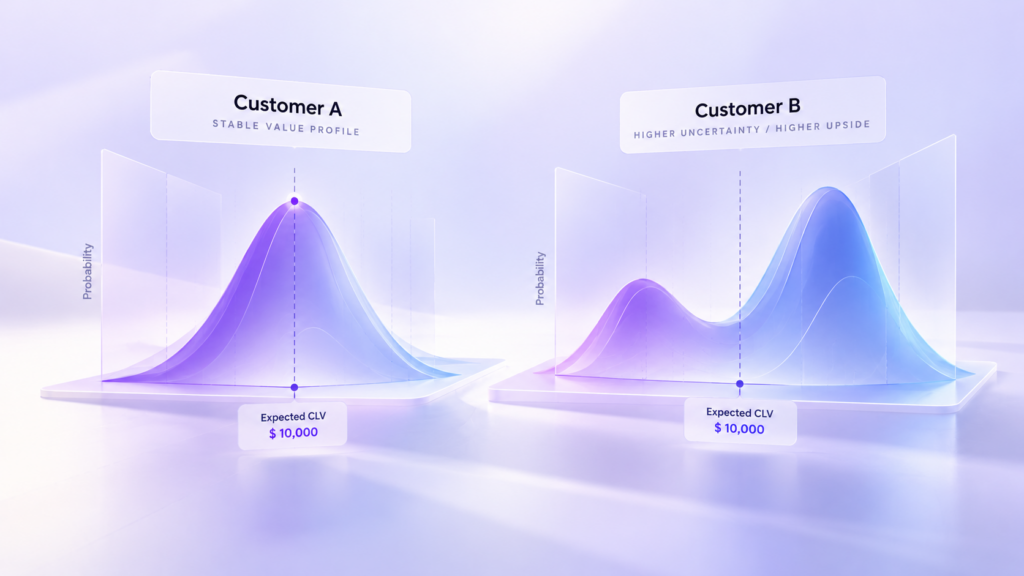
Two customers may have the same predicted lifetime value and yet present very different future prospects. One relationship may be relatively stable, with most plausible outcomes concentrated around its expected value. Another may have a much wider range of possibilities, including substantial growth as well as significant decline. On paper, the two customers look equally valuable. From a commercial perspective, they may call for very different strategies.
That difference becomes important when resources are limited. Knowing the expected amount of customer value is useful, but understanding how that value could develop can be just as relevant to the investment decision.
The 2026 research by Mainak Sarkar and Arnaud De Bruyn, published in the Journal of the Academy of Marketing Science, examines this challenge through a distributional approach to customer lifetime value, modeling possible future outcomes instead of relying exclusively on a single expected value. The findings suggest that expected CLV remains a useful reference, while some investment decisions benefit from a clearer view of the risks and opportunities behind that estimate.
Why a Single CLV Estimate May Not Tell the Whole Story
Customer lifetime value summarizes the future economic contribution expected from a customer relationship, drawing on information such as transaction history, spending patterns, purchasing frequency, tenure and engagement.
Predictive models can combine these signals into a point estimate that makes customer relationships easier to compare. A predicted lifetime value of $10,000, for example, can serve as a reference when evaluating acquisition costs, service requirements or the potential economic contribution of different accounts. The problem appears when customers with the same expected CLV have materially different distributions of possible outcomes. Ranking them exclusively by expected value can remove information that matters commercially.
An organization seeking predictable cash flows may favor relationships with relatively stable prospects. A business pursuing expansion opportunities may be more interested in customers whose expected value includes substantial upside potential. The appropriate choice depends on available resources, commercial objectives, tolerance for risk and the organization’s ability to influence future customer behavior.
The research explores this limitation by modeling distributions of possible customer lifetime values, including cases in which future outcomes may diverge or form distinct concentrations of probability.
Expected CLV remains useful in this framework. The distribution simply adds information that may become relevant when the shape of a customer’s possible future affects decisions about retention, development or investment.
Expected CLV, Uncertainty and Possible Customer Trajectories
Expected CLV answers an important business question: based on the available information and the assumptions of the predictive model, what economic contribution can the organization reasonably expect from a customer relationship?
A distributional perspective goes further by showing how actual outcomes could differ from that expectation and how likely those different results may be.
This becomes particularly useful when organizations compare customers whose expected values are similar but whose future economic prospects differ in ways that could influence commercial priorities.
Expected Value
Expected CLV provides a central estimate that supports comparisons between relationships, portfolio analysis and the evaluation of acquisition or development strategies. It is especially useful when organizations need a consistent measure for planning and reporting.
When customers share similar expected values despite having different underlying distributions, however, the average may not provide enough information to determine which relationship deserves additional investment.
Predictive Uncertainty
A distribution shows the relative likelihood of different future values and gives decision makers a fuller view of the variation around a customer’s expected economic contribution.
Uncertainty about the customer’s future should not automatically be treated as evidence that the predictive model is unreliable. A customer relationship can genuinely have several plausible outcomes even when the model has been appropriately developed and validated. Uncertainty in the model itself is a separate issue and needs to be assessed on its own terms.
For decision makers, the relevant question is whether the possible outcomes differ enough to change the commercial decision, rather than whether the prediction can be expressed as one apparently precise number.
Possible Customer Trajectories
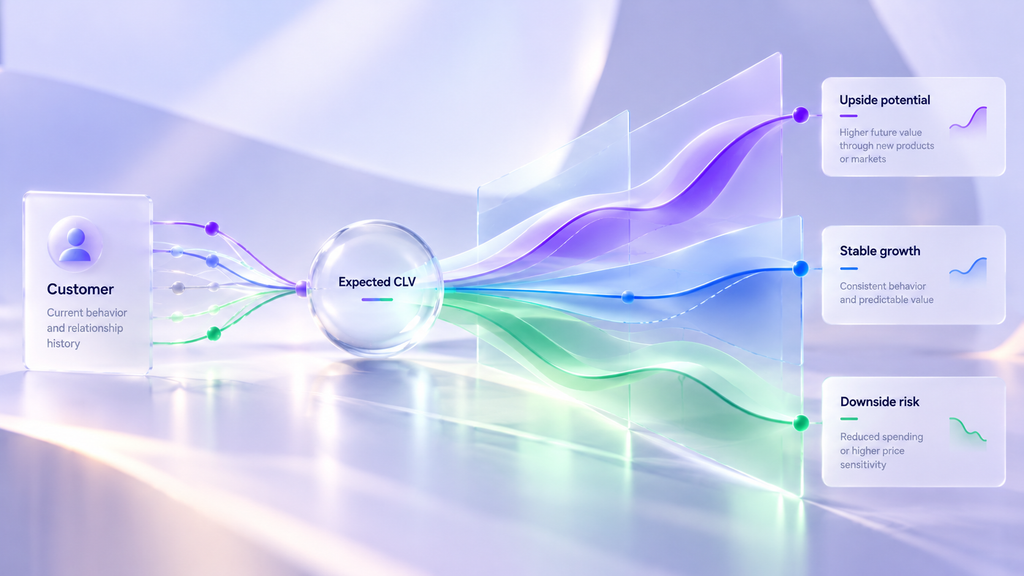
Customer value develops through purchases, interactions and changes in the commercial relationship. Over time, a customer may increase engagement, adopt additional products, reduce spending or eventually disengage.
These developments rarely follow a perfectly smooth progression. A single relationship can have several plausible future paths, each with different economic implications.
An interval around an expected CLV does not necessarily communicate the same information as a distribution. An interval summarizes a range, while a distribution shows how probability is spread across possible outcomes. Understanding how those outcomes may emerge over time may also require looking at customer behavior and the actions taken by the organization.
The level of detail needed will depend on the decision. Portfolio-level planning and individual account development, for example, may require different views of future customer value.
How Customer Behavior and Company Actions Shape Future Value
Future customer value depends on how customers behave, but those behaviors develop in an environment shaped partly by the organization’s own commercial decisions.
Marketing communications, sales interactions, service experiences and retention initiatives can influence the relationship, while previous customer behavior often determines which actions the business chooses to take.
The research on distributional CLV examines this interaction through a dual-LSTM architecture that models customer behavior alongside marketing activity, using nine years of donation and solicitation histories from 21,939 individuals in a fundraising organization.
The empirical setting matters. It limits how broadly the results can be generalized, and the study does not establish that identical distributional patterns or intervention effects will appear across industries. The broader implication for customer strategy is still important: predictions of future value may partly reflect the commercial practices contained in historical data.
An organization may consistently allocate more attention to customers who already appear valuable, and those decisions can influence the behaviors subsequently recorded in its systems. A predictive model trained on that history may therefore capture relationships involving both customer characteristics and the company’s existing engagement strategy.
Forecasting customer value under observed conditions is one question. Estimating how much a new intervention could change that value is another.
A customer with substantial growth potential is not automatically the best opportunity for incremental marketing investment. Identifying a favorable possible outcome does not demonstrate that a proposed action will make that outcome more likely.
When the investment decision depends on whether the business can actively influence customer behavior, causal analysis or experimentation may be needed alongside predictive CLV to estimate the incremental effect of a retention initiative, service adjustment or commercial offer.
How CLV Distributions Can Change Customer Investment Decisions
The value of a distributional approach becomes particularly clear when organizations have to allocate limited resources across relationships with different combinations of expected value, risk and potential.
Consider two customers with the same expected CLV. The first has a relatively narrow distribution, with most possible outcomes concentrated around the expected value. The second has a wider distribution that includes both substantial downside risk and the possibility of significantly greater future returns.
A point estimate assigns the same expected value to both customers, but the commercial implications are different.
For an organization seeking predictable future cash flows, the first customer may provide a more suitable profile. A business actively pursuing growth may place greater weight on the second customer’s upside potential. A CRM team focused on retention may interpret the same two relationships differently from an account development team looking for expansion opportunities.
The distribution does not determine the answer. It gives the organization more information about the alternatives being compared and reduces the risk of treating expected value as the only basis for customer prioritization.
The research offers an empirical illustration. Within the fundraising dataset examined by the authors, using upside potential in the predicted CLV distribution to prioritize customers improved targeting lift by up to 8.3% compared with ranking customers exclusively by expected CLV.
That figure belongs to the specific research setting and should not be interpreted as a universal performance expectation or as an outcome achieved by ELAI. What matters is the underlying finding: information contained in the distribution can change customer rankings when the decision objective emphasizes opportunities that are not fully reflected in the average.
For marketing and CRM leaders, customer lifetime value prediction can therefore support more informed allocation decisions when expected returns are considered alongside uncertainty, growth potential, profitability and the likely effectiveness of available actions.
Updating CLV as Customer Relationships Evolve
Customer lifetime value is forward looking, but the information used to estimate it changes as relationships develop and new behaviors become observable.
Additional purchases, product adoption, service interactions, changes in engagement and responses to commercial initiatives all provide new evidence about a customer’s potential economic contribution. A prediction that supported an earlier decision may therefore become less relevant as the relationship evolves, and the frequency of model updates should reflect the business environment and the decisions being supported rather than follow a universal schedule.
Subscription businesses with frequent customer interactions may need a different cadence from B2B organizations with long purchasing cycles, where meaningful changes in customer behavior emerge less often.
A distributional perspective adds another layer because new evidence can change both the expected CLV and the relative likelihood of different future outcomes.
A relationship that initially appeared uncertain may become more predictable as additional purchasing behavior becomes available. A previously stable customer may begin showing new risks or opportunities that alter the distribution of future value.
Updating the predictive view when appropriate helps organizations maintain relevant customer intelligence and reassess how future value may be developing as new evidence becomes available.
From Expected CLV to Better Resource Allocation
Customer lifetime value prediction gives organizations a forward-looking view of customer economics and helps leaders compare relationships according to their potential contribution to future business performance. Expected CLV remains an important reference. For some decisions, however, leaders also need to understand the downside risk, upside potential and different ways in which a customer relationship could evolve.
That becomes especially relevant when resources are constrained and organizations have to decide which relationships to protect, where development investment may be justified and which opportunities deserve closer evaluation.
The analytical approach should reflect the business problem, the available data and the decision being made. Not every organization needs the specific distributional architecture examined in the academic research.
Within Elai’s broader approach to predictive customer intelligence, CLV can be considered alongside other predictive indicators to help organizations build a more complete view of customer opportunities and priorities.
The broader point is that customer lifetime value becomes more informative when leaders can see not only the value they expect from a relationship, but also the different ways that value could materialize. That perspective can provide a stronger basis for deciding where to protect existing value, where to pursue growth and how to allocate commercial resources when a single number does not fully describe the future.