
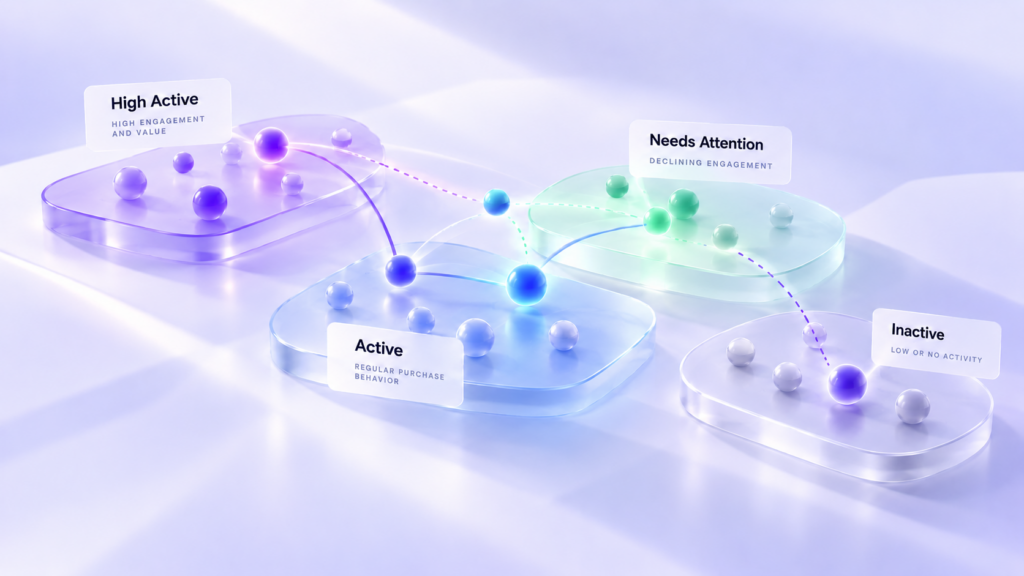
A customer who has consistently purchased from a company for several years may gradually reduce their activity without immediately losing their status as a high-value customer. At the same time, another customer who previously made only occasional purchases may begin exploring new product categories, increasing order frequency and developing a more valuable relationship with the business.
When CRM strategies continue to rely on the original classification of these customers, commercial decisions risk being based on a picture of customer behavior that no longer reflects what is happening.
Customer segmentation helps organizations manage this complexity by grouping customers according to shared characteristics and purchasing patterns. However, its effectiveness depends on how accurately those groups represent customer relationships as they evolve, particularly when segmentation influences retention initiatives, marketing investments and the allocation of sales resources.
Customer segment migration adds an important dimension to this analysis by examining how customers move between behavioral groups over time and what those changes may mean for business decisions.
Rather than treating segmentation as a classification exercise performed periodically, organizations can use a more dynamic perspective to evaluate whether customer relationships are improving, deteriorating or remaining stable, while identifying the changes that deserve further investigation.
Why Customer Segments Change Over Time
Customer segmentation organizes individuals into groups based on shared characteristics, including purchasing activity, spending patterns, engagement levels and estimated customer value. These classifications provide a practical foundation for CRM strategies because they allow organizations to identify meaningful differences across a customer base and develop approaches suited to different types of relationships.
The challenge is that customer behavior continues to evolve after a segment has been assigned, while the commercial decisions associated with that classification may remain unchanged.
Purchasing frequency can decline as needs evolve, engagement may increase following the adoption of a new product, and customers who once purchased occasionally may become more active as their relationship with the company develops. Similarly, a historically valuable customer may begin reducing their spending gradually, without immediately displaying an obvious signal of disengagement.
A segment therefore represents a customer relationship at a particular moment, using the information available within a defined observation period. As new transactions and interactions accumulate, that classification may become less representative of the customer’s current behavior, especially when the organization does not review the underlying data frequently enough.
This can have practical consequences when segmentation informs marketing budgets, retention priorities or sales coverage. A customer whose purchasing activity has declined for several months may continue receiving attention based on their previous classification, while a developing relationship may remain underprioritized because the customer’s historical segment has not yet changed.
Dynamic customer segmentation addresses this challenge by introducing time into the interpretation of customer relationships, allowing organizations to consider not only which group a customer belongs to, but also whether their behavior is changing in a commercially relevant direction.
Understanding Customer Segment Migration
Customer segment migration refers to the movement of customers between defined behavioral groups across successive observation periods, providing information about how the composition and characteristics of a customer base evolve.
One common approach to segmentation uses recency, frequency and monetary value, known as RFM analysis, to distinguish different patterns of purchasing behavior. Although these indicators offer a useful way to describe customer relationships, they do not automatically explain why behavior changes or establish which developments are likely to occur in the future.
A 2026 study by Yuto Fukui and Tomoaki Tabata, published in the Journal of Marketing Analytics, explores this challenge through an absorbing Markov chain framework designed to analyze transitions between RFM-based customer segments.
The researchers examine six states: High Active, Active, Needs Attention, Low Active, Inactive and Churn. The first five represent behavioral conditions through which customers may move, while Churn is treated as an absorbing state within the model, meaning that once a customer reaches that state, the framework does not model a subsequent return. This is a methodological assumption rather than a claim that customers who stop purchasing can never become active again.
By analyzing movement between these states, the study provides a way to examine customer behavior over time, including transition probabilities and the expected number of periods before reaching the modeled churn condition.
Three analytical perspectives are particularly relevant for businesses seeking to understand customer segment migration.
Observed transitions
An observed transition occurs when a customer’s classification changes between two measurement periods, revealing a difference in the purchasing behavior represented by the segmentation.
For example, a customer moving from Active to Needs Attention after reducing their purchase frequency may warrant closer evaluation, particularly if the change continues across multiple periods. However, the transition itself does not explain why the relationship has changed or establish whether further deterioration is likely.
Its immediate value is descriptive, providing CRM teams with evidence that a customer’s recent behavior differs from the previous observation and may require additional analysis.
Transition probabilities
Historical movement between segments can also support estimates of how likely customers are to move from one behavioral state to another, allowing organizations to examine possible future changes in the composition of their customer base.
These probabilities depend on the assumptions of the model and the patterns observed in the available data, which means they should not be interpreted as deterministic predictions about the behavior of individual customers.
A transition model estimating how customer groups may evolve answers a different question from an individual predictive model estimating whether a specific customer is likely to purchase again or disengage within a defined period.
Expected time before churn
The absorbing Markov framework used in the research also estimates the expected number of periods before customers beginning in different behavioral states reach the modeled Churn condition, together with the expected number of visits to other states along the way. These estimates can help organizations understand the structure of customer movement and identify differences between groups, although they do not establish an exact deadline for intervention or imply that every customer will follow the same sequence of transitions.
For CRM leaders, distinguishing observed changes, estimated segment transitions and individual customer predictions is important because each provides a different type of information, with different implications for commercial planning.
Which Customer Segment Changes Deserve Attention?
Not every movement between segments signals a problem or requires an immediate commercial response, particularly when purchasing behavior is influenced by seasonality, product cycles or the frequency with which customers normally interact with a business.
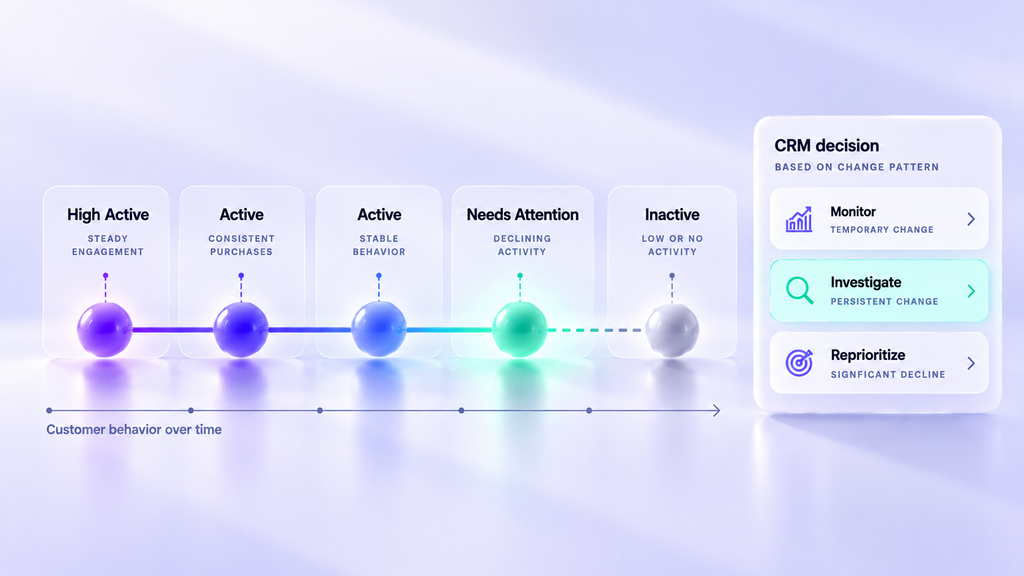
A temporary reduction in activity may simply reflect a longer purchasing interval, while a persistent decline across several periods could indicate a more significant change in the relationship. Understanding that difference requires examining the direction of customer movement, how long the change persists and whether it is relevant to a business decision.
A customer moving from High Active to Active presents a different situation from one progressing from Needs Attention to Inactive, even though both transitions indicate a reduction in purchasing activity. The commercial significance depends on the customer’s previous behavior, expected purchasing cycle, economic importance and the evidence available about what may be driving the change.
Persistence also matters because a single transition may represent ordinary variation, whereas repeated movement toward lower activity can provide stronger reasons to investigate potential disengagement.
The research by Fukui and Tabata illustrates the importance of interpreting inactivity within a defined business context. In their retail dataset, churn was defined as four consecutive quarters without purchases, following an examination of how return behavior changed as inactivity continued. That definition reflects the purchasing patterns and analytical choices of the study rather than a universal threshold. Subscription companies may define churn through cancellations, while businesses operating without formal contracts may need to establish inactivity thresholds using historical purchasing intervals and customer behavior.
For marketing and CRM leaders, the objective is therefore to distinguish movements that represent ordinary fluctuations from those that could affect retention, customer development or the allocation of commercial attention.
A sustained decline in activity may justify investigating potential churn risk, while improving purchasing patterns could indicate an opportunity to reassess an account’s growth potential. In either case, segment migration provides a reason to revisit the relationship rather than an automatic instruction to launch a campaign or modify the customer’s treatment.
Customer Segment Migration Can Differ Across Channels
Customer behavior also develops within different purchasing environments, which means that patterns of segment migration may vary depending on how customers interact with a business.
Fukui and Tabata examined transaction data from a retailer operating physical stores and an ecommerce channel, comparing customers initially classified as online-only, offline-only and multichannel.
For customers beginning in the High Active state during the first analysis period, the model estimated an expected time before the modeled Churn state of 10.6 quarters for online-only customers, 15.3 quarters for offline-only customers and 33.8 quarters for multichannel customers.
These estimates are specific to the groups, period and assumptions examined in the study, and they should not be interpreted as guaranteed customer lifetimes or evidence that purchasing through multiple channels directly causes stronger retention. Nevertheless, the differences illustrate why customer migration patterns should be interpreted within their purchasing context, rather than assuming that similar behavioral classifications necessarily imply similar future developments.
A customer who initially purchases through one channel may later adopt additional purchasing channels, while changes in product availability, service preferences or customer needs can also influence how the relationship evolves.
For organizations operating across physical and digital environments, this creates an additional consideration when evaluating CRM priorities: changes in segment membership may need to be examined alongside changes in channel usage, rather than treating channel classifications as permanent characteristics of the customer. The broader implication is that dynamic segmentation becomes more informative when it reflects how customers interact with the business, including the commercial environment in which their behavior develops.
Connecting Dynamic Segmentation with CRM Decisions
Making segment migration useful in CRM requires more than identifying which customers have moved between behavioral groups. Organizations need to understand the changes behind those movements, assess whether they represent temporary fluctuations or more persistent developments, and determine which situations justify additional commercial attention.
Because CRM teams operate with limited budgets and capacity, the objective is to prioritize changes that could influence customer retention, account development or engagement decisions rather than respond automatically to every change in classification.
Consider a group of previously active customers whose purchasing frequency has declined consistently over several observation periods. Applying the same retention incentive to every customer would assume that the causes of disengagement and the appropriate response are similar across the group, even though the underlying relationships may differ substantially.
A more informed approach would begin by examining whether the decline reflects shared purchasing patterns, changes in customer needs or other developments that warrant investigation. The organization could then consider the economic value of the relationships involved, the likelihood of future purchasing activity and the actions available to address the situation.
Predictive models can complement this process by estimating individual outcomes, including purchase propensity and churn risk, while segment migration provides context about how behavioral groups are evolving across the customer portfolio.
These approaches should not be treated as interchangeable. Segment transition analysis helps organizations understand movement between defined customer states, while individual predictive models use relevant data to estimate the probability of a particular future outcome.
Neither approach independently demonstrates that a commercial intervention will generate incremental value, since determining whether a retention offer, service adjustment or sales initiative will change customer behavior may require additional evidence, experimentation or causal analysis.
For business leaders, the value comes from combining a more current understanding of customer behavior with clearly defined commercial objectives, so that decisions about resource allocation and customer engagement reflect the information most relevant to the situation.
Keeping Dynamic Segmentation Relevant Over Time
Observing customer movement over time requires a consistent analytical framework, particularly when organizations need to distinguish genuine behavioral changes from fluctuations introduced by the segmentation process itself.
One consideration is the frequency of observation, which should reflect the normal rhythm of customer purchasing behavior and the decisions that depend on it. Monthly or quarterly reviews may be appropriate in different business environments, while updating classifications too frequently can amplify temporary variation and reviewing them too slowly can delay recognition of meaningful changes.
The stability of segment definitions is equally important because changes in classification rules or segment boundaries can create apparent migrations that do not necessarily correspond to changes in customer behavior.
A second 2026 study, Monitoring of Customer Segment Dynamics Using Clustering and Event-Based Alerts, examines continuous monitoring of customer segments and methods for identifying meaningful structural changes while reducing alerts triggered by temporary fluctuations.
The research reinforces a practical principle: increasing the frequency of segmentation analysis creates value only when organizations can distinguish persistent developments from analytical noise.
Useful indicators may include the rate of movement between important segments, the persistence of customers within particular groups, repeated transitions toward higher or lower activity, and changes in patterns of inactivity or reactivation. Organizations should also periodically reassess whether their segmentation framework continues to capture commercially meaningful differences, particularly as products, purchasing habits and customer relationships evolve.
When individual predictive models are used alongside segmentation, their performance should be evaluated separately, because the stability of a segmentation framework and the predictive accuracy of a churn or propensity model represent different analytical questions.
Dynamic Segmentation and Predictive Customer Intelligence
Customer segmentation and individual predictive models offer complementary perspectives on the same customer base, allowing organizations to examine both how customer groups evolve and what future outcomes may be relevant to specific relationships.
Clustering can help identify groups with similar characteristics or behaviors, while predictive models focused on individual outcomes can estimate probabilities associated with future purchases, churn or other commercially relevant events.
Within Elai’s approach to predictive customer intelligence, organizations can develop and maintain predictive models using relevant business data, including models designed to estimate purchase propensity, churn risk and other customer outcomes.
These predictions can complement segmentation analysis by providing forward-looking information that helps CRM teams evaluate customer opportunities and prioritize commercial resources, without treating the observation of segment migration and the prediction of individual outcomes as the same analytical process.
The distinction matters because a change in segment membership does not automatically establish that a customer will leave or expand their relationship, just as an individual churn probability does not explain every development occurring across a customer portfolio.
Using each analytical approach for the question it is designed to answer helps organizations develop a more complete understanding of customer behavior while maintaining a clear connection between predictive information and business decisions.
Customer Segmentation as a Continuous Business Capability
Customer segmentation provides a practical structure for understanding differences across a customer base, but its effectiveness depends on whether those classifications continue to reflect how relationships evolve.
A highly active customer may gradually reduce purchasing frequency, while a relationship previously considered less valuable may begin showing stronger engagement and new commercial potential. When those developments are not reflected in CRM analysis, organizations risk maintaining priorities that no longer correspond to current customer behavior.
Monitoring customer segment migration can help businesses recognize these changes, evaluate whether they represent meaningful developments and reconsider customer engagement, retention or development strategies when the available evidence supports a different approach.
The objective is not to react to every movement or treat every transition as an early indication of churn, but to maintain a more current understanding of customer relationships and use that information to support decisions about attention, investment and commercial priorities.
Customer segmentation creates greater business value when it evolves alongside the customers it is intended to represent, helping organizations understand not only where relationships stand today, but also when changing behavior requires a different decision.