

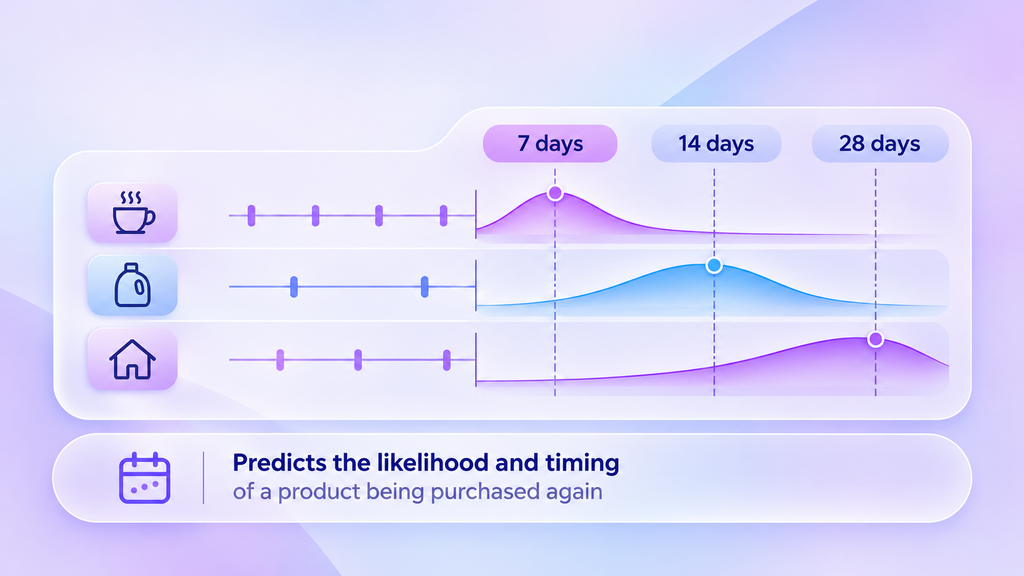
A customer may purchase coffee every week, laundry detergent every few weeks, and household supplies at considerably less predictable intervals. Although these products all appear in the same purchase history, recommending them at the same moment may not be equally relevant, particularly when individual consumption habits and purchasing quantities influence how frequently each item needs to be replenished.
For online retailers, historical transactions provide valuable evidence of customer preferences, but they do not necessarily reveal when another purchase is likely to occur. A recommendation can correctly identify a familiar product while reaching the customer too early in the replenishment cycle, when there is little immediate reason to buy it again, or after the customer has already purchased it elsewhere.
Repurchase prediction estimates the likelihood that a customer will buy a previously purchased product again within a defined future period. Timing-aware approaches extend this analysis by modeling the time until the next purchase, allowing retailers to evaluate repurchase probabilities across different recommendation horizons.
Research presented at RecTemp 2026, a workshop associated with ACM RecSys, examines how survival analysis can support these predictions, revealing important trade-offs between recommendation ranking, probability calibration, and model efficiency.
Why Purchase History Alone Cannot Determine Repurchase Timing
Traditional recommendation systems frequently rely on historical transactions to identify products that customers may want to purchase again. While repeated purchases provide strong evidence of established preferences, they offer less certainty about whether a particular product is relevant to the customer’s immediate shopping needs.
Consider two customers who regularly purchase laundry detergent. One might buy smaller quantities every week, while another purchases several units at once and returns after a month, creating different replenishment patterns despite their shared interest in the same product.
These differences become more complex when customers alternate between shopping channels, change purchasing frequency, or buy certain products outside the retailer’s observable data. A recommendation strategy based exclusively on average purchase frequency may therefore overlook important variations in purchasing behavior.
For retailers, the challenge is identifying which previously purchased products are likely to become relevant within an upcoming shopping period, using purchasing intervals, recency, and other behavioral signals to estimate when demand may reappear.
How Survival Analysis Supports Repurchase Prediction
Conventional repurchase prediction can be approached as a binary classification problem, where a model estimates whether a customer will purchase a particular product again within seven, fourteen, or thirty days. Although effective for predefined periods, this approach may require separate classifiers for each prediction horizon, increasing development and maintenance requirements.
Survival analysis offers an alternative by estimating the time until a specified event occurs. Originally developed for time-to-event applications in medicine and reliability engineering, these methods can also describe the intervals between purchases, allowing a single model to estimate cumulative repurchase probabilities across multiple future periods.
An important advantage is the ability to account for right-censored observations, which occur when the event being studied has not been observed before the available observation period ends.
If a retailer analyzes thirty days of transactions, some customers will repurchase a product during that period while others will not. For the second group, the data establishes that no purchase occurred within the observed window, but it cannot determine whether another transaction will occur later.
Rather than treating these incomplete histories as definitive negative outcomes, survival models incorporate the available information into their estimates, which is particularly useful when products have substantially different replenishment cycles.
What the RecTemp 2026 Research Reveals
The study Timing-Aware Repurchase Prediction for Web-Scale E-Commerce: Survival Models for Multi-Surface Grocery Recommendation, by Akshay Kekuda and colleagues, examines repurchase prediction using transactional data involving millions of customers and tens of millions of customer-product pairs from a major grocery e-commerce platform.
Published in August 2026 and presented at the RecTemp workshop in September, the research compares conventional binary classifiers with survival-based approaches, including Accelerated Failure Time (AFT) models.
The experiments use a thirty-day observation period, with the principal ranking evaluation covering seven-, fourteen-, and twenty-eight-day horizons.
Predictive performance and model efficiency
One of the study’s main findings concerns model efficiency, as a single AFT model matched or exceeded the ranking performance of separately trained binary classifiers across the evaluated horizons while using approximately three times fewer decision trees.
In the reported comparison, three conventional classifiers contained approximately 2,400 trees in total, whereas the survival-based approach achieved competitive or stronger results with a substantially smaller ensemble.
This suggests that modeling repurchase timing can simplify predictive architectures, although fewer decision trees do not necessarily translate into proportional reductions in infrastructure expenses or serving latency.
The researchers also found that signals associated with recent purchasing behavior, shopping-channel cadence, and customer activity became more influential under the survival-modeling objective, while some aggregate purchase-frequency measures became less prominent.
Another noteworthy result concerns the relationship between elapsed time and repurchase likelihood. Although it may seem intuitive that customers become increasingly likely to replenish a product as time passes, the researchers observed a slightly decreasing marginal repurchase hazard across the population examined.
This aggregate pattern can partly reflect differences between products and purchasing routines, since frequently replenished items may be purchased relatively early, leaving a greater proportion of customer-product combinations associated with longer purchase intervals.
The result does not establish that every individual product becomes less likely to be repurchased over time, but it demonstrates why retailers should evaluate purchasing patterns empirically rather than assume that all replenishment cycles follow the same behavior.
Ranking Accuracy and Probability Calibration
Repurchase recommendation systems may serve different purposes, and the RecTemp research highlights why model selection should reflect the decisions those predictions are expected to support.
For a retailer displaying a replenishment carousel, ranking performance may be the primary requirement, since the system needs to identify which products deserve the highest positions. Other applications, particularly CRM decisions involving probability thresholds, may require numerical estimates that reliably describe the likelihood of future purchases.
This second requirement concerns probability calibration, which evaluates whether predicted probabilities correspond reasonably closely to observed event frequencies.
The researchers found that Log-Normal AFT models achieved particularly strong ranking performance, while an Exponential AFT specification produced substantially better calibration following the study’s calibration procedure.
At the fourteen-day horizon, the Exponential model recorded an expected calibration error of approximately 0.00013, compared with 0.00075 for the Log-Normal model, demonstrating a considerable difference in probability reliability despite relatively similar ranking performance.
The study also identifies an architectural limitation: the single-output AFT models examined preserve the same relative product ranking across different horizons, even when the estimated cumulative probabilities change. Applications requiring different product orderings for short- and long-term recommendations may therefore need another modeling approach.
The broader methodological distinction between ranking performance and probability reliability is discussed in this article on probability calibration in machine learning.
What Repurchase Timing Means for Retail Recommendations
Timing-aware repurchase prediction could support more relevant recommendations in replenishment-driven retail categories, particularly where historical transactions already contribute to personalized shopping experiences.
An online grocery retailer, for example, could incorporate estimated repurchase probabilities when selecting products for a replenishment section, considering both established preferences and the expected timing of another purchase rather than relying exclusively on transaction frequency.
The same information could inform personalized CRM communications, helping retailers evaluate whether a previously purchased product is likely to become relevant within an upcoming shopping period, subject to customer preferences and communication consent.
However, predicting that a customer is likely to repurchase a product does not establish that sending a recommendation will generate an additional transaction. Some customers may already intend to purchase without any intervention, while others may respond positively to appropriately timed communications.
Determining whether timing-aware recommendations create incremental commercial value therefore requires separate evaluation, ideally through controlled experiments comparing the proposed strategy with an existing approach.
Product availability, profitability, customer experience, and communication frequency also influence these decisions, making repurchase timing one component of a broader recommendation strategy.
Evaluating Repurchase Models Before Deployment
Organizations considering timing-aware recommendation models should define their prediction target precisely, since estimating whether a customer will repurchase a specific product differs from forecasting their next shopping visit or predicting the contents of their next basket.
Historical validation must preserve the chronology of transactions, ensuring that models use only information available before the relevant prediction date, while accounting appropriately for censored observations.
Evaluation should distinguish ranking performance from probability calibration and examine whether results remain reliable across customer segments, product categories, and purchasing frequencies.
The RecTemp study provides evidence from one proprietary grocery e-commerce environment, with limitations concerning generalization to other retailers, long purchasing cycles, and dependencies between products purchased together. Its findings therefore require further validation before being applied to substantially different retail contexts.
For retailers, survival-based repurchase prediction offers a promising way to incorporate purchasing intervals into recommendation systems, potentially improving how products are prioritized across different future periods.
Its commercial value ultimately depends on the reliability of those predictions and on whether the resulting recommendations produce measurable incremental benefits for customers and businesses.