
Introduction
AI agents are among the most significant innovations in modern supply chain management. These intelligent systems can make independent decisions, analyzing complex data in real time to optimize key processes such as inventory management, logistics planning, and cost control.
Digital transformation is essential to enable this shift. Leveraging advanced technologies not only drives innovation in logistics but also enhances the ability to respond quickly to market changes and customer demands. Without a robust digital infrastructure, AI agents cannot fully realize their decision-making potential.
The true value of AI agents lies in their ability to:
- Make autonomous decisions based on accurate, up-to-date data,
- Reduce operational costs by eliminating waste and inefficiencies,
- Manage inventory flexibly to maintain high service levels,
- Redesign business processes by leveraging new technological opportunities.
These factors represent a new mindset in supply chain management, where intelligent automation and innovation come together to create tangible and lasting competitive advantages.
How AI Agents Make Autonomous Decisions in the Supply Chain
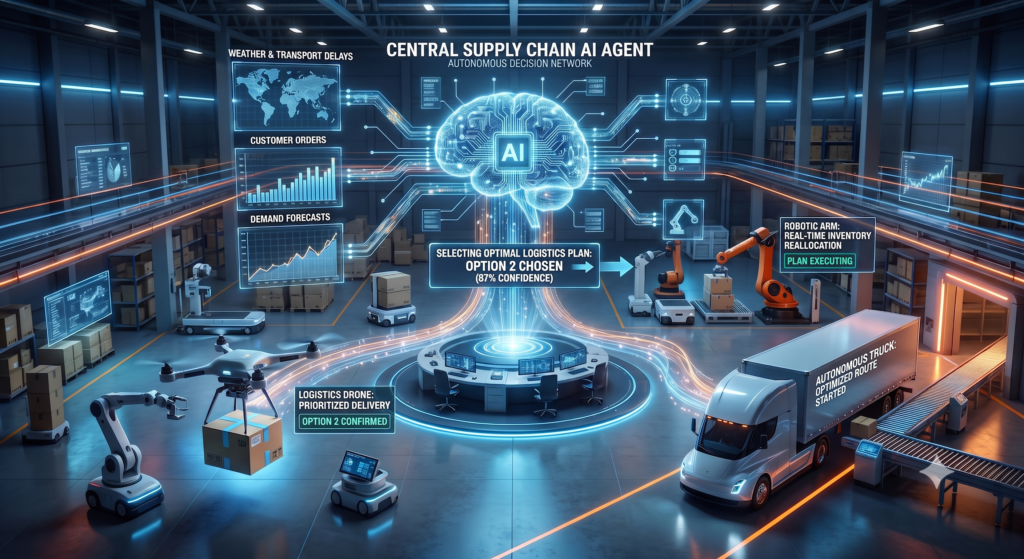
AI agents rely on advanced algorithms and machine learning models to make autonomous decisions, leveraging real-time data collected from various sources within the supply chain. These systems continuously analyze variables such as orders, inventory levels, delivery times, and market conditions to optimize operations without the need for direct human intervention.
Real-Time Data-Driven Decisions
The key factor enabling AI agents to act independently is access to accurate and up-to-date data. IoT sensors, ERP systems, warehouse management platforms, and external data like weather forecasts or demand trends are integrated and analyzed in real time. The AI agent evaluates this information to:
- Forecast changes in demand
- Identify logistical bottlenecks
- Automatically adjust inventory levels
- Plan more efficient transportation routes
This immediate decision-making capability allows for quick responses to unexpected events or market fluctuations, reducing delays and associated costs.
Cost Optimization through Predictive Analytics and Automation
AI agents enhance economic efficiency by:
- Predictive analytics: anticipate future demand by analyzing historical data and external signals, enabling targeted purchasing and preventing unnecessary stockpiling.
- Process automation: automatically manage restocking orders, adjusting quantities and timing based on forecasts, thus eliminating human errors and delays.
For example, a company distributing perishable goods can use an AI agent to balance the risk between understocking (which leads to stockouts) and overstocking (which causes waste). The system can independently decide when to order raw materials or finished products, keeping costs under control without compromising availability.
The Role of AI Agents in Inventory Management
Inventory management is an area where AI agents have a significant impact. They:
- Monitor warehouse stock levels in real time
- Calculate optimal quantities to order or transfer between different locations
- Dynamically adjust inventory strategies based on seasonality or unexpected events
This approach reduces waste related to obsolete inventory or surpluses, while at the same time ensuring high service levels to promptly meet customer needs. In industries with high logistical complexity, such as electronics or pharmaceuticals, these systems translate into tangible competitive advantages.
AI agents are transforming the supply chain, making it more agile, efficient, and sustainable. The ability to make autonomous decisions regarding costs, inventory, and service levels in real time relies heavily on the quality of available data and the intelligence built into the models used. This new paradigm requires an integrated approach that combines technology, business processes, and human expertise.
Key Requirements for Unlocking the Potential of AI Agents
The effectiveness of AI agents in the supply chain is critically dependent on the quality of data they are based on. Without reliable and up-to-date data, autonomous decisions risk being inaccurate or misleading.
Reliable Data: The Essential Foundation
- AI agents can analyze numbers, trends, and patterns only if the data is complete and accurate.
- Data errors can lead to incorrect forecasts, overstocking or stockouts, and logistical inefficiencies.
- For instance, inaccurate information about warehouse inventory can cause delivery delays or resource waste.
Data integration: A complex but essential challenge
- Data comes from various sources: ERP systems, warehouse management systems (WMS), transportation platforms, and external suppliers.
- Each system uses different formats and update schedules, making seamless integration difficult.
- Without proper integration, AI agents work with fragmented information, limiting their ability to make effective decisions.
- Middleware tools and data integration platforms are crucial for harmonizing information flows.
Rethinking business processes to maximize impact
- The introduction of AI agents requires a thorough review of traditional processes.
- Automating decisions means redefining responsibilities and operational workflows.
- Internal procedures must be adapted to allow the AI system to operate without bureaucratic or technical obstacles.
- A concrete example is dynamic inventory management: a rigid process prevents the AI agent from optimizing stock levels in real time.
“The true value of an AI agent emerges only when the entire operational chain is ready to embrace change.”
Investing in data quality improvement, seamless integration between different systems, and business process redesign is essential to fully unlock the potential of AI agents within the supply chain.
Tangible Benefits of Implementing AI Agents in the Supply Chain
The integration of AI agents into the supply chain leads to concrete, measurable advantages that directly impact operational efficiency, costs, and customer service quality.
Increased Operational Efficiency
AI agents process data in real time, enabling fast and accurate decision-making. This results in:
- Faster response times: Agents can quickly identify issues or opportunities, enabling prompt interventions without delays.
- Smart automation: Processes such as automatic reordering or dynamic route management become smoother and less prone to human error.
- Continuous adaptability: With machine learning, operational strategies are constantly refined in response to market and demand changes.
Significant cost reduction
The main financial savings come from the AI agents’ ability to:
- Efficiently manage inventory: Reducing excess stock that leads to storage costs and product obsolescence.
- Minimize logistical waste: Optimizing transport routes and improving delivery planning to cut fuel and labor expenses.
- Prevent disruptions: By anticipating supply chain issues, they help avoid delays and penalties related to missed deliveries or production stoppages.
Enhanced customer service
AI agents help raise service quality by offering:
- More reliable service levels: thanks to the ability to anticipate demand fluctuations and quickly adjust resources.
- Personalized offerings: by analyzing behavioral data, agents can suggest tailored solutions for specific needs.
- Greater transparency: up-to-date information on order status is shared with customers in real time, increasing trust and satisfaction.
Practical example: A large manufacturing company implemented AI agents to monitor inventory and optimize logistics flow. Within a few months, they saw a 20% reduction in warehouse costs and a 15% improvement in delivery times, directly impacting customer satisfaction.
These benefits show that adopting AI agents is not just a technological matter, but a strategic lever capable of profoundly transforming the supply chain—making it more agile, cost-effective, and customer-focused.
Challenges and Considerations for Adopting AI Agents in the Supply Chain
Introducing AI agents into the supply chain isn’t only about technology; it requires a significant organizational change. Companies must undergo a cultural transformation that affects several areas:
1. Resistance to change
Teams accustomed to traditional processes may be wary of autonomous systems. It is essential to clearly communicate the benefits of AI agents and emphasize their role as support tools, not replacements.
2. Redefining Roles
The automation of operational decisions requires a reassessment of staff responsibilities. Some tasks may become obsolete, while new skills related to monitoring and supervising AI technologies will emerge.
3. Cross-Functional Collaboration
To fully leverage the potential of AI agents, synergy between IT, logistics, sales, and other departments is necessary. This encourages an integrated perspective and smoother processes.
Staff training is a crucial element to ensure effective interaction with autonomous systems. Key aspects include:
- Digital skills: Train staff to use AI platforms, understand real-time dashboards, and interpret the data generated.
- Exception management: Despite automation, some situations still require human intervention. Training should therefore include the ability to respond promptly when AI agents flag anomalies or complex issues.
- Collaborative mindset: Encourage a proactive approach that views the AI agent as an allied tool to enhance daily performance.
Some companies have implemented ongoing training programs with hands-on workshops and simulations, resulting in greater employee engagement and fewer operational errors.
Addressing these organizational challenges and investing in training is essential for effectively integrating advanced AI agents into the supply chain. Overlooking these aspects risks undermining the expected benefits of technological adoption and slowing progress toward smarter, more responsive logistics management.
Conclusion
The evolution of AI agents is shaping the future of the supply chain by enabling real-time autonomous decision-making. These intelligent systems are radically transforming logistics management, optimizing costs, inventory, and service levels with a speed and accuracy that would have been unimaginable just a few years ago.
AI Agents in the Supply Chain:
- Make decisions based on reliable, up-to-date data.
- Automate complex processes to minimize waste and inefficiencies.
- Enhance responsiveness to fluctuations in supply and demand.
- Enable a higher level of service personalization, boosting customer satisfaction.
Logistics digitalization isn’t just a technological upgrade—it’s a profound transformation that demands a complete redesign of business processes. Without this structural overhaul, the potential of AI agents risks remaining untapped or underutilized.
“The key to fully leveraging the evolution of AI agents in the supply chain lies in the synergistic integration of accurate data, advanced digital infrastructure, and reimagined business processes.”
To fully embrace this digital revolution, a continuous commitment to digital transformation is essential—one that involves not just technology, but also people and organizational structures. Only in this way can an agile, resilient supply chain be built, capable of competing in increasingly dynamic markets.
The future of the supply chain will be shaped by companies’ ability to strategically adopt these innovations, leveraging them to enhance operational efficiency and deliver greater value to customers. Consider this transformation as an essential opportunity to keep pace with the times and lead change in the world of smart logistics.
Frequently Asked Questions
What are AI agents and what role do they play in the modern supply chain?
AI agents are intelligent systems capable of making autonomous decisions based on real-time data. In today’s supply chain, they play a crucial role in optimizing costs, inventory management, and service levels—transforming logistics processes through digital innovation.
How do AI agents optimize costs and inventory management within the supply chain?
AI agents analyze up-to-date data to make autonomous decisions that enhance operational efficiency. Through predictive analytics and automation, they help reduce waste and costs associated with inventory and logistics processes, while ensuring high and personalized service levels.
What tangible benefits can be achieved by implementing AI agents in the supply chain?
The adoption of AI agents leads to a significant increase in operational efficiency thanks to rapid, real-time data-driven decisions. There is also a noticeable reduction in costs related to logistical inefficiencies and excess inventory, along with improved customer satisfaction through more reliable services.
How is the role of AI agents expected to evolve in the future digitalization of the supply chain?
The future of the supply chain will see AI agents continuously evolving, with increasingly sophisticated capabilities for autonomous decision-making. The digital transformation of logistics will be driven by the redesign of business processes, making the integration of artificial intelligence essential for maintaining competitiveness and fostering innovation.