
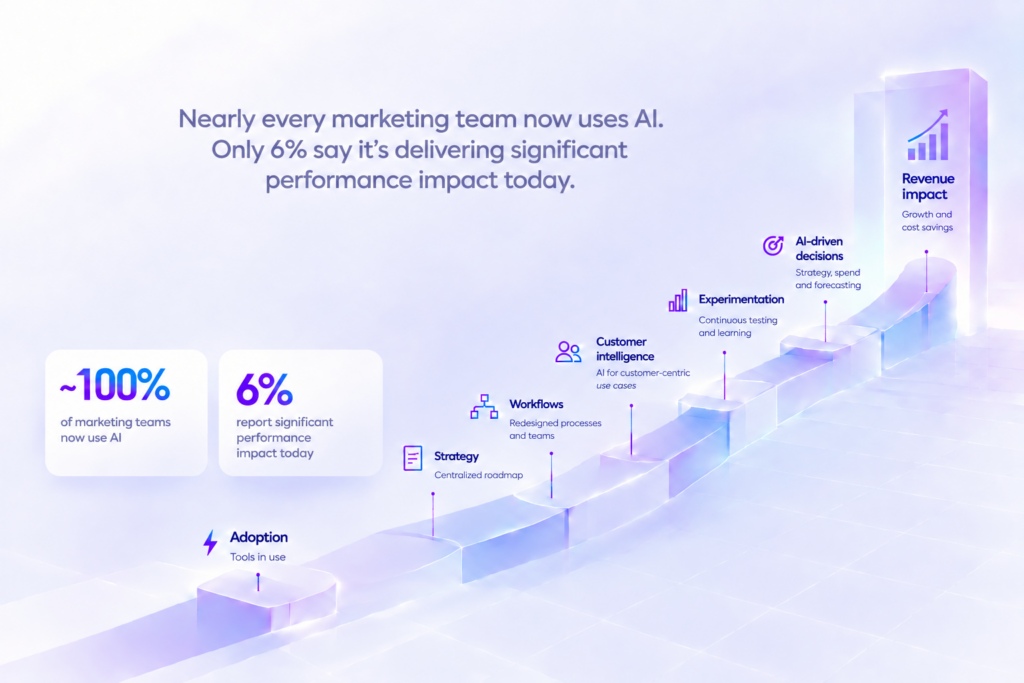
AI adoption in marketing is rapidly becoming universal, yet the ability to translate that adoption into measurable business impact remains far less widespread, creating a growing divide between organizations that simply use AI and those that have learned how to integrate it into the way marketing decisions are made.
New research from Bain & Company highlights the scale of this gap, showing that nearly every marketing team now uses AI and that even lower performing organizations are catching up in areas such as media buying and content creation, while only 6% of marketing organizations say AI is delivering significant performance impact today.
This difference is becoming increasingly difficult to explain through technology alone because marketing leaders and laggards generally have access to similar underlying AI models, which means the competitive distinction increasingly depends on how AI is integrated into strategy, workflows and customer decisions rather than simply whether the technology is available.
Bain’s 2026 study of 1,397 CMOs, CFOs and senior marketing and finance executives suggests that the most advanced organizations are moving beyond the use of AI as a productivity tool and are beginning to treat it as an operating capability that can influence decisions, improve execution and contribute to greater revenue and cost impact.
AI Adoption Is No Longer a Competitive Advantage
As AI becomes embedded across marketing functions, the adoption gap between leading organizations and the rest of the market is narrowing quickly, which means that simply having access to AI capabilities is becoming less effective as a source of differentiation.
Bain found that 47% of marketing leaders and 30% of laggards now describe AI as a core capability, compared with 35% and just 8%, respectively, one year earlier, demonstrating how rapidly AI is becoming part of mainstream marketing operations even among organizations that have historically been slower to adopt it.
However, this convergence in adoption has not produced the same convergence in performance, since only 6% of marketing organizations report significant performance impact from AI today, while marketing leaders are twice as likely as laggards to attribute double digit revenue growth or cost savings to AI initiatives.
For executives, this distinction challenges the assumption that increasingly sophisticated AI tools will naturally translate into stronger performance, because as access to these technologies becomes more widespread, the differentiator shifts from having AI capabilities to building an organization that knows where to apply them, how to scale them and how to connect them to measurable business value.
AI Strategy Starts at the Operating Model
Leading organizations distinguish themselves not simply through higher levels of AI adoption, but through the way they centralize AI strategy, redesign workflows and teams around new capabilities, and prioritize applications that are closely connected to customer needs and commercial outcomes.
Marketing leaders are 1.8 times more likely to follow a centralized AI roadmap with priorities defined from the top, while laggards are ten times more likely to operate without a defined marketing AI strategy, indicating that stronger performance is associated with a clearer understanding of where AI should be deployed and what business outcomes it is expected to support.
The organizational differences extend well beyond strategic planning, because leaders are also 3.7 times more likely to fundamentally redesign workflows rather than simply inserting AI tools into existing processes, while they are twice as likely to restructure teams and job descriptions around AI capabilities.
This changes the meaning of AI transformation because using AI to execute an existing activity more quickly can certainly improve productivity, but redesigning the workflow itself determines whether those improvements remain isolated or become part of a broader operating model that can scale across the organization.
The strategic question therefore becomes less about which tool employees should use for a specific task and more about which processes should exist in an AI enabled operating model, how those processes should interact and where human expertise and AI capabilities can create the greatest combined value.
Customer Intelligence Is Where AI Starts to Affect Growth
Another major distinction between leaders and laggards lies in where AI is being deployed, since the most advanced organizations are increasingly directing the technology toward customer understanding and commercial decision making rather than concentrating primarily on routine automation.
Bain finds that leaders are 5.2 times more likely to focus on customer centric AI use cases and 1.5 times more likely to use AI to improve personalization and customer experiences, bringing the technology closer to the decisions that influence demand, product development and growth.
Nestlé provides one example of this approach through a proprietary AI platform designed to deepen consumer insight and accelerate concept testing, allowing employees to analyze market trends and social signals, generate and refine product concepts, and simulate consumer responses within a more integrated process.
According to Bain, this approach reduced product development cycles from six months to six weeks, while generating nearly three times the ROI through a combination of cost savings and top line growth, showing that the potential value of AI extends beyond faster execution when customer information is incorporated directly into what the organization develops, tests and ultimately brings to market.
The broader lesson is therefore not simply that AI can increase speed, but that it becomes more strategically valuable when customer intelligence can move directly into experimentation, product development and commercial decisions.
The Next AI Advantage Is a Faster Decision Cycle
Perhaps the clearest difference between marketing leaders and laggards emerges when AI begins to influence decisions rather than simply produce outputs, because the most advanced organizations use experimentation and performance data to create a continuous feedback loop between what they learn and what they decide to do next.
Bain reports that marketing leaders are 8.5 times more likely to conduct 100 or more experiments per month, creating a much larger volume of performance signals that can be analyzed and incorporated into future marketing decisions.
This experimentation matters because leading organizations do not simply collect the resulting data, but use those insights to modify strategy and resource allocation, with nearly 70% of leaders regularly or extensively changing marketing strategy and spending based on AI insights, compared with only 31% of laggards.
The same pattern extends into more analytical applications, as leaders are twice as likely to use AI for demand forecasting and revenue modeling, while they are three times more likely to continuously reallocate marketing spending across channels using insights generated through AI.
This represents an important evolution in AI marketing strategy because content generation and automation primarily increase organizational capacity, while forecasting, experimentation and AI based insights can influence which action the organization takes next and how quickly it responds to changing performance signals.
For business leaders, this is where AI begins to move beyond productivity infrastructure and increasingly becomes part of the decision infrastructure through which marketing resources are allocated, customer opportunities are evaluated and commercial priorities are adjusted.
From AI Insights to Action
More advanced implementations extend this principle beyond marketing decisions and into operational processes, creating systems in which data, prediction and execution become more closely connected.
Bain highlights Walmart’s use of more than 1,700 digital twins, which are photorealistic virtual representations of stores built using Nvidia Omniverse and used to test traffic flows and planogram resets before changes are implemented in physical locations.
Within this environment, AI agents help predict customer behavior and identify potential traffic bottlenecks before rollout, while Bain reports that the digital twin technology has enabled 10% faster resets, generating time and cost savings across Walmart’s store network.
The example illustrates a broader progression in enterprise AI, where systems are increasingly capable not only of generating information but also of analyzing possible outcomes, supporting decisions and, in more advanced applications, contributing directly to operational action.
The value therefore lies not simply in greater automation, but in creating a tighter connection between data, prediction, experimentation and execution, so that insights can move more efficiently from analysis into business processes.
AI ROI Depends on Transformation, Not Tool Adoption
The implications for the C suite are becoming increasingly clear as AI tools become more widely available and basic applications such as content creation and media buying become easier for competitors to replicate, reducing their ability to create a durable advantage when they are used in isolation.
Bain’s evidence instead points toward a combination of centralized strategy, redesigned workflows, customer intelligence, experimentation and AI based decision making, suggesting that the organizations generating stronger results are those that integrate AI more deeply into how marketing operates rather than simply deploying a larger number of tools.
Marketing organizations identified by Bain as leaders are twice as likely as laggards to attribute double digit revenue growth or cost savings to their AI initiatives, reinforcing the idea that AI ROI depends not only on technological capability but also on the organizational systems required to convert that capability into business outcomes.
This reframes the objective of AI transformation because the goal is not to insert AI into as many activities as possible, but to identify where it can improve the cycle through which an organization understands customers, predicts outcomes, tests alternatives, makes decisions and acts, while ensuring that those improvements can be measured and scaled.
For marketing leaders, competitive advantage is therefore moving beyond adoption and toward the ability to build an operating model in which AI contributes to customer understanding, experimentation, forecasting and faster decision making.
The organizations pulling ahead are not simply using AI more extensively, but are building the strategies, workflows and decision systems that allow AI to influence what the business does next and to connect those decisions more directly with measurable commercial impact.