
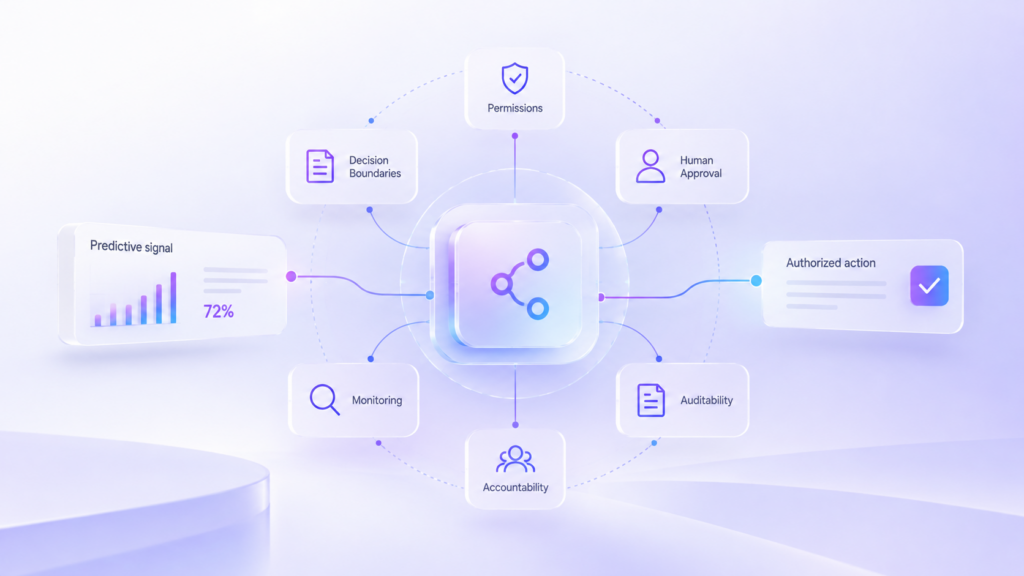
As AI systems move further into business workflows, governance has to answer a different question. It is no longer enough to ask whether a model produces a reliable prediction. Organizations also need to decide what the system is allowed to do with that prediction, where human approval is required and who remains accountable for the result.
This becomes especially important when Predictive AI is connected to agentic workflows. A model might identify a customer at risk of churn, estimate that demand is about to change or determine which sales opportunity deserves attention first. Once an AI agent can use that signal to interact with business systems or support the next action, governance moves closer to the workflow itself.
The World Economic Forum focuses on this shift by introducing the Agent Capability and Authorization Profile (ACAP), a framework designed to define what an agent is allowed to do, under which conditions and with what level of oversight throughout deployment.
Research from the Organisation for Economic Co-operation and Development, OECD, adds an important practical perspective. Its September 2026 study on agentic AI draws on interviews with practitioners from 25 organizations across 11 countries and shows that, even as agentic systems move into real workflows, organizations are still managing autonomy carefully rather than allowing agents to act without limits.
Together, the two sources suggest a simple principle: the more an AI workflow can act, the more clearly its authority needs to be defined before execution begins.
Agentic Workflow Governance Starts With Authority
AI governance is often discussed in terms of model performance, fairness, security or compliance. Those questions remain important, but agentic systems introduce another layer because they can move from producing information to participating in actions.
The World Economic Forum frames this as a question of delegated authority. Its ACAP framework brings together three elements: delegation policy, system design and operational oversight. The objective is to make agent decisions and actions enforceable, auditable and accountable throughout the life cycle of the deployment.
For a Predictive AI workflow, this changes the governance discussion.
A churn prediction, purchase propensity score or demand forecast is an analytical output. The governance question becomes more significant when that output can trigger another step, such as surfacing an account, updating a workflow, preparing an intervention or initiating an action within a connected system.
The organization therefore needs to define not only what the model can predict, but also what authority the workflow receives once that prediction exists.
Predictive AI Makes the Boundary Between Insight and Action Visible
Predictive AI is particularly useful for understanding this distinction because its outputs are naturally connected to business decisions, which means that the same prediction can lead to very different actions depending on the context, the level of risk involved and the rules an organization has defined for the workflow.
A high churn probability, for example, might simply appear in a dashboard as a signal for the sales or customer success team, but it could also move a customer into a priority list, trigger a recommended retention action or allow an agent to prepare the next step automatically. In some environments, that action may be executed within predefined rules, while in others the workflow may require human approval before anything changes in the system or reaches the customer.
None of these choices is inherently the right one in every context. What matters is that the level of autonomy matches the business impact and risk of the action being taken.
The OECD’s interviews provide useful evidence here. None of the participating organizations reported using agentic AI with unrestricted autonomy. Instead, deployments tend to concentrate on tasks where outcomes can be checked and potential errors remain bounded or reversible. Many organizations also use checkpoints at which human approval is required before the agent proceeds, particularly when actions have greater impact or are difficult to reverse.
This makes human oversight part of workflow design rather than a safeguard added after deployment.
Human Approval Should Be Designed Around the Action
An agent that retrieves information or prepares a recommendation presents a different governance profile from one that changes a customer record, initiates a transaction or takes an action with direct commercial consequences.
The OECD research shows that organizations are already approaching governance through layered controls, combining human oversight with domain expertise, restricted access, testing, continuous monitoring and approved agent registries.
This suggests that the relevant question is not whether a workflow should be human or autonomous.
A more useful question is: At which point does the consequence of an action become significant enough to require human confirmation?
For Predictive AI, this can be decided at the workflow level. The system may be allowed to identify a signal, rank priorities and prepare the next action automatically, while execution remains subject to approval when the financial, customer or operational impact crosses a defined threshold.
Governance then becomes more proportional to the decision being made.
A Practical Governance Checklist for Predictive AI Workflows
Before a predictive signal becomes part of an agentic workflow, organizations can test the design against a small number of practical questions:
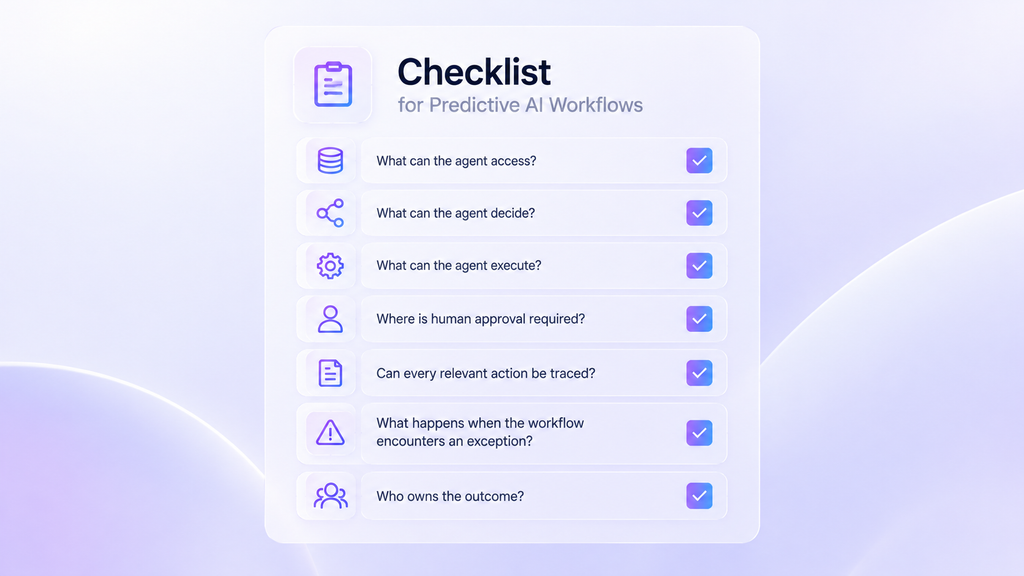
- What can the agent access? Define the data, applications and tools the workflow actually needs rather than granting broad access by default.
- What can the agent decide? Separate analytical outputs, recommendations and decisions that the system is permitted to make within defined rules.
- What can the agent execute? Specify which actions can happen automatically and which remain outside the agent’s authority.
- Where is human approval required? Identify the points where business impact, risk or irreversibility makes human confirmation necessary.
- Can every relevant action be traced? Decisions, tool use and workflow steps should leave enough information to understand what happened and why.
- What happens when the workflow encounters an exception? Define when the agent should stop, escalate or request additional input rather than continuing automatically.
- Who owns the outcome? Autonomous execution should not create ambiguous accountability. A person or business function still needs clear responsibility for the process.
These questions closely reflect the governance direction emerging from both sources. The World Economic Forum emphasizes authorization profiles, enforceable limits and operational oversight, while the OECD finds that organizations are combining several safeguards rather than relying on a single control.
Monitoring Matters After Deployment
Agentic workflows can involve several steps, systems and tools, which can make it harder to understand how an outcome was reached when something behaves differently from expected. The OECD highlights this as a particular challenge in multi step and multi agent workflows, where traceability and accountability can become more difficult as complexity increases.
Practitioners interviewed by the OECD also pointed toward a shift from static governance toward continuous oversight, with attention not only to final outcomes but also to the intermediary actions an agent takes while pursuing its objective.
For Predictive AI, this matters because the workflow can change even when the predictive model itself has not.
Permissions may evolve. New applications may be connected. Business thresholds may change. An action that was originally low impact may become more consequential in a different context.
Governance therefore needs to remain connected to the operating workflow, not only to the model that produces the prediction.
From Prediction to Governed Action
The value of Predictive AI comes from helping organizations act on what is likely to happen next. Agentic systems can reduce the distance between that prediction and the business response, but the same capability makes clear boundaries more important.
The goal of agentic workflow governance should be to make autonomy usable within conditions the organization understands and controls.
The World Economic Forum provides a useful structure for defining delegated authority, while the OECD’s practitioner research shows how organizations are already translating similar principles into checkpoints, restricted permissions, monitoring and human oversight.
For business leaders, the practical implication is straightforward: before a predictive workflow is allowed to move from insight to action, the organization should know what the agent can access, what it can decide, what it can execute and when a person must step in.
A well governed workflow does not slow Predictive AI down. It creates the conditions for organizations to use it with greater confidence as systems take on a more active role in business decisions.