
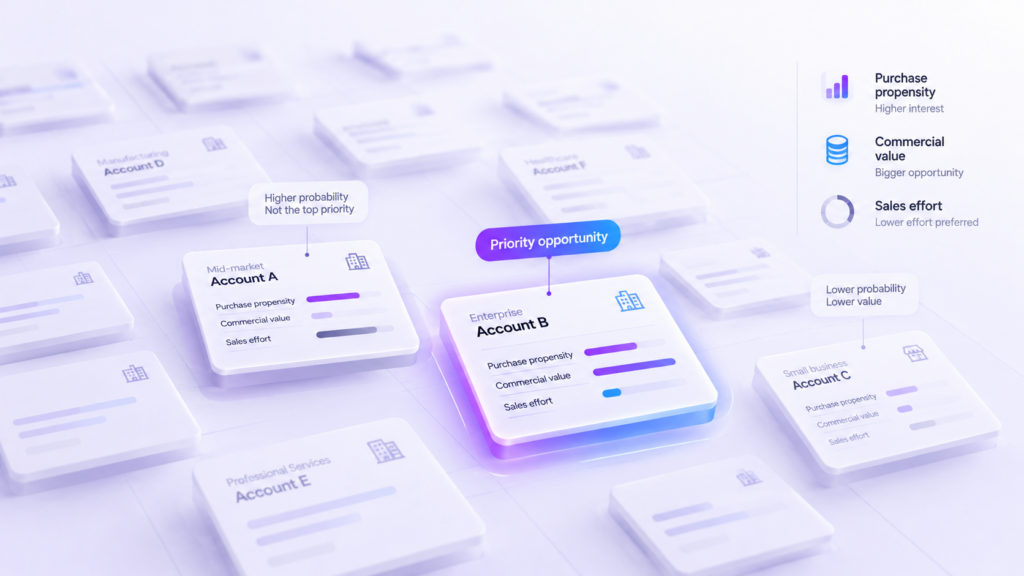
Sales prioritization starts with a practical commercial question: which opportunities deserve attention first?
For a sales team working across hundreds or thousands of customers, answering that question consistently is difficult. Previous purchases, company characteristics, relationship history and product fit can all contain signals of future demand, yet those signals rarely carry the same meaning across an entire customer base.
A propensity to buy model can help by estimating how likely a customer is to purchase a particular product or service. The probability creates a useful starting point, although the final sales priority depends on more than likelihood alone. Customer context, potential opportunity value and the economics of pursuing that opportunity can all influence where commercial attention should go.
Recent B2B research provides a useful example. A 2026 study published in Applied Intelligence analyzed 3,007 customers from a telecommunications company and combined purchase probability with customer segmentation, explainability and cost sensitive decision criteria. The objective was to make opportunity forecasting more useful for sales prioritization and resource allocation, particularly when customer data are heterogeneous and purchase signals are difficult to interpret.
The result points toward a broader role for propensity modeling: helping Sales decide where attention can create the most value.
Sales Prioritization Starts With a Commercial Decision
A propensity model estimates the likelihood that a customer will buy, but Sales has to translate that probability into a commercial priority. That means deciding whether the opportunity deserves attention now, how much effort it justifies and where it should sit relative to other accounts.
Imagine that one account receives a purchase probability of 78%, while another receives 67%. Ranking them purely by score would place the first account at the top. Yet the second opportunity could represent greater commercial value, require less effort to pursue or belong to a customer segment where similar signals have proved more meaningful.
The probability provides evidence for the decision, but it does not contain every element needed to make that decision.
This is where propensity modeling becomes more relevant for commercial teams. Rather than creating another score inside the CRM, it can provide a more consistent basis for deciding how sales attention should be distributed across different opportunities.
Better Targets Start With Better Customer Signals
The quality of that decision depends heavily on the data behind it.
The Applied Intelligence study examined 53 variables across 3,007 B2B customers, including historical purchasing behavior, relationship information and firmographic characteristics such as annual revenue and employee count. The researchers used these signals to estimate purchase probabilities for two telecommunications products.
An important part of the framework was customer segmentation. B2B customer bases are rarely homogeneous. Signals associated with purchasing behavior in a smaller organization may differ from those that matter for a larger enterprise, while previous purchases or relationship history can have different relevance depending on the product being considered.
The researchers therefore combined prediction with explainability guided segmentation to identify groups where purchasing patterns were more coherent. High probability segments achieved F1 scores of 0.964 for Product 1 and 0.922 for Product 2, while more heterogeneous groups showed weaker signals.
For Sales, the significance is less about the technical metric itself and more about what it reveals. Purchase probability becomes easier to interpret when the business also understands which type of customer sits behind the score and which signals are associated with that predicted behavior.
This creates a stronger foundation for targeting before the business even decides which opportunities should receive priority.
A Propensity Score Is Not Yet a Sales Priority
Once the target population has been identified, the next question is where to draw the line between an opportunity worth pursuing and one that should receive less attention.
The researchers also looked at how the decision threshold changes when commercial economics are taken into account. Instead of relying only on the statistical cutoff produced by the model, their framework incorporated factors such as expected revenue and the cost of sales activity to determine when an opportunity was worth pursuing.
The effect was significant. For one of the products analyzed, the threshold for medium sized customers fell from 0.57 to 0.17 once the economic assumptions were introduced. For large customers, it moved from 0.64 to 0.00, meaning that under the conditions modeled in the study, the expected value of the segment justified contacting every customer, even when individual purchase probability was relatively low.
These thresholds are specific to the study and should not be applied directly to another business, where product value, margins, sales costs and commercial priorities may be very different. What is more transferable is the underlying principle: the threshold that performs best statistically is not always the one that creates the most commercial value.
A costly sales process may require a more selective approach, while a higher value opportunity can justify pursuing a broader group of customers. In practice, this means that the same propensity score can lead to different priorities depending on the economics around the opportunity, turning propensity modeling from a simple ranking mechanism into a more useful framework for commercial decision making.
The study itself describes these cost sensitive thresholds as tools for operational decision making rather than changes to the underlying model prediction. The probability remains the same; what changes is the business rule that determines when the organization should act on it.
Context Helps Sales Understand Why an Opportunity Matters
Prioritization becomes more useful when the score arrives with enough context for Sales to interpret it.
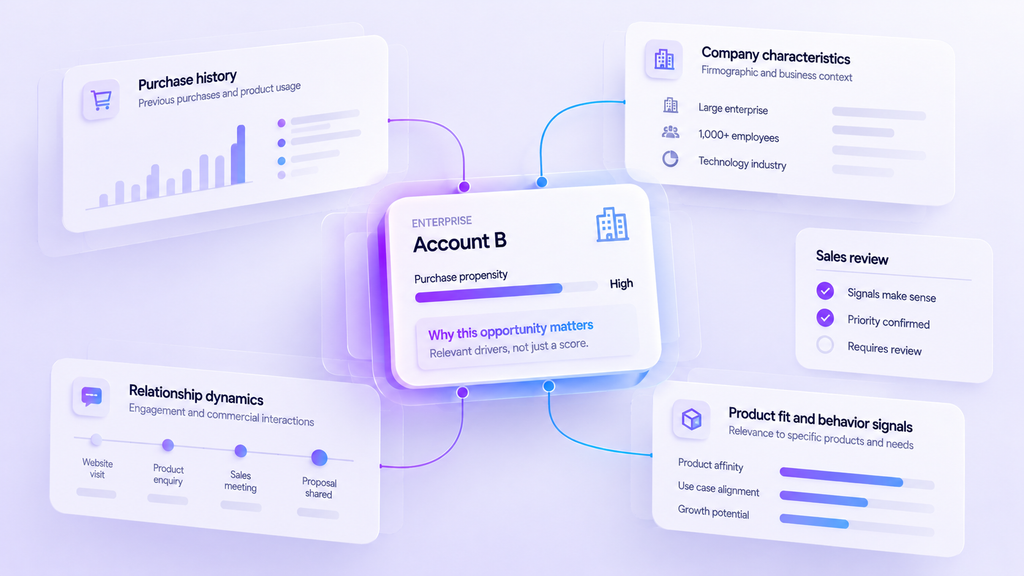
A list of customers ranked from highest to lowest purchase propensity can indicate where potential demand appears stronger, but it still leaves an important part of the commercial decision unresolved. Teams need to understand what is contributing to the prediction and whether those signals make sense in the context of the account.
The framework in the study incorporates feature attribution specifically to make purchasing patterns more interpretable and uses that information within customer segmentation. The resulting groups reflect features that are relevant to predicted purchasing behavior rather than relying only on broad demographic categories.
For a sales professional, this can add meaning to the score.
Purchase history, company characteristics, relationship dynamics and other available enterprise data may all contribute to the probability attached to an account. Bringing relevant drivers forward gives the person making the decision more information to evaluate the opportunity and determine whether it deserves attention.
That context also makes prioritization easier to challenge when necessary. Predictive intelligence can inform the decision without removing commercial judgment from it.
Turn Purchase Propensity Into the Next Sales Action
If propensity scores remain inside an analytics dashboard, Sales may still need to identify the relevant account, search for additional information and decide manually how the opportunity should be handled. The predictive signal exists, but several operational steps remain between insight and action.
A more connected sales workflow can bring the relevant elements together. Depending on the organization, that could include:
- the account or customer identified as a priority;
- the purchase probability for a specific product or service;
- the most relevant signals associated with that prediction;
- the customer’s segment and commercial context;
- the next permitted action within the sales process.
For Elai, this is where Predictive AI connects naturally with the sales workflow. Purchase propensity can provide the initial signal, while the surrounding customer context helps teams understand why an opportunity deserves attention and supports the next appropriate action.
The appropriate level of automation can vary. A predictive signal might reorder an opportunity list, prepare relevant information for an account owner or support a predefined next step, while more consequential commercial decisions remain under human control.
The important change is that prediction begins to influence the sequence of commercial activity instead of remaining an isolated analytical output.
Measure the Commercial Value of Better Prioritization
A propensity model still needs to perform reliably from a statistical perspective. Poor predictions cannot provide a sound basis for commercial prioritization. Once the model becomes part of the sales process, however, technical performance represents only one part of the evaluation.
The research demonstrates this distinction particularly well. The underlying prediction can remain unchanged while the economically preferred decision threshold shifts according to expected revenues, sales effort and the cost of missed opportunities. The study therefore connects model output with a profit oriented decision layer rather than treating predictive performance as the final objective.
In a live sales environment, that logic can be extended to commercial KPIs such as:
- conversion among prioritized opportunities;
- revenue generated per opportunity pursued;
- sales effort required per conversion;
- cost per successful opportunity;
- incremental commercial value compared with the previous prioritization approach.
These are examples of business metrics that companies could use to evaluate a propensity strategy rather than metrics reported directly by the study.
Together, they help answer the question that matters once the model enters the workflow: does propensity based prioritization improve where Sales invests its attention and the value generated from that effort?
A more accurate prediction is useful. A better commercial decision is the outcome the business ultimately needs.
From Purchase Probability to Better Sales Priorities
Propensity to buy models can make purchase potential more visible across a B2B customer base, but their value grows when that probability becomes part of a broader commercial decision process.
The 2026 Applied Intelligence research shows how customer signals, segmentation and economic assumptions can change the point at which a predicted opportunity becomes worth pursuing. It also illustrates why different customer groups may require different decision thresholds rather than one universal rule for the entire sales portfolio.
For Sales, the progression is clear: Commercial decision → customer data and target → priority → action → KPI
The model provides the predictive signal. Customer context helps define the target. Business economics influence the priority. The workflow turns that priority into action, while commercial KPIs show whether the decision generated value.
That is where propensity to buy models become most useful: helping Sales understand not only who may buy, but where commercial attention should go first.