
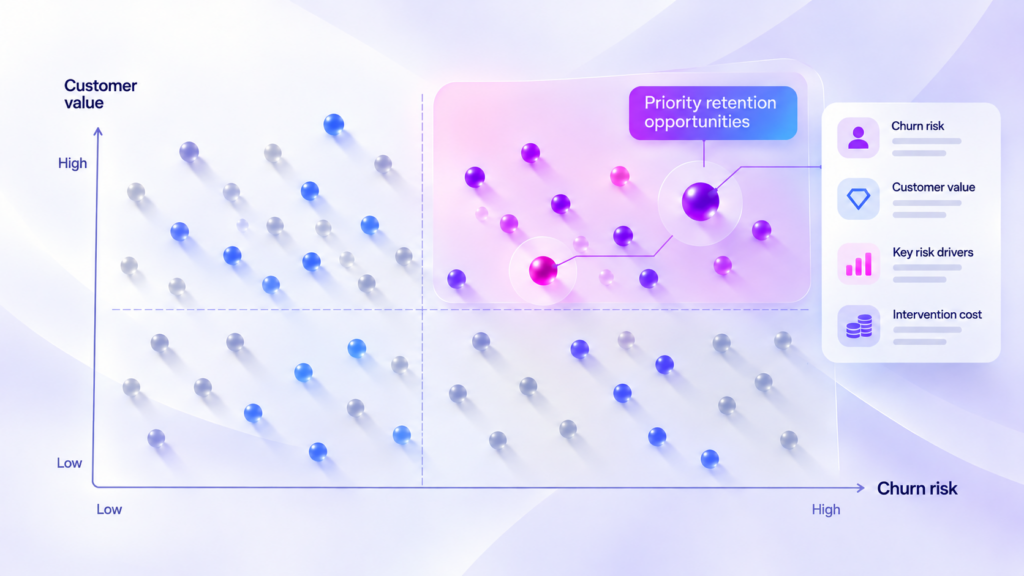
A churn probability can tell a company where risk appears to be rising. It does not automatically reveal which customers deserve attention first, what may be driving the change, whether an intervention is likely to work or whether the economics justify taking action.
That distinction is becoming increasingly important as AI Customer Churn Prediction moves from an analytics exercise into CRM and customer management workflows. Recent research suggests that greater business value may come from connecting the prediction with customer value, timing, context and intervention economics rather than concentrating exclusively on improving model accuracy.
For retention teams, the question is therefore becoming more practical: once churn risk has been identified, where can action protect measurable customer value?
A Churn Score Is the Beginning of the Decision
Traditional churn models usually assign each customer a probability of leaving within a given period. The result can help organizations identify patterns across a large customer base and focus attention on relationships where risk appears elevated.
The difficulty starts when the score reaches the business.
A customer with a high probability of churn may represent significant future revenue, while another customer with the same probability may have relatively limited economic value. Their reasons for leaving may also be completely different, which means the appropriate response may range from resolving a service issue to changing a contract, adjusting engagement or deciding that an intervention would cost more than the value it could realistically preserve.
Research published by Wiley in July 2026 illustrates this shift clearly. Using data from 10,000 banking customers, the researchers tested seven machine learning classifiers but then extended the analysis through three additional business layers: identifying influential churn predictors, segmenting customers into interpretable risk groups and optimizing the decision threshold using a bank specific cost matrix.
The significance for business teams lies less in which algorithm won the comparison and more in what happened after prediction.
The Best Statistical Threshold May Not Be the Best Business Threshold
A model still needs to predict churn reliably, but the point at which a company decides to intervene can materially change the economics of the retention program.
The Wiley study provides a useful example. With the authors’ specific cost assumptions, the standard classification threshold of 0.50 produced an estimated net loss of $1,250. A lower threshold of 0.14 generated the highest estimated net saving, at $6,350 for the evaluation period. The difference came from accepting more false positives in exchange for identifying substantially more customers who would otherwise have churned.
Those dollar values should not be generalized to another company. They depend on the cost structure constructed for that banking study. The broader implication is more transferable: the threshold used to trigger a retention action is a business decision as well as a modeling decision.
A technically strong prediction can still produce weak commercial outcomes when every customer is evaluated with the same assumptions about value, intervention cost and acceptable risk.
Customer Value Changes How Churn Risk Should Be Read
A second recent study moves the discussion one step further by looking at what happens after churn risk has been identified. Researchers in Discover Informatics developed a framework that combines churn probability with expected retention duration, customer specific explanations, possible interventions and a profit aware targeting rule. The framework was tested on three public telecommunications datasets, so the findings should be read as evidence from a modeled decision environment rather than from a live commercial retention campaign.
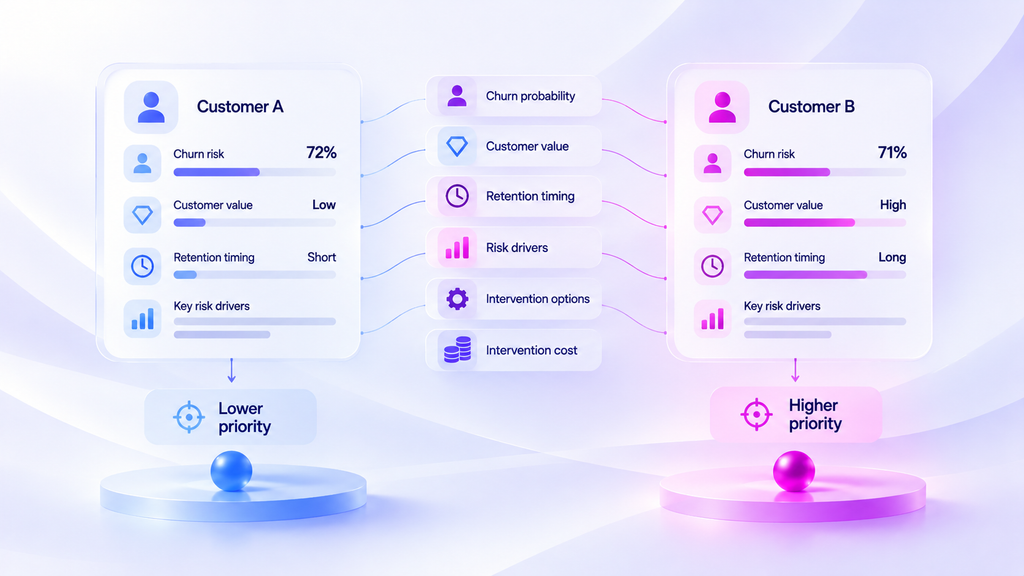
One of its most useful ideas is that two customers with a similar churn probability can still represent very different retention decisions. Timing may differ. The underlying risk drivers may differ. Customer Lifetime Value can differ substantially. An intervention that makes economic sense for one customer may therefore make little sense for another.
In the study’s simulation, incorporating customer value into the targeting logic was important for moving the retention strategy toward positive economics. The adaptive expected profit approach eventually produced a simulated 48% ROI, outperforming the probability based alternatives evaluated by the researchers. The authors explicitly caution that this figure is based on assumed intervention costs, an assumed success rate and a CLV proxy, so it should not be interpreted as the expected return from a real retention campaign.
That limitation actually reinforces the business lesson. Churn prediction becomes more useful when companies define their own economics rather than adopting a generic probability threshold.
What Makes a Churn Prediction Actionable
Moving from a churn score to a retention decision requires several pieces of information to come together:
- Churn probability, to identify customers whose behavior indicates elevated risk.
- Customer value, to understand the economic importance of retaining the relationship.
- Timing, because the usefulness of a warning depends partly on how much opportunity remains to respond.
- Risk drivers, so teams can understand why the model is flagging a particular customer.
- Intervention options, which may include service, engagement, contractual or commercial responses.
- Intervention cost, so retention activity can be evaluated against the value it is expected to preserve.
- Observed outcome, allowing the company to learn which actions actually influence retention.
Seen this way, AI Customer Churn Prediction becomes a prioritization problem as much as a prediction problem.
A large customer base may contain customers with high risk but relatively low retention potential, alongside customers whose combination of risk, value and actionable context makes them much stronger priorities. Treating both groups identically can consume retention resources without necessarily improving the underlying economics.
Risk Drivers Matter Because Different Customers Need Different Responses
Knowing that a customer may churn provides an early warning. Understanding the factors behind that prediction gives the business more information for deciding what to do with it.
The Discover Informatics framework is particularly relevant here because it combines prediction with explainability and counterfactual analysis. Rather than returning only a probability, it is designed to identify the factors contributing to an individual customer’s risk and explore feasible changes that could move that prediction below the defined threshold.
For a retention team, that changes the quality of the conversation.
A customer whose risk is associated with contract structure may call for a different response from one whose pattern reflects declining service usage. A third customer might be expensive to retain relative to the expected future value of the relationship.
Prediction provides the signal. Context helps determine whether that signal should become an action.
Bring Churn Prediction Into the Customer Workflow
The operational challenge is to make this intelligence available where customer decisions actually happen.
A churn model that refreshes a dashboard but remains disconnected from CRM processes still leaves people to interpret the risk, search for customer context, decide on priorities and determine the appropriate response manually.
A more connected workflow can bring those elements together. When churn risk increases, the relevant team could receive the predictive signal alongside customer value, important risk drivers and the available context needed to evaluate the next step.
This is where the topic connects naturally with Elai’s approach to Predictive AI. Churn prediction can become an operational signal inside the customer workflow, helping teams identify priority relationships, understand the context around the prediction and support the next permitted action.
Different organizations may choose different levels of automation. Routine actions can potentially follow predefined business rules, while decisions involving significant discounts, contractual changes or strategically important customers may still require explicit human review.
The important point is that the prediction reaches the place where a decision can actually be made.
Measure the Value Protected, Not Only the Risk Predicted
Technical metrics remain necessary. A business should understand how accurately a model identifies churn and how reliably its probabilities behave.
Those measures do not describe the full commercial outcome.
The Wiley research demonstrates why. The model remained the same while different decision thresholds produced very different estimated financial results. The Discover Informatics research makes a related point by showing that an optimization layer can alter the economics of targeting without changing the underlying AUC or F1 performance of the predictive model.
Once churn prediction enters a live workflow, measurement can therefore expand beyond model performance to include outcomes such as incremental retention, revenue preserved, Customer Lifetime Value protected, intervention costs and differences between treated customers and an appropriate comparison group.
This leads to a more useful measure of model performance: the measurable customer value protected after accounting for intervention costs.
From Prediction to Retention Value
AI Customer Churn Prediction gives companies earlier visibility into customer risk. The larger opportunity is to use that visibility selectively.
Recent research across banking and telecommunications points toward a similar operating principle. Risk probability becomes more valuable when it is combined with customer economics, explanations, timing and a clear rule for deciding when an intervention is worthwhile.
For CRM, marketing and customer teams, that moves churn analytics closer to the actual retention decision.
The aim is not simply to identify more customers who might leave. It is to understand where the business has a realistic opportunity to intervene, which response makes sense and how much measurable value that decision ultimately protects.