
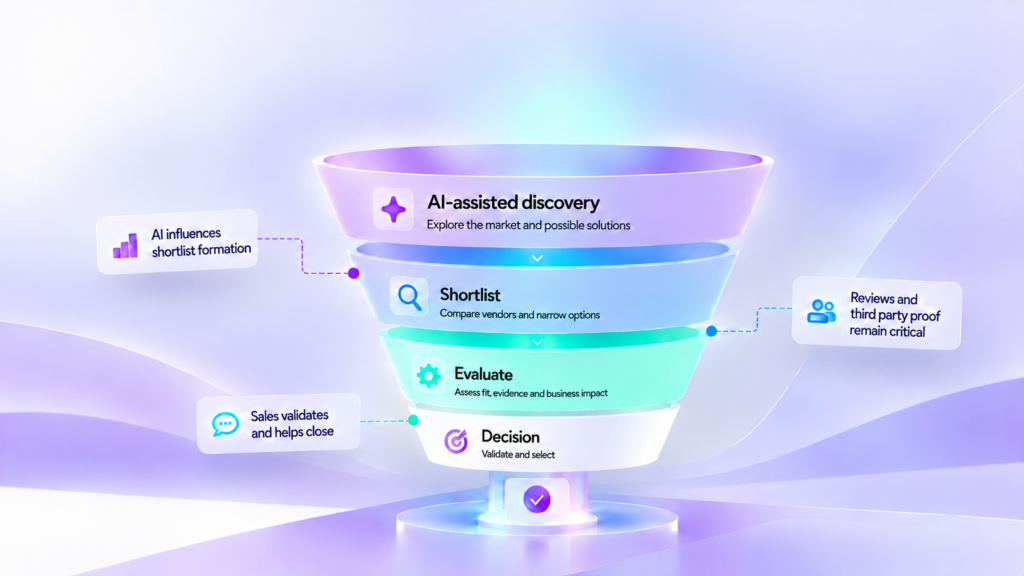
A B2B buyer can now form an initial view of a market without opening a vendor website. A prompt to an AI interface can surface categories, compare possible solutions, suggest vendors and summarize differences within minutes, moving part of the discovery process into an environment where companies have less control over the order in which their story is presented.
The shift is already visible in buyer behavior. Gartner’s 2026 research among 645 B2B buyers found that they used an average of seven information sources during a recent purchase, while 45% used Generative AI, primarily to gather information about vendors and products. G2 offers a more specific view of software purchasing: in its global survey of 1,038 B2B decision makers, 82% said they had sourced software recommendations from an AI chatbot during the previous two years.
These findings make AI search difficult for B2B marketers to ignore. They also describe a buying journey with several layers. AI may help a buyer get oriented or create an early shortlist, while reviews, vendor information, internal stakeholders and sales conversations continue to shape what happens next.
Discovery Can Start Before a Buyer Reaches Your Website
Independent research has been part of B2B buying for years. AI makes that research faster and gives buyers another way to explore a category before they reveal any visible intent to a vendor.
Gartner found that 70% of buyers preferred a completely digital, self service buying experience, and 67% preferred an experience without a sales representative. Yet those same buyers reported consulting seven sources on average during a recent purchase.
That combination is worth paying attention to. Buyers may prefer to research independently while still moving between several sources to build confidence in what they find.
For marketing teams, this also makes part of discovery harder to observe. A company can enter a buyer’s consideration set through an AI generated answer without receiving a website visit, form submission or other familiar demand signal. The reverse can happen just as quietly: a brand may never appear among the options being considered.
Visibility is therefore becoming broader than traffic alone. It increasingly includes whether the company can be found and understood while the buyer is still defining the problem and exploring possible solutions.
AI Is Helping Buyers Build Their Shortlists Earlier
G2’s research suggests that the influence of AI becomes particularly interesting once buyers begin narrowing the market.
Among buyers who had sourced software recommendations from an AI chatbot, around half said AI had its greatest influence during shortlisting and evaluation. G2 also found that buyers using AI recommendations were more likely to purchase from their initial shortlist: 80% had done so in at least three of their previous five purchases, compared with 65% among buyers who had not used AI chatbots for recommendations.
The data is correlational, so the safest interpretation is that AI assisted discovery is associated with earlier shortlists that can become relatively persistent as the evaluation continues.
For vendors, that timing matters. A buyer who reaches a company only after several alternatives have already been identified is entering the conversation with a different frame of reference from someone starting with an open market.
G2’s research focuses specifically on B2B software purchasing, which means its findings should be applied most confidently to technology and SaaS markets. Within those categories, however, the commercial implication is already clear: being considered early can influence the rest of the buying journey.
Clear Positioning Has Become Part of Discoverability
SEO has traditionally focused heavily on whether a buyer can find a page. AI search adds another question: once information about a company is surfaced, is its position in the market easy to understand?
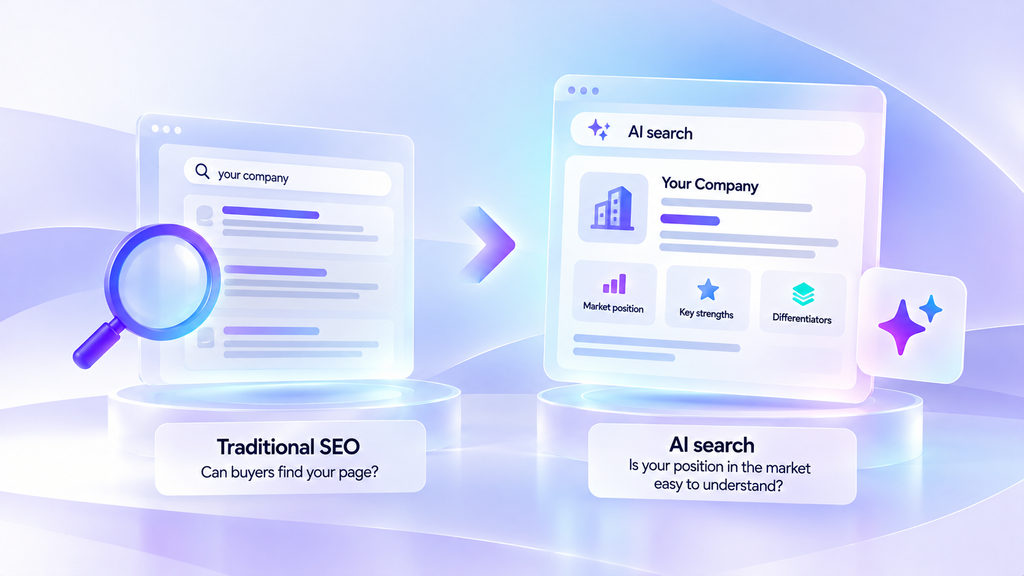
That puts more weight on the consistency of the information surrounding a brand. A buyer researching through an AI interface should be able to understand several things quickly:
- Which business problem the company addresses, using language that reflects how customers actually describe that problem.
- Where the solution fits, especially in categories where AI terminology can become broad or ambiguous.
- Which use cases provide evidence of relevance, connecting capabilities with recognizable business situations.
- What supports the proposition, including customer proof, documentation, third party information and measurable outcomes.
- Which business decisions or workflows improve, giving the buyer a concrete reason to continue the evaluation.
This is also where marketing and commercial positioning begin to overlap more closely.
For Elai, for example, explaining Predictive AI through the decisions it supports can make the proposition clearer across several channels. Forecasting, propensity, churn prediction or prioritization give buyers a more concrete frame than a broad description of AI capability.
Faster Discovery Is Putting More Pressure on Evaluation
Finding potential vendors may be getting easier. Deciding which one deserves confidence still takes work.
In G2’s survey, 40% of buyers described evaluation as the longest stage of the software buying journey, ahead of research at 36% and the final decision stage at 22%. When buyers were asked which sources influenced the shortlist, review sites ranked first at 38%, followed closely by AI chatbots at 37%.
That is an important counterweight to some of the more dramatic claims around AI search. Being surfaced by AI can create an opportunity to be considered, while evaluation brings a different set of questions into the process.
A buyer may want to understand implementation, security, integration, pricing, expected business impact and the experience of existing customers. G2 also identifies security reviews, budget approval and implementation planning among the sources of friction that appear after a vendor has been selected.
For content teams, the implication extends beyond producing more material designed for AI discovery. Different parts of the buying journey need different types of evidence. Thought leadership and educational content can establish relevance early, while product information, customer evidence, technical documentation and commercial conversations become increasingly important as scrutiny rises.
Sales Enters the Journey With a Different Job
That changes the context in which many sales conversations begin.
One of the more interesting findings comes from Gartner: 69% of B2B buyers said they prefer to validate AI generated insights with a sales representative. Gartner also found that sales representatives remain especially important when buyers are researching a business problem, identifying a preferred supplier, securing internal support and finalizing a purchase.
A buyer may arrive having already compared providers, read reviews, asked AI systems about the category and formed an initial opinion about the available options. Sales then has the opportunity to clarify assumptions, provide context and address questions that broad research cannot resolve.
Consistency between Marketing and Sales becomes particularly valuable here. If AI search, the website and the sales conversation describe the company in substantially different ways, the buyer has to reconcile those differences during an already complex evaluation.
A coherent commercial narrative makes that journey easier. The buyer encounters the same underlying business value at different levels of depth, while Sales adds the context that becomes relevant once the conversation moves from general discovery to a specific organization and use case.
What the Evidence Supports Today
The evidence available today points to a meaningful change in B2B discovery, with some important boundaries around how far that change has progressed.
- AI is already being used for vendor and product research, and its role is particularly visible in software discovery and shortlist formation.
- The initial shortlist deserves more attention from marketing teams, because buyer consideration can begin before conventional intent signals appear.
- Third party proof continues to influence evaluation, with review platforms remaining highly relevant alongside AI chatbots.
- Sales retains an important role in validation, particularly when a buyer needs context, reassurance or support around a higher stakes decision.
- Marketing, product and sales communication increasingly need a shared narrative, because buyers move between these sources without following a clean, linear funnel.
For B2B marketers, the practical priority is fairly concrete: make the company understandable before the first website visit and give buyers enough evidence to keep it in consideration as the research becomes more demanding.
AI search changes where that first impression can happen. The quality of the underlying positioning, content and commercial proof will determine what the buyer finds when they decide to look closer.