
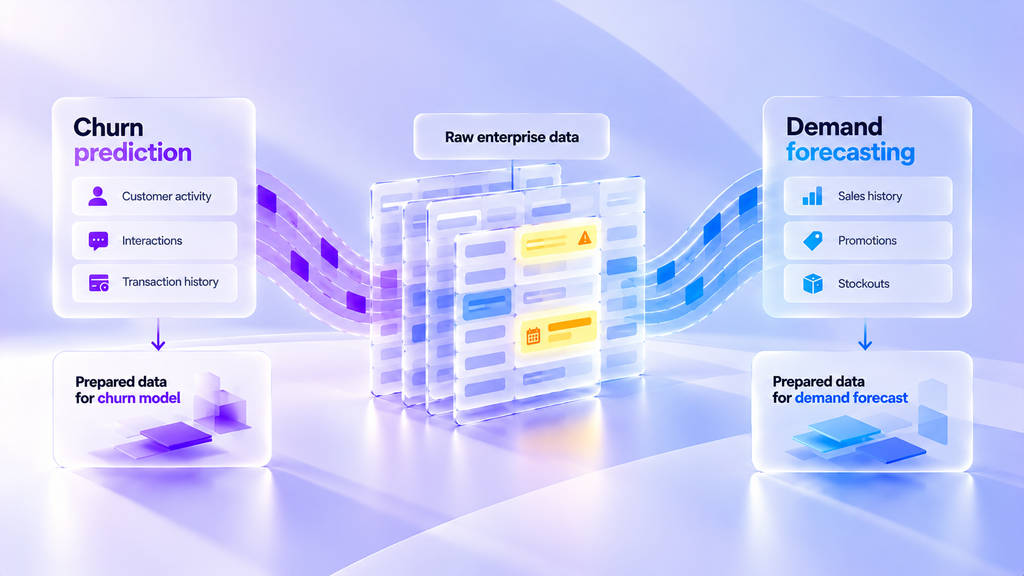
Two predictive models can be trained on datasets with similar quality issues and still require very different preparation decisions. An inaccurate transaction date may affect a model designed to identify customers at risk of churn, while a missing promotional indicator could distort a demand forecast even when most of the dataset appears complete.
As organizations automate more of their data science processes, these differences are raising an important question about how data preparation should be managed. Correcting errors remains essential, but deciding which problems deserve attention first also requires understanding how the information will be used and which outcomes the model is expected to predict.
Recent machine learning research is exploring this relationship by connecting data cleaning more closely with model development, rather than treating preparation as an independent stage that must be completed before predictive modeling begins.
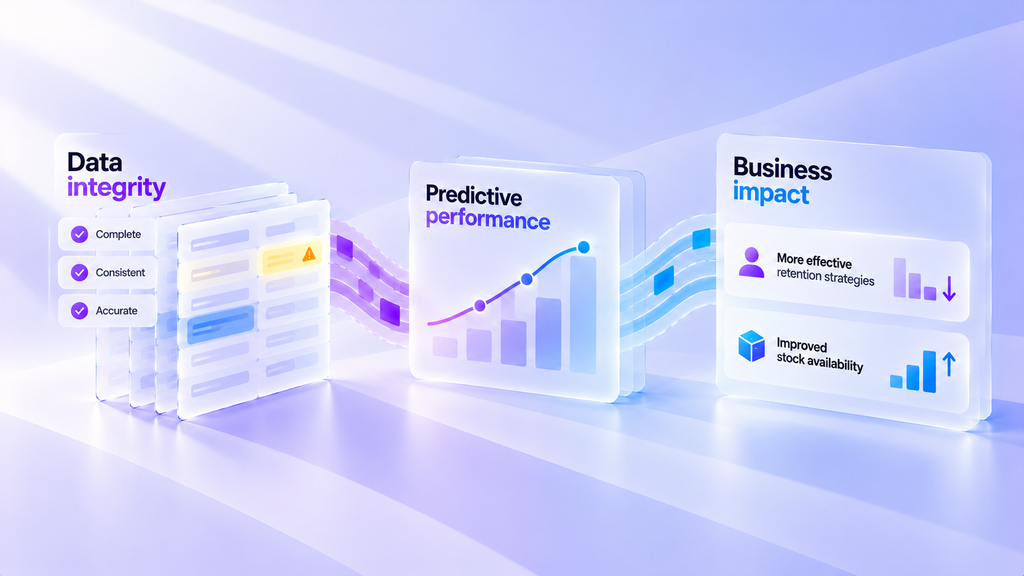
For CIOs, CDOs and data science leaders, automated data cleaning for machine learning is increasingly about balancing data integrity, predictive performance and the resources available to achieve both.
Why Cleaner Data Does Not Always Mean Better Predictions
Missing values, duplicate records and inconsistent information can undermine the reliability of a dataset, although correcting these problems does not necessarily produce equivalent improvements in every predictive model.
Consider a customer database containing transaction histories, account information and records of previous interactions. Standardizing an incorrectly formatted field may improve consistency across the organization’s systems without materially affecting a churn model, particularly if that field contributes little useful information to the prediction. Correcting inaccurate transaction dates, however, could have a much greater effect when the model relies on recent purchasing activity to identify potential disengagement.
Both problems may require attention, but their importance to the predictive task is different.
The distinction becomes particularly relevant when organizations work with large datasets and must decide how to allocate limited preparation time and computational resources. Some corrections protect the integrity of information used across the business, while others may also influence how effectively a specific model recognizes patterns associated with its target outcome.
Data cleaning should therefore be distinguished from preprocessing and feature engineering, even though these activities frequently operate within the same automated pipeline. Cleaning addresses incorrect or unreliable information, preprocessing transforms data into a suitable format for learning algorithms, and feature engineering creates additional variables that may improve the model’s ability to identify relevant relationships.
A transformation such as numerical scaling or category encoding may improve predictive performance without correcting an error in the original dataset. Conversely, a necessary correction to a business record may have little measurable effect on the model while remaining essential for the reliability of the information.
This is why data correctness and model performance need separate evaluation criteria, particularly when automated systems are allowed to select or modify preparation strategies.
What Research Reveals About Task-Driven Data Cleaning
Traditional machine learning workflows often place data cleaning before model development, with preparation decisions largely completed before the predictive algorithm is trained and evaluated.
Research published at the 2026 International Conference on Machine Learning suggests that a closer relationship between these stages can improve the use of computational resources.
In DMCO: Budget-Aware Co-Optimization of Data Cleaning and AutoML, Xiaoou Ding and colleagues introduce a framework that coordinates data cleaning and automated machine learning within a fixed computational budget.
Rather than completing all cleaning operations before beginning model construction, DMCO alternates between preparation and AutoML, using intermediate feedback to determine how computational resources should be distributed as the process progresses.
The researchers evaluated the framework on six real-world datasets covering classification and regression tasks, reporting better results than the standalone cleaning and AutoML baselines included in their experiments, based on F1 score and mean squared error.
The significance of the research lies in its approach to resource allocation. When cleaning and model training are evaluated together, the system can use information from model development to guide subsequent preparation decisions instead of following a rigid sequence.
A second study, A Task-Driven Interpretable Data Cleaning Framework Based on LLM, published online in May 2026, examines a related challenge through a framework called TR-Agent.
Developed by Shuhuan Fan and colleagues, TR-Agent combines table knowledge extraction, error detection, data repair and structured reporting, using feedback from downstream tasks to refine its cleaning strategies.
The framework also records information about the modifications performed and their rationale, addressing an important concern when automated systems make changes to datasets that analysts must subsequently validate or reuse. Its experimental results suggest that task-related feedback can improve preparation outcomes under the conditions examined, although the findings remain specific to the datasets and evaluation procedures used by the researchers.
Taken together, the studies suggest that data preparation can become more adaptive when model feedback contributes to decisions about cleaning and transformation. Neither study, however, establishes that improving a predictive metric automatically produces better commercial decisions, or that correctness requirements should be relaxed whenever an alternative transformation improves model performance.
Why Different Prediction Problems Require Different Preparation
The relationship between data quality and predictive performance becomes clearer when comparing applications that rely on different types of information.
Churn prediction
Customer churn models often use purchasing history, service interactions, payment behavior and engagement patterns to estimate the probability that a customer will stop buying or discontinue a relationship.
A missing interaction record could mean that the customer never contacted the organization, but it might also indicate an integration failure between customer service and CRM systems. Automatically replacing every missing interaction with zero could therefore introduce a misleading behavioral signal.
Duplicate customer identities present another challenge, since activity distributed across multiple records may fragment the customer’s history, while duplicated transactions could exaggerate apparent engagement.
The timing of information is equally important because variables used to predict churn must have been available when the prediction would actually have been generated. A cancellation-related event recorded after the customer left cannot legitimately be used to forecast that earlier departure.
Demand forecasting
Demand forecasting requires a different interpretation of historical data, particularly when datasets contain promotions, stockouts, product substitutions and missing sales periods.
A period with zero recorded sales may reflect weak demand, but it could also indicate that a product was unavailable or that transaction records were not collected correctly. Treating these situations identically could distort the patterns used to estimate future demand and lead to inappropriate inventory or production decisions.
Promotional indicators create additional timing requirements, because a forecasting model should only use information that would have been available at the relevant prediction date.
These examples demonstrate why automated preparation cannot be designed entirely independently of the intended prediction. Although many integrity controls apply across an organization’s data systems, the target variable, available history and decision timing influence which transformations are appropriate and which errors are most consequential.
The Risks of Optimizing Data Cleaning for Model Performance
Connecting preparation decisions to model feedback creates opportunities for more efficient workflows, but the approach also introduces risks when predictive metrics become the dominant measure of success.
One of the most important concerns is data leakage, which occurs when information unavailable at the intended prediction time improperly influences model development or evaluation.
Leakage can arise when imputation parameters, preprocessing transformations or feature selection decisions are learned using validation or test information that should remain outside the fitting process. A reliable evaluation therefore requires data-dependent preparation choices to be fitted within the appropriate training folds, with the final test set kept independent of model and pipeline selection.
Forecasting introduces additional constraints because validation procedures must respect the temporal sequence of observations and prevent future information from influencing earlier predictions.
These safeguards do not imply that predefined business rules cannot be applied consistently across datasets. A validity constraint established independently of model evaluation, for example, serves a different purpose from a preprocessing decision selected because it improves performance on data that should have remained unseen.
Automated cleaning can also create misleading improvements when a system modifies legitimate but unusual observations because removing them produces a better aggregate score. In some applications, these exceptional records may represent precisely the situations that the predictive model needs to recognize.
Traceability and governance therefore remain essential, particularly when preparation systems operate with limited human intervention. Organizations need to understand what information was changed, why a modification was considered appropriate and whether the result remains consistent with authoritative sources and business definitions.
The reporting capabilities examined in the TR-Agent study offer one approach to improving visibility into automated cleaning, although documentation alone cannot establish that a correction is valid.
Connecting Data Quality with Business Decisions
For data leaders, the practical implication of task-driven preparation is that organizations need to distinguish mandatory integrity requirements from choices that can legitimately be optimized for a specific prediction.
Critical business rules, regulatory constraints and inconsistencies with authoritative systems must be addressed independently of their immediate effect on model performance. Within those boundaries, alternative preprocessing and cleaning strategies can be evaluated according to how well they support the task for which the model is being developed.
The consequences of prediction errors introduce a further consideration. A churn model and a demand forecast may both benefit from improved data preparation, but the economic significance of their mistakes can be very different.
An inaccurate churn prediction might lead to unnecessary retention spending or missed opportunities to protect valuable relationships, while a forecasting error could affect stock availability, working capital or production planning.
Improving a statistical metric does not necessarily improve these outcomes, particularly when different types of prediction errors carry different costs.
For organizations investing in automated machine learning, this suggests that data quality, predictive performance and business impact should be connected without being treated as interchangeable measures.
Research into task-driven cleaning offers a way to make preparation more responsive to the model being developed, while appropriate governance ensures that efficiency gains do not undermine the reliability of the underlying information.
The broader opportunity is to build predictive workflows in which preparation, model development and validation inform one another, while the standards for data integrity remain explicit and the value of the resulting predictions is evaluated against the decisions they are intended to support.
Effective automated data cleaning is therefore measured not by how many records a system modifies, but by whether the resulting information remains trustworthy and supports predictive models that can be used reliably in business decisions.