

A hotel may have strong reservations for a particular weekend and still face considerable uncertainty about how many rooms will ultimately be occupied. While some guests will arrive as planned, others may cancel their bookings days or weeks before check-in, leaving revenue managers to reconsider availability, pricing, overbooking policies, and operational resources as the arrival date approaches.
Predictive models can estimate which reservations are more likely to be canceled, but two bookings with similar cancellation probabilities may create very different planning challenges depending on when those cancellations occur. A room released several weeks in advance can potentially be resold, whereas a cancellation shortly before arrival leaves less time to recover the expected revenue.
A study published online in July 2026 in the International Journal of Hospitality Management examines this additional dimension through survival analysis, investigating how hotels can estimate not only whether a reservation may be canceled, but also when that event is most likely to occur.
The findings introduce a potentially useful perspective for hotel demand management, particularly when reservation uncertainty affects decisions that must be made before the final occupancy level becomes known.
Why Cancellation Probability Alone Cannot Explain Demand Uncertainty
Hotel booking cancellation prediction is commonly approached as a classification problem, using reservation characteristics and historical information to estimate the probability that a booking will be canceled before arrival.
These predictions can help hotels assess the reliability of their reservation portfolio, although an overall cancellation probability does not describe how risk may evolve during the period between booking and check-in.
Consider two reservations for the same arrival date, both associated with a relatively high cancellation probability. Historical patterns might indicate that one is more likely to be canceled shortly after booking, while the other tends to remain active until the final days before arrival. Although both reservations contribute to expected cancellation exposure, their timing creates different opportunities for managing room availability.
For revenue managers, this distinction becomes important when estimating how many bookings will remain active as the arrival date approaches. If cancellations are expected relatively early, the hotel may have additional time to adjust inventory distribution or respond to changes in demand, whereas late cancellations can be more difficult to recover, especially in markets with limited last-minute booking activity.
Cancellation probability estimates the likelihood that a booking will be canceled, while cancellation timing adds information about when that event may occur. Combining these perspectives could help hotels develop a more detailed understanding of reservation uncertainty and its potential consequences for occupancy planning.
How Survival Analysis Models Cancellation Timing
Survival analysis provides a statistical framework for estimating the time until a specified event occurs, making it suitable for problems where understanding the timing of an outcome is as important as predicting its occurrence.
Although these methods are widely used in medical research and reliability engineering, they can also be applied to customer behavior and reservation management, where individual observations may experience the same event after different periods of time.
For hotel bookings, the event of interest is cancellation, and the model examines how cancellation risk develops throughout the reservation lifecycle. Rather than producing only a single probability for the final outcome, survival methods estimate a time-dependent risk profile that can help characterize when a particular reservation is more likely to be canceled.
Two concepts are especially relevant: the survival function, which represents the probability that a reservation remains uncanceled beyond a given time, and the hazard function, which describes the instantaneous cancellation risk among bookings that have remained active until that point.
An important methodological advantage is the ability to account for right-censored observations, including reservations for which no cancellation occurs during the relevant observation period. Such records still provide information about how long bookings remained active and can contribute to estimating cancellation patterns without requiring an event date that was never observed.
Among the available modeling approaches, Random Survival Forests offer a machine learning method that combines multiple survival trees to capture nonlinear relationships and interactions between reservation characteristics.
Depending on the dataset and prediction objective, potentially relevant information may include booking lead time, reservation attributes, and historical customer behavior, provided these variables are available when the prediction is generated.
What the 2026 Research Found About Cancellation Timing
In From if to when: Timing hotel booking cancellations to improve demand management, Nuno António and Maria André de Almeida investigate survival-based cancellation prediction using reservation data from four Portuguese hotels.
Published online on July 31, 2026, the study evaluates different survival-analysis methods, identifying Random Survival Forests as particularly effective among the approaches examined. The researchers use these models to estimate day-by-day cancellation risk profiles and translate their predictions into two outputs designed to support managerial interpretation.
Predicted Cancellation Day
The Predicted Cancellation Day (PCD) identifies the individual day on which a reservation is estimated to be most likely to be canceled, providing a more specific temporal indication than an overall cancellation probability.
For a revenue manager, this information could help identify periods when uncertainty surrounding a reservation deserves closer attention, particularly when several bookings associated with the same arrival date display similar risk patterns.
However, the predicted day represents the most likely point in the estimated temporal profile, rather than a guaranteed cancellation date. Cancellation risk may remain distributed across several days, making a single-date prediction insufficient to describe the full range of plausible outcomes.
Predicted Cancellation Window
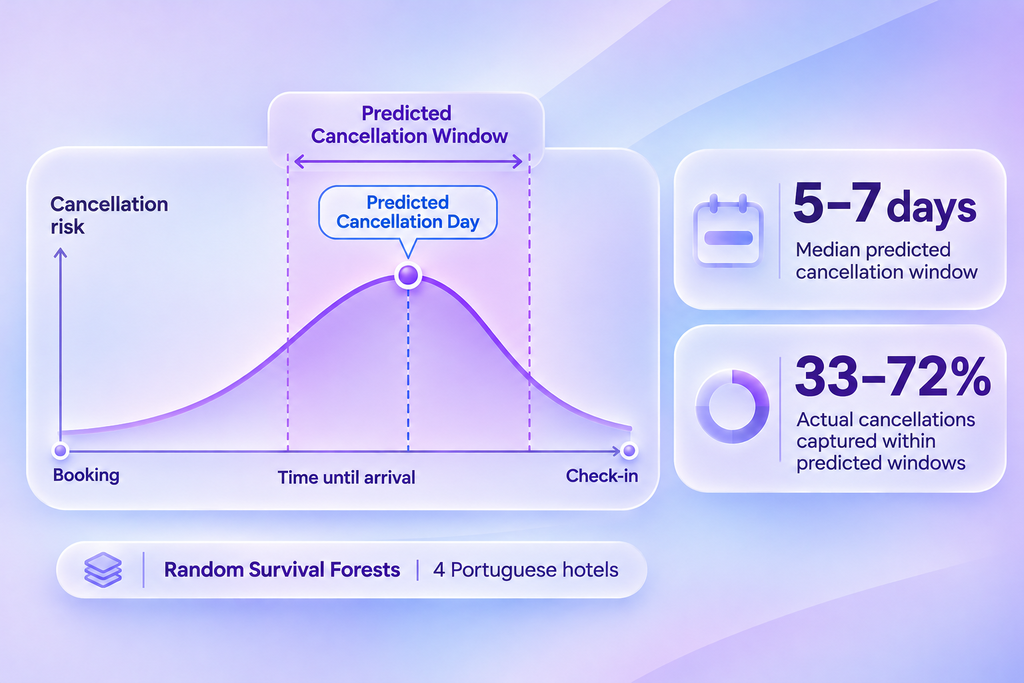
The Predicted Cancellation Window (PCW) addresses this limitation by identifying a compact interval around the estimated cancellation timing, offering a broader representation of the period during which the event is considered more likely to occur.
The researchers report that their best-performing window configuration captured between 33% and 72% of actual cancellations, depending on the hotel evaluated, within windows with a median duration of five to seven days.
These figures describe the proportion of observed cancellation dates that fell within the predicted windows under the experimental conditions. They do not represent the overall probability that a reservation will be canceled, nor do they establish that the model can prevent cancellations.
The results indicate that relatively narrow prediction windows can capture a meaningful proportion of cancellation events, although the variation between hotels also demonstrates that considerable uncertainty remains.
For hotel managers, the potential advantage lies in having a time-specific estimate of cancellation risk that can be considered alongside existing occupancy forecasts and reservation management processes.
How Cancellation Timing Could Inform Hotel Demand Management
Timing-aware cancellation prediction could contribute to several operational and commercial decisions, particularly those involving room availability, reservation uncertainty, and the remaining time before guest arrival.
Occupancy forecasting and room availability
Hotels continually update occupancy expectations as new reservations arrive, existing bookings are canceled, and arrival dates approach. While conventional cancellation models can help estimate the number of bookings that may ultimately be lost, timing-aware predictions could provide additional information about when those losses are more likely to occur.
A concentration of estimated cancellation risk during a particular period might prompt closer monitoring of reservations or a reassessment of expected room availability. However, an accurate occupancy forecast must also consider new bookings, no-shows, changes in demand, and other factors that influence the final number of occupied rooms.
Overbooking and revenue management
Overbooking strategies allow hotels to accept additional reservations to compensate for expected cancellations and no-shows, but these decisions involve financial and operational risks when more guests arrive than the property can accommodate.
Cancellation timing estimates could contribute information about when room availability may change, potentially informing the assumptions used in overbooking and inventory management.
A predicted cancellation window should not, however, be treated as confirmation that a room will become available. Decisions involving additional reservations must account for prediction uncertainty, service commitments, relocation costs, and the consequences of accepting more bookings than can ultimately be accommodated.
Whether timing information improves an overbooking strategy would need to be demonstrated through an appropriate operational or economic evaluation.
Operational planning and customer interactions
Hotels may also use cancellation timing estimates to identify periods when booking uncertainty requires additional attention, helping teams determine when to review reservation portfolios or reassess near-term occupancy expectations.
In some circumstances, these predictions could inform decisions about customer communications, although the model does not explain why a guest might cancel or establish whether contacting that guest would change the outcome.
A retention intervention may have different effects depending on the reservation, customer expectations, and circumstances surrounding the potential cancellation, making separate evaluation necessary before treating predicted risk as a reason to initiate a particular action.
Limitations and Requirements for Operational Adoption
The study provides evidence that cancellation timing can be estimated using survival-analysis methods, but its findings should be interpreted within the characteristics of the evaluated datasets and experimental design.
First, the reported window coverage indicates that a meaningful proportion of actual cancellations occurred outside the predicted intervals, which limits the confidence that managers can place in any individual estimate.
Second, the research uses data from four Portuguese hotels, and cancellation behavior may differ across property types, geographic markets, booking channels, customer segments, and cancellation policies. Models developed in one environment therefore require validation before being relied upon in another.
Predictive performance may also change as seasonal demand, pricing conditions, and customer booking behavior evolve, making temporally appropriate validation and ongoing monitoring relevant considerations for operational deployment.
Finally, the study evaluates predictive performance rather than the effectiveness of commercial interventions. Although identifying a likely cancellation window could provide information for revenue management decisions, the research does not establish that using those predictions reduces cancellation rates, increases revenue, or improves overbooking outcomes.
Such benefits would require additional evidence connecting the predictions to specific operational decisions and comparing the resulting outcomes with an appropriate baseline.
Why Cancellation Timing Matters for Demand Management
Hotel booking cancellation prediction becomes more informative when it considers how reservation risk develops before arrival, particularly because the timing of cancellations affects the opportunities available to manage inventory and respond to changing demand.
The research by António and de Almeida demonstrates how survival analysis can produce predicted cancellation days and windows, providing a temporal perspective that complements conventional cancellation classification models.
For revenue managers, this approach offers a basis for investigating whether time-specific cancellation estimates can support occupancy forecasting, availability management, and operational planning. Its practical value will depend on the reliability of those predictions and whether incorporating them into existing decision processes produces measurable improvements.