
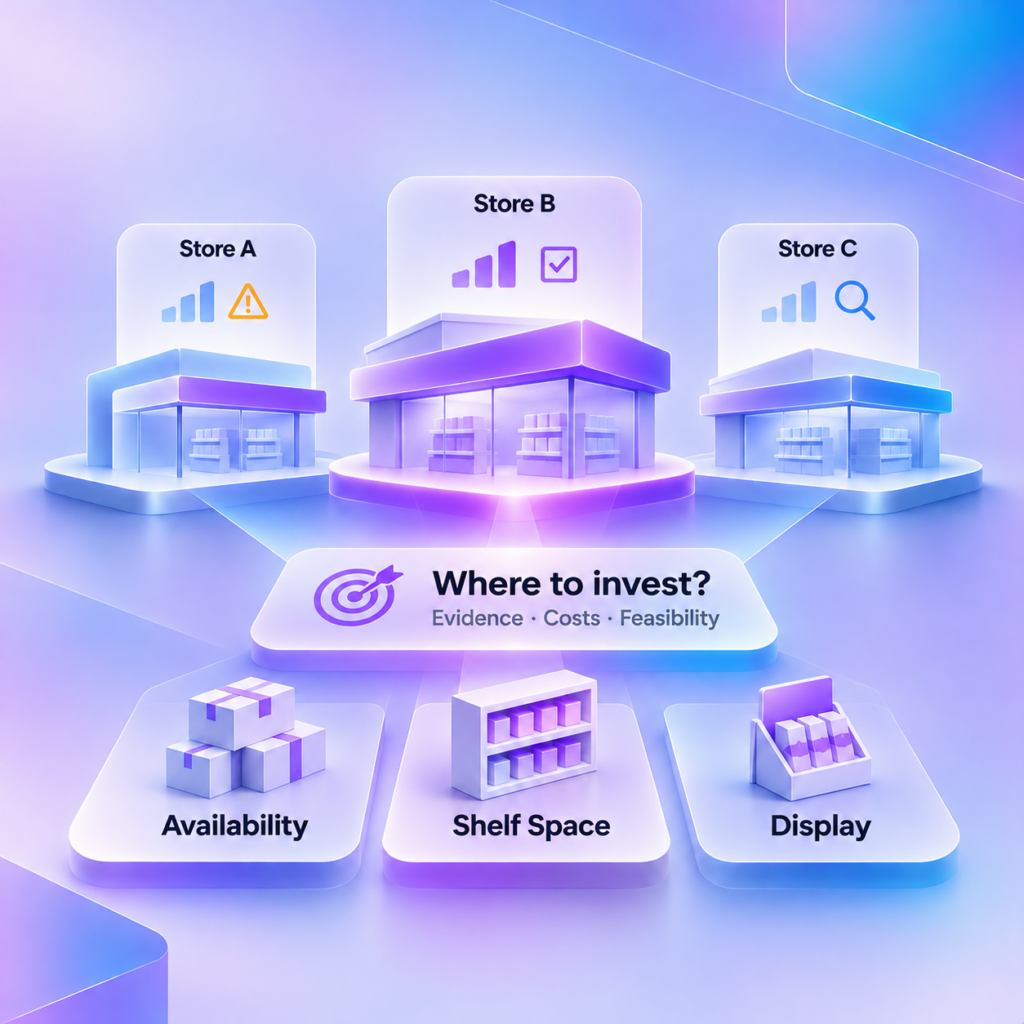
Retailers rarely lack opportunities to improve store execution. Across a network of locations, there may be recurring stock shortages, categories that need additional shelf space, displays that could be repositioned or assortments that no longer reflect local demand. The difficulty is deciding which of these issues deserves investment when budgets, staff availability and operational capacity are limited.
Historical sales often provide the starting point for these decisions, but they do not necessarily reveal where additional spending would make the greatest difference. A store with declining revenue may be struggling with inventory inaccuracies, while another with similar results could be facing weaker demand or an assortment that does not match customer preferences.
These distinctions are central to retail execution optimization, which involves understanding the conditions affecting performance, identifying interventions that could address them and assessing where limited resources have the strongest economic justification.
Why Similar Stores May Need Different Investments
Standardized execution plans make retail networks easier to manage, particularly when hundreds of locations need consistent promotional materials, display arrangements or field support. Additional resources are often directed toward larger stores or categories with stronger sales histories, partly because these locations appear to offer greater commercial potential.
The limitation is that store performance does not necessarily reveal how much an additional intervention would contribute.
Consider two stores selling similar volumes of the same product. At the first location, demand regularly exceeds the available stock before the next replenishment, while the second maintains sufficient inventory but attracts relatively little customer interest. Improving replenishment or adjusting shelf capacity could help address unmet demand in the first store, provided additional stock can be supplied, whereas applying the same intervention in the second may have limited value.
The difference lies in the underlying execution problem rather than the stores’ overall performance. Before deciding where to invest, retailers need to understand whether a specific operational condition is restricting sales and whether the proposed action can realistically change that condition.
This makes store-level analysis more useful when it connects observed performance to identifiable problems, instead of treating every shortfall against target as an equivalent investment opportunity.
What Inventory Audits Reveal About Execution Gaps
A July 2026 study published in the Journal of Business Logistics offers a concrete example of why the circumstances surrounding an intervention matter. Yacine Rekik, Rogelio Oliva, Aris A. Syntetos and Christoph H. Glock examined inventory record inaccuracy across approximately 24,000 SKUs in 11 stores operated by a European grocery retailer, investigating how discrepancies related to factors such as stock levels, replenishment frequency and product perishability.
The researchers also conducted a field quasi-experiment involving two matched stores to evaluate the effects of a store-wide inventory audit. In that setting, the audit was associated with an estimated 11% increase in store-wide sales over the following two months, although the improvement varied considerably across products.
The reported sales lift was concentrated among items for which recorded inventory exceeded the quantity physically available, with perishable products also showing stronger benefits. These findings are consistent with the possibility that inaccurate inventory records interfere with replenishment decisions, leaving products unavailable despite systems indicating that sufficient stock remains.
The results should not be interpreted as evidence that inventory audits generally produce an 11% sales increase. The intervention was evaluated in a specific grocery environment, the quasi-experiment involved only two matched stores, and the researchers did not have the cost information needed to establish the audit’s net financial return.
Nor does the study demonstrate how investments in displays, assortment changes or shelf-space adjustments would perform. Its contribution to the broader retail execution discussion is more focused: the value of an operational intervention depends partly on whether the condition it is intended to correct is present and sufficiently important to affect commercial outcomes.
For retailers evaluating competing investments, that is a useful distinction. Identifying an execution problem is only the beginning; understanding whether a particular action can address it is what makes the opportunity worth examining.
What Predictive AI Can Tell Retailers About Investment Opportunities
Predictive AI can help retailers develop a clearer picture of future demand, sales patterns and operating conditions across their networks. By analyzing information from transactions, inventory systems, promotions and store characteristics, predictive models can highlight differences between locations that might otherwise be difficult to recognize in standard performance reports.
A demand forecast, for example, may suggest that pressure on shelf capacity is likely to persist, making a particular category worth investigating. Similarly, unusual patterns in recorded inventory or sales could indicate where stock accuracy deserves closer attention, even before the underlying cause has been established.
These insights are valuable because they help commercial and operations teams decide where to focus their analysis, but they answer a different question from the one ultimately facing an investment committee.
Knowing that a store is likely to generate substantial sales does not establish whether an additional display will increase those sales. A location with lower forecast revenue might offer a better opportunity if a specific, correctable problem is limiting performance, although that possibility still needs to be supported by evidence about the proposed intervention.
The distinction is between predicting what is likely to happen under existing conditions and estimating what would change if the retailer took a particular action. Demand forecasting and other predictive models can inform the first assessment, while the second requires evidence about the intervention itself, potentially drawn from comparable previous initiatives, controlled tests or other suitable evaluation methods.
When that evidence is unavailable, an expected improvement remains an assumption to be tested rather than a result that can confidently be attributed to the proposed action.
Comparing Competing Retail Investments
Once retailers have identified where operational improvements may be possible, the challenge becomes comparing proposals that address different problems and require different resources.
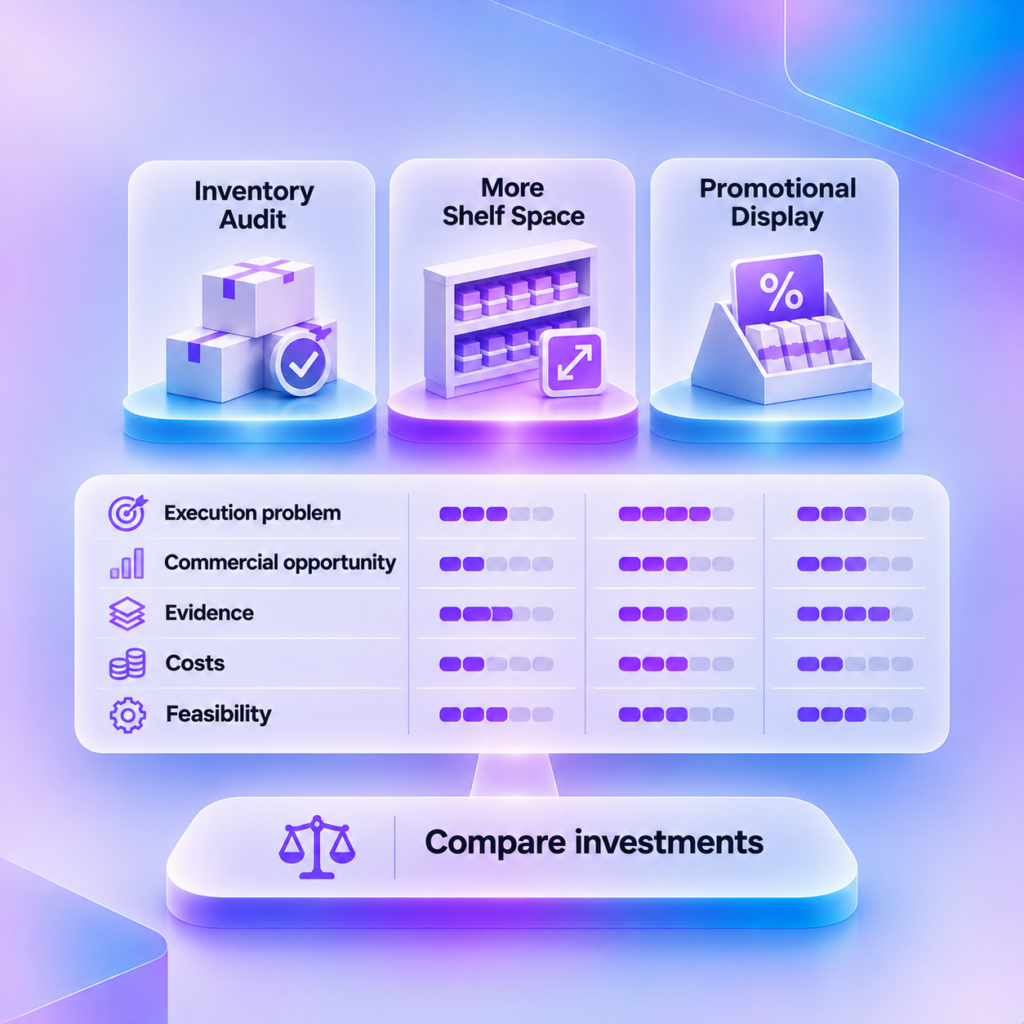
One store might need an inventory accuracy audit, another could benefit from additional display space, while a third may require changes to replenishment frequency for a fast-moving category. Even if all three proposals appear commercially reasonable, they cannot be evaluated solely by comparing the sales volumes of the locations involved.
A useful assessment considers the execution problem, the commercial opportunity, the evidence supporting the proposed action and the resources required to implement it. Costs should reflect more than the immediate expenditure, particularly when an intervention also requires field-team time, additional inventory or changes to existing store arrangements.
Practical constraints can alter the comparison substantially. A shelf-space expansion may require reducing the space allocated to another product, while a promotional display could increase sales of one item without producing an equivalent improvement in category revenue if customers simply switch from competing products.
Uncertainty also deserves attention, especially when a proposal relies on results observed in stores with different customer profiles or operating conditions. An intervention that performed well elsewhere may still be worth testing, but its expected benefit should not be treated as equally reliable in every location.
Evaluating these factors together provides a more consistent basis for investment decisions, although it does not amount to a universally validated optimization algorithm. The quality of the comparison ultimately depends on the evidence available, the assumptions used and the retailer’s ability to assess the trade-offs between competing opportunities.
A smaller intervention may consequently offer a stronger investment case than a larger one when its costs are more manageable, the operating conditions are favorable and previous evidence provides greater confidence in the expected benefit.
Learning From Retail Execution Interventions
Once an intervention has been introduced, its results can provide information that was unavailable when the original investment decision was made. For that evidence to be useful, retailers need to record what changed, which products and stores were affected, when the action took place and what resources were required.
The measures used to assess performance should reflect the intended outcome. An initiative designed to improve availability may need to track inventory accuracy, out-of-stock frequency, sales and margins, whereas changes to displays or shelf space may require closer examination of category performance and substitution between products.
It is also important to consider when results are measured, since some execution changes may produce a relatively immediate response while others take longer to influence purchasing behavior. Temporary effects associated with promotions or seasonal demand should not automatically be interpreted as evidence of a lasting improvement.
Comparisons with similar stores or products that did not receive the intervention can help determine whether observed changes are plausibly attributable to the action, particularly when the analysis accounts for pre-existing differences and other factors affecting performance. Randomized testing will not always be practical in retail operations, but the assumptions behind alternative comparisons should remain clear.
Over time, the results of these assessments can give retailers a better understanding of which interventions tend to work, where their effectiveness appears to depend on local conditions and which approaches have repeatedly failed to justify their costs.
Rather than approaching every execution decision as an isolated project, organizations can use this accumulated evidence to improve how future opportunities are evaluated.
From Execution Problems to Investment Priorities
Retail execution optimization involves more than identifying underperforming stores or directing additional resources toward locations with strong sales forecasts. Its purpose is to make better use of limited budgets by understanding which operational problems can be addressed and whether the available evidence supports the proposed interventions.
Predictive AI can contribute by identifying patterns, anticipating demand and helping retailers recognize where further investigation may be worthwhile. Those insights become more useful when combined with knowledge of store operations, previous intervention results, implementation costs and the constraints affecting individual locations.
The same investment will not necessarily produce comparable results across different stores, and an intervention that appears promising may still require testing before its economic value can be established.
For retailers deciding where to allocate resources, the strongest investment case is therefore not automatically associated with the largest location or the widest performance gap, but with an identifiable execution problem, a feasible response and credible evidence that the proposed action can create additional value.