
For companies without a dedicated Data Science team, adopting Predictive AI can be challenging even when the business problem is clearly defined. A sales department may want to identify opportunities with a higher likelihood of conversion, while a retention team may need to recognize customers at risk of leaving or an operations manager may be looking for more accurate demand forecasts.
Although these objectives are relatively straightforward, turning business data into reliable predictions requires a series of interconnected technical activities, from preparing information and developing models to validating their performance and making the results available within operational systems.
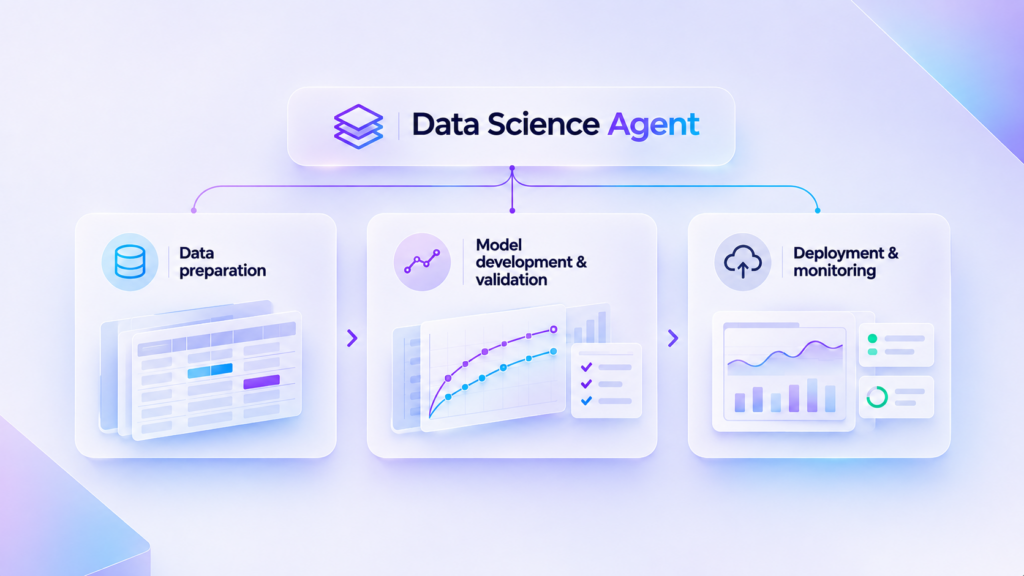
A Data Science Agent offers a different way to manage this work by coordinating the predictive modeling process from initial data preparation through deployment and ongoing monitoring. Rather than automating individual tasks in isolation, the agent can connect successive stages of the workflow, reducing the manual execution and coordination traditionally required from Data Science specialists.
For businesses exploring Predictive AI, this can change how predictive projects are organized and make it possible to approach certain applications without first building a complete internal Data Science function.
The Work Behind a Predictive Model
Developing a reliable predictive model involves considerably more than selecting and training an algorithm, particularly when the necessary information is distributed across multiple business systems.
Customer records may be stored in a CRM, transactions in another database and operational outcomes in separate applications, requiring these sources to be connected, interpreted and prepared before modeling can begin.
The information must also reflect the objective of the prediction. A model estimating whether a customer will renew a subscription, for example, should rely on data available before the renewal decision rather than information recorded after the outcome was already known.
Once the data has been prepared, feature engineering transforms it into variables that capture relevant patterns, such as purchase frequency, changes in customer activity or the time elapsed since the last interaction. These inputs support the development of predictive models, which must then be compared and evaluated on data not used during training to assess their ability to perform reliably on new observations.
Even after a suitable model has been selected, its predictions need to reach the business systems where they can inform decisions, while ongoing monitoring helps determine whether performance remains reliable as data and operating conditions change.
Managing this process has traditionally required several forms of specialist expertise, creating an organizational challenge for companies that want to explore predictive applications without maintaining a dedicated technical department.
How a Data Science Agent Connects the Different Stages
A Data Science Agent can coordinate activities throughout the predictive modeling lifecycle, using connected tools to perform technical tasks while allowing information and results from one stage to guide the next.
During data preparation, for example, an agent can examine available tables, identify missing values or inconsistent formats, and apply suitable transformations before proceeding to feature engineering, model training and evaluation. Instead of requiring specialists to manage these activities separately, the workflow can maintain continuity between them and use intermediate results to inform subsequent operations.
This becomes particularly relevant when a model does not achieve satisfactory performance during validation, since the appropriate response may involve reconsidering the selected features, revisiting data preparation or testing alternative modeling approaches. Within an appropriately configured workflow, the agent can use evaluation results to investigate these possibilities and compare new candidates before a model is considered for deployment.
The same coordination can extend beyond model development, allowing approved predictions to be delivered through APIs or periodic integrations with operational systems. As new information becomes available, monitoring can identify changes in data or predictive performance that require further investigation, additional validation or a controlled model update.
By connecting these activities, a Data Science Agent can reduce the manual effort needed to move from business data to an operational predictive model, although the extent of its autonomy depends on the tools, permissions and controls available in the specific implementation.
From Customer Data to a Retention Decision
Consider a subscription company that has accumulated years of customer activity and renewal records in its CRM but does not have a dedicated Data Science team to analyze them. Its retention department wants to identify customers who may be less likely to renew, allowing account managers to review those relationships before contracts expire.
Addressing this objective requires preparing historical records, identifying renewal outcomes and developing variables that describe customer activity before each renewal date. Different predictive models must then be evaluated before reliable risk scores can be introduced into the retention process.
A Data Science Agent can coordinate these activities within a connected workflow, from preparing the original records and generating predictive variables to comparing models and delivering approved predictions into the systems used by account managers. As new customer information and renewal outcomes become available, the workflow can also support monitoring and subsequent model updates.
For the retention team, the resulting predictions could help identify which customer relationships deserve earlier attention, provided that the information arrives in time to influence outreach and that the organization has the capacity to act on it.
The company therefore retains responsibility for defining the objective and determining how predictions should be used, while the agent helps manage the technical work needed to make those predictions available.
What Changes for Data Science Specialists
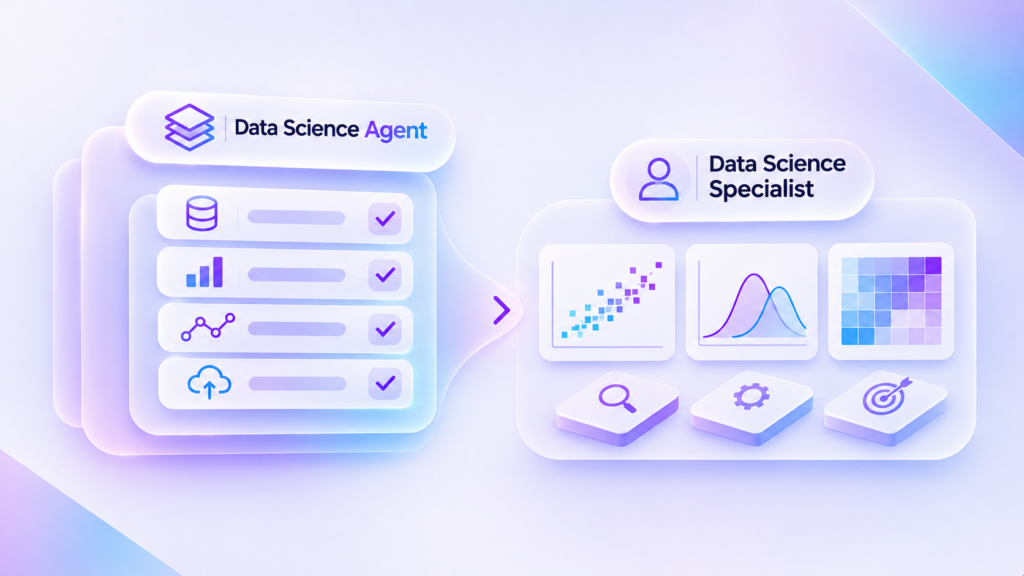
Introducing a Data Science Agent can change how technical work is distributed, particularly when activities such as data preparation, feature generation, model comparison and deployment would otherwise require repeated manual intervention.
For organizations without an internal Data Science department, coordinating these activities through an agent may reduce the specialist resources needed to explore a clearly defined predictive application, making projects more manageable without requiring every technical stage to be organized separately.
Companies that already employ data scientists can benefit from the same approach, as automating repetitive activities allows specialists to devote more attention to complex datasets, evaluation strategies and problems that require deeper investigation.
Their expertise remains important when projects involve unusual data, difficult modeling choices or decisions with significant consequences, but the agent can assume a greater share of routine execution and workflow coordination.
The Role of Data Quality
Even when a Data Science Agent can coordinate much of the modeling process, its usefulness depends on whether the organization has collected information that supports the business question it wants to answer. Companies may hold substantial amounts of data across their CRM and operational systems, yet those records can be incomplete, inconsistent or insufficiently connected to the outcomes they are trying to predict.
In the subscription example, renewal outcomes may not have been recorded consistently, while important customer information may only have become available after a contract ended. Under these conditions, historical records could provide a misleading basis for predicting future non-renewals, regardless of how efficiently the technical workflow is managed.
An agent can help identify missing values, combine information from different sources and apply appropriate transformations, but it cannot reconstruct outcomes that were never captured or resolve ambiguous business definitions without the necessary context.
When these limitations emerge, improving data collection or clarifying how information is recorded may be more valuable than proceeding immediately with model development, helping the organization establish a stronger foundation for future predictive applications.
When Predictions Become Useful
Introducing Predictive AI into a business involves more than developing a model that performs well during testing, because its predictions must also support decisions capable of producing meaningful results.
A retention model, for example, may accurately identify customers who are likely to leave, but this does not establish whether those customers would respond positively to an additional offer or a call from an account manager. Evaluating predictive reliability and determining whether an intervention can influence customer behavior are separate responsibilities, requiring different forms of evidence.
Model validation helps establish whether predictions are sufficiently dependable for their intended purpose, while measuring retention activities through suitable comparisons can help determine whether acting on those predictions generates additional business value.
These assessments must also consider the consequences of incorrect predictions, relevant privacy and data-access requirements, and the operational costs associated with using the model. Although a Data Science Agent can coordinate technical activities across the workflow, business teams and specialists remain responsible for defining acceptable outcomes, reviewing relevant limitations and deciding how the results should inform operational decisions.
A Different Way to Approach Predictive AI
Companies considering Predictive AI do not necessarily need to begin by building an entire internal Data Science function, particularly when their immediate objective is to explore a specific business application rather than establish a permanent modeling department.
A practical starting point is to identify a recurring decision that could benefit from prediction and examine whether the available historical information can support it. From there, a Data Science Agent can help coordinate the technical activities involved, from preparing data and developing models to delivering approved predictions and monitoring their performance over time.
By reducing the manual effort and specialist coordination traditionally required across these stages, an agent can make predictive projects more accessible to organizations with limited internal resources, while preserving the expertise and oversight necessary to ensure that the resulting models are reliable and appropriate for their intended use.