
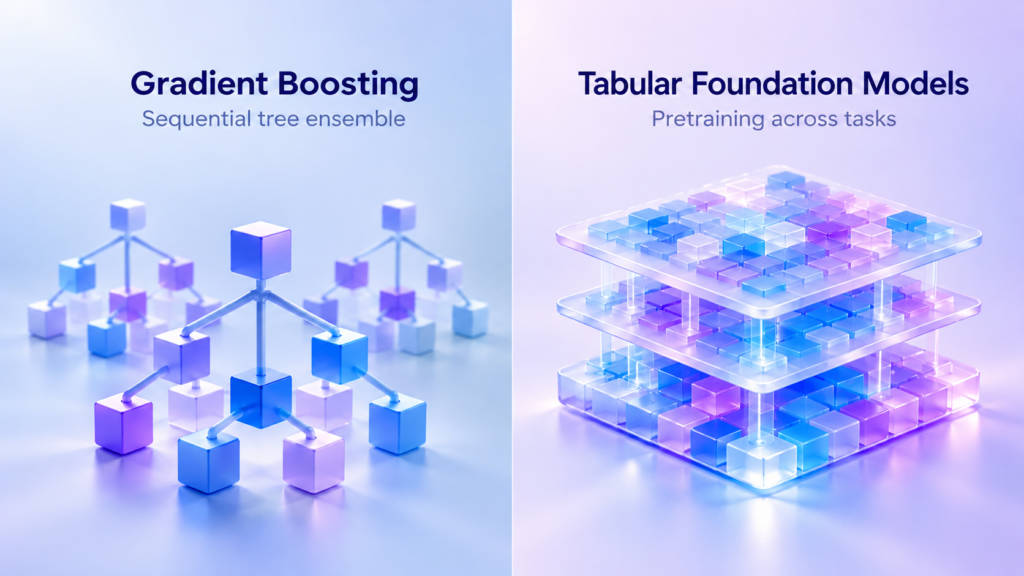
Enterprise prediction still runs largely on rows and columns. Customer records, transactions, contract details and operational indicators support decisions about churn, purchase propensity, customer value and risk.
Gradient boosting libraries such as XGBoost, LightGBM and CatBoost have become strong baselines for these tasks, combining predictive performance with mature deployment tools. Tabular foundation models offer another route: pretraining on diverse learning problems, then transferring useful patterns to a new dataset.
TabICLv2, published at ICML 2026, strengthens the case for evaluating this approach. Its benchmark results are promising, but choosing an enterprise model requires a closer comparison of predictive quality, operating costs and the decisions those predictions support.
What Are Tabular Foundation Models?
A conventional supervised model learns from a dataset assembled for a specific target. A churn model, for example, uses historical customer information and observed departures to predict which customers may leave.
A tabular foundation model has already been pretrained across many learning problems before encountering that local task. Depending on its design, it can adapt through in-context learning, fine-tuning or other mechanisms.
In-context models such as TabICLv2 use labelled examples from the local dataset as context for predicting new observations. In their default application, this does not require updating the pretrained model’s weights for each task.
Less task-specific training does not remove the need for representative local data. Reliable labels, consistent feature definitions and appropriate validation remain essential. Pretraining cannot establish what “churn” means for a particular business or correct a target that was defined inconsistently.
Why Gradient Boosting Remains Competitive
Gradient boosting constructs an ensemble of trees sequentially, with additional trees improving the current model according to a chosen objective. It captures nonlinear relationships and feature interactions without requiring a foundation model’s pretraining process.
Its practical strengths extend beyond accuracy. Teams can draw on established software, familiar tuning procedures, CPU deployment options and widely used explanation tools. Those advantages matter when a model must score customers repeatedly within a fixed budget or integrate into an existing production system. A modest predictive gain may have little business value if it adds substantial serving costs or delays decisions.
The appropriate baseline is therefore a well-validated boosting model with a reasonable tuning budget. Comparing a carefully configured foundation model with an untuned tree ensemble would reveal little about the choice an enterprise actually faces.
What TabICLv2 Demonstrates
In the ICML 2026 paper, researchers introduce TabICLv2 for classification and regression. The work combines a diverse synthetic data generation engine, architectural improvements for longer contexts and an optimized pretraining process.
The authors evaluate the model on TabArena and TALENT. The official repository reports that TabICLv2 outperforms heavily tuned XGBoost, CatBoost or LightGBM on approximately 80% of TabArena datasets.
That figure describes the reported benchmark comparisons. It is neither an 80% improvement in accuracy nor an estimated probability of winning on a new enterprise task. The article’s business implications should remain separate from the authors’ experimental results.
Scalability has also improved. The paper documents processing a table with one million observations and 500 features using disk offloading, with GPU memory below 50 GB in that experiment. This demonstrates a technical capability under specified conditions, rather than a general guarantee about latency or infrastructure requirements.
For enterprise evaluation, the useful conclusion is that pretrained tabular models merit a place alongside established candidates. The benchmark does not settle which architecture should serve a particular business process.
Build a Comparison That Resembles Production
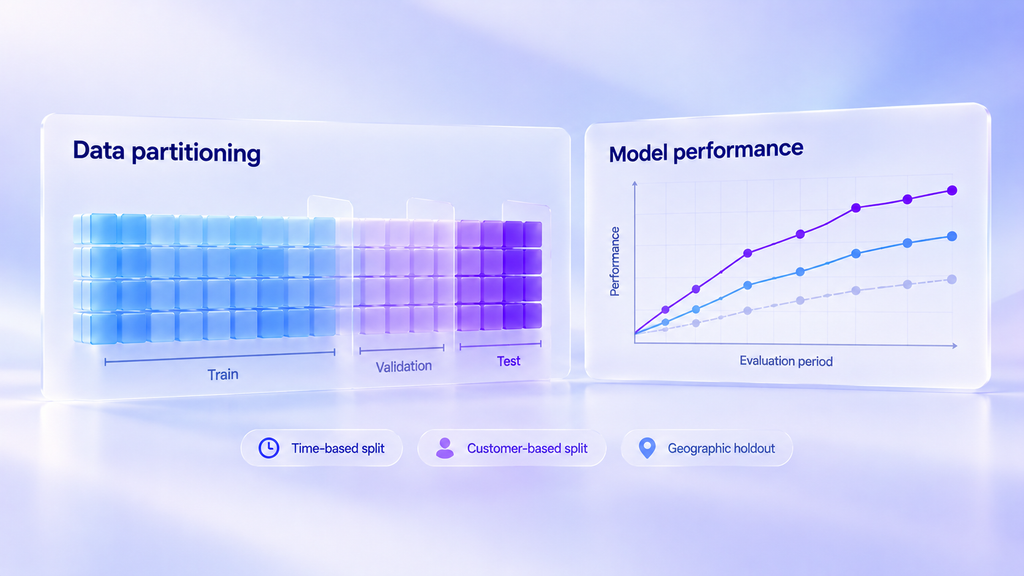
The evaluation design can matter more than a small difference between models. A random split may allow information from similar customers or adjacent periods to appear in both training and test data, producing an optimistic estimate of future performance.
A churn model may need validation on later months. A model deployed to new customers may require separation by customer identity. Expansion into another market may call for a geographic holdout.
All candidates should use the same target definition, data partitions and evaluation windows. Teams should also disclose tuning budgets, ensemble settings, hardware and preprocessing. Equal data access alone does not make two experiments comparable.
Keep a simple statistical baseline in the comparison. If a more complex approach produces little improvement over it, the organization should understand what additional capability justifies the cost.
Measure the Business Decision
Aggregate accuracy rarely captures everything a decision requires. Campaign targeting may depend on ranking customers within a fixed contact budget. Risk assessment may also require calibrated probabilities and careful analysis of costly errors.
Consider a hypothetical retention campaign that can contact 10,000 customers. A model that ranks likely churners more accurately could improve targeting, but high churn risk does not establish that a customer will respond to an offer.
The evaluation should distinguish predictive performance from intervention effectiveness. Controlled campaign testing can estimate incremental retained customers and contribution margin after discounts and contact costs. Offline churn metrics cannot establish that commercial impact by themselves.
This distinction helps executives assess whether a predictive improvement changes an action, improves its outcome or simply raises a dashboard score. Performance within important customer segments should also be examined, since an average gain can conceal deterioration where errors are most expensive.
Compare Compute, Explanations and Maintenance
Tabular foundation models can reduce the effort spent on hyperparameter search, while moving more computation into inference over the training context. Actual costs depend on dataset size, configuration, hardware and opportunities to reuse cached computations.
Gradient boosting often supports efficient CPU scoring. Whether that advantage matters depends on the workload: monthly batch predictions and an interactive service have different operating requirements.
Measure development time, memory, scoring throughput and recurring infrastructure costs using the expected production workload. Faster experimentation is valuable, but it should be assessed alongside the cost of operating the selected model.
Explainability also deserves a practical test. Boosted trees have a mature explanation ecosystem, while TabICL provides an integration with SHAP. The comparison should examine explanation cost, stability and usefulness for investigation.
Neither architecture automatically satisfies governance requirements. Teams still need documented data provenance, reproducible configurations, performance checks across relevant groups and a process for investigating unusual predictions.
Maintenance completes the picture. Feature changes, delayed outcomes and shifting customer behavior affect both approaches. Evaluate how each candidate fits existing monitoring, versioning and update procedures before committing to deployment.
When Each Approach Deserves Priority
A tabular foundation model is worth early testing when rapid experimentation across several tasks is valuable, tuning resources are limited and suitable computational infrastructure is available.
Limited local data may also motivate a trial, provided the examples are informative and representative. Its value in that setting must be measured rather than assumed from the existence of pretraining.
Gradient boosting deserves particular attention when CPU serving, predictable response times and established operational tooling are central requirements. A large dataset alone does not determine the winner; feature structure, task complexity and the evaluation design also matter.
A useful pilot can produce a different winner for different tasks. There is no operational requirement to standardize every predictive application on the same model family.
Choose the Model That Improves the Decision
TabICLv2 provides evidence that in-context tabular models can compete seriously with established boosting methods. Enterprises can act on that evidence by adding a credible candidate to their evaluation process.
The deployment decision should follow a comparison on realistic holdouts, with declared experimental budgets and measured operating costs. Any expected commercial benefit should then be tested in the workflow where predictions change actions.
Adopt the model whose improvement is meaningful for the decision and sustainable in production. Sometimes that will be a tabular foundation model; sometimes an established boosting pipeline will remain the stronger choice.