
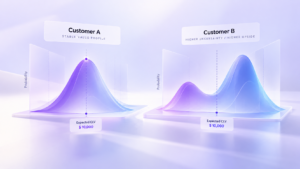
Customer Lifetime Value Prediction: Why a Single Number May Not Be Enough
Customer lifetime value prediction helps organizations estimate the future economic contribution of a customer relationship and use that information to guide decisions about acquisition, retention and customer development. For marketing, CRM and finance leaders, it provides a forward-looking basis for comparing customer opportunities and deciding where commercial resources may create
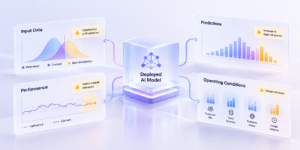
AI Model Monitoring: What to Track After Deployment
AI model monitoring is the ongoing assessment of a deployed model’s data, predictions, performance and operating conditions. It helps teams decide whether the model remains suitable for its intended use and when to investigate, adjust, retrain or suspend it. Deployment marks the moment a model begins supporting real decisions. From

AI Shopping Agents: How Product Visibility Changes When AI Chooses
For C level leaders exploring agentic commerce, product visibility is becoming more complex than simply appearing in a set of results, because a product can be available to an AI agent without being examined in detail, inspected without remaining a serious candidate, or considered without ultimately becoming the selected option.

Propensity to Buy Models for Better Sales Priorities
Sales prioritization starts with a practical commercial question: which opportunities deserve attention first? For a sales team working across hundreds or thousands of customers, answering that question consistently is difficult. Previous purchases, company characteristics, relationship history and product fit can all contain signals of future demand, yet those signals rarely
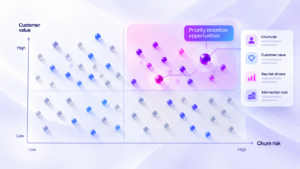
AI Customer Churn Prediction: From Risk Scores to Measurable Retention Value
A churn probability can tell a company where risk appears to be rising. It does not automatically reveal which customers deserve attention first, what may be driving the change, whether an intervention is likely to work or whether the economics justify taking action. That distinction is becoming increasingly important as
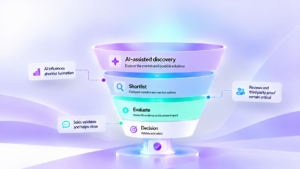
AI Search and B2B Discovery: What the Evidence Supports Today
A B2B buyer can now form an initial view of a market without opening a vendor website. A prompt to an AI interface can surface categories, compare possible solutions, suggest vendors and summarize differences within minutes, moving part of the discovery process into an environment where companies have less control
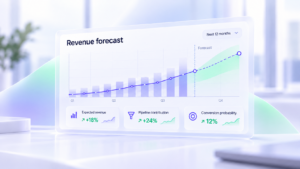
AI Agent for Finance: Using Predictive Sales Signals to Improve Revenue Forecasting
Revenue forecasting often begins too late in the information chain. By the time a change becomes visible in financial reporting, the commercial conditions behind it may have been developing for weeks. Customer interest may be shifting, opportunities may be progressing differently from expected and conversion probabilities may already be moving
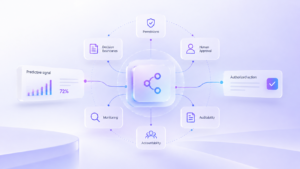
Agentic Workflow Governance: A Practical Checklist for Predictive AI
As AI systems move further into business workflows, governance has to answer a different question. It is no longer enough to ask whether a model produces a reliable prediction. Organizations also need to decide what the system is allowed to do with that prediction, where human approval is required and

AI Sales Agent: From Purchase Propensity to Better Lead Priorities
A larger prospect list does not automatically create a stronger sales pipeline. What matters is knowing which opportunities are most likely to convert and which deserve attention first, especially when signals of purchase propensity are spread across customer, company and interaction data. This is where purchase propensity becomes useful in

AI Agent vs AI Assistant: Who Owns the Predictive Workflow?
As AI becomes more deeply embedded in enterprise operations, the AI Agent vs AI Assistant distinction is starting to matter for reasons that go well beyond the interface. The real difference is not simply how sophisticated the answer is, but how far the system can move through a business process

AI for Data Analytics: When Forecast Uncertainty Changes the Decision
AI for data analytics is increasingly moving beyond reporting and descriptive insights, as predictive models are used to support operational decisions in areas such as energy, transportation, public health and logistics, which raises a more important question than forecast accuracy alone: when does uncertainty around a prediction become significant enough
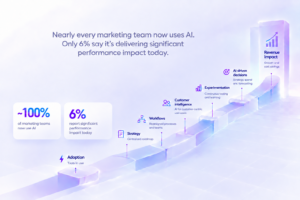
AI in Marketing: The New Divide Between Adoption and Revenue Impact
AI adoption in marketing is rapidly becoming universal, yet the ability to translate that adoption into measurable business impact remains far less widespread, creating a growing divide between organizations that simply use AI and those that have learned how to integrate it into the way marketing decisions are made. New